
Close Menu
    Facebook X (Twitter) Instagram
    SciTechDaily
    • Biology
    • Chemistry
    • Earth
    • Health
    • Physics
    • Science
    • Space
    • Technology
    Facebook X (Twitter) Pinterest YouTube RSS
    SciTechDaily
    Home»Space»New Horizons Reveals a Distinct Water-Ice Signature on the Surface of Hydra
    Space

    New Horizons Reveals a Distinct Water-Ice Signature on the Surface of Hydra

    By NASAMay 6, 2016No Comments2 Mins Read
    Facebook Twitter Pinterest Telegram LinkedIn WhatsApp Email Reddit
    Share
    Facebook Twitter LinkedIn Pinterest Telegram Email Reddit
    New Horizons Spacecraft Reveals a Distinct Water-Ice Signature on the Surface of Pluto’s Outermost Moon Hydra
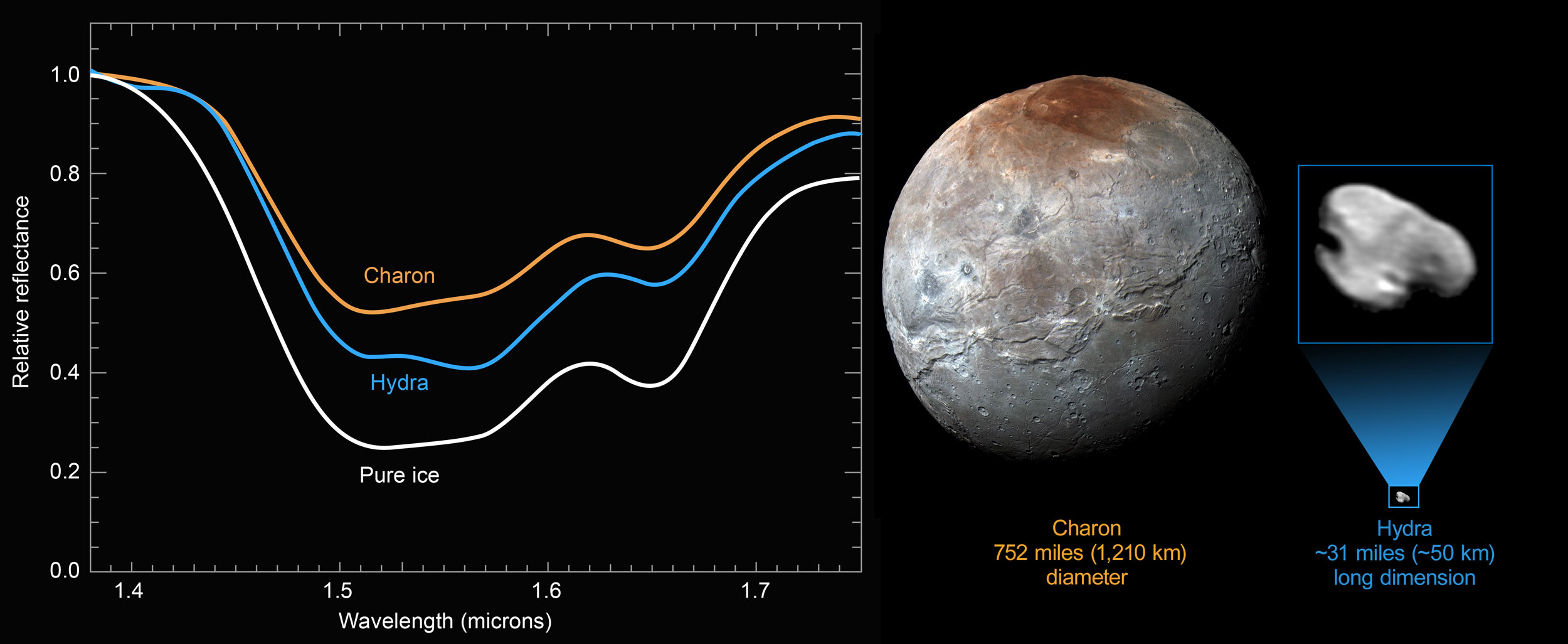
    New compositional data from NASA’s New Horizons spacecraft reveal a distinct water-ice signature on the surface of Pluto’s outermost moon, Hydra. Pluto’s largest moon Charon measures 752 miles (1,210 kilometers across), while Hydra is approximately 31 miles (50 kilometers) long.

    NASA’s New Horizons Spacecraft reveals a distinct water-ice signature on the surface of Pluto’s outermost moon, Hydra.

    NASA’s New Horizons spacecraft has sent home the first compositional data about Pluto’s four small satellites. The new data show the surface of Hydra, Pluto’s outermost small moon, is dominated by nearly pristine water ice – confirming hints that scientists picked up in New Horizons images showing Hydra’s highly reflective surface.

    The new compositional data, recently received on Earth, was gathered with the Ralph/Linear Etalon Imaging Spectral Array (LEISA) instrument on July 14, 2015, from a distance of 150,000 miles (240,000 kilometers).

    The new data – known as infrared spectra – show the unmistakable signature of crystalline water ice: a broad absorption from 1.50 to 1.60 microns and a narrower water-ice spectral feature at 1.65 microns. The Hydra spectrum is similar to that of Pluto’s largest moon, Charon, which is also dominated by crystalline water ice. But Hydra’s water-ice absorption bands are even deeper than Charon’s, suggesting that ice grains on Hydra’s surface are larger or reflect more light at certain angles than the grains on Charon. Hydra is thought to have formed in an icy debris disk produced when water-rich mantles were stripped from the two bodies that collided to form the Pluto-Charon binary some 4 billion years ago. Hydra’s deep water bands and high reflectance imply relatively little contamination by darker material that has accumulated on Charon’s surface over time.

    Mission scientists are investigating why Hydra’s ice seems to be cleaner than Charon’s. “Perhaps micrometeorite impacts continually refresh the surface of Hydra by blasting off contaminants,” said Simon Porter, a New Horizons science team member from Southwest Research Institute in Boulder, Colorado, “This process would have been ineffective on the much larger Charon, whose much stronger gravity retains any debris created by these impacts.”

    The New Horizons science team is looking forward to obtaining similar spectra of Pluto’s other small moons, for comparison to Hydra and Charon.

    Never miss a breakthrough: Join the SciTechDaily newsletter.
    Follow us on Google and Google News.

    Astronomy Hydra NASA New Horizons Planetary Science Pluto Popular
    Share. Facebook Twitter Pinterest LinkedIn Email Reddit

    Related Articles

    NASA Releases New Pluto Images Taken by the New Horizons Spacecraft

    NASA Reveals New Pluto Images from New Horizons Spacecraft

    Data from NASA’s New Horizons Hints at Underground Ocean on Pluto

    New Horizons Reveals Flowing Ices, Exotic Surface Chemistry, Mountains, and Haze on Pluto

    New Horizons Reveals a Dense Region of Atmospheric Ions Behind Pluto

    New Horizons Measures Size of Pluto, Settles Decades-Long Debate

    NASA’s New Horizons Spacecraft Reaches Historic Encounter with Pluto

    New Horizons Reveals Signs of Pluto’s Geology

    Dwarf Planet Pluto: The ‘Other’ Red Planet

    Leave A Reply Cancel Reply

    • Facebook
    • Twitter
    • Pinterest
    • YouTube

    Don't Miss a Discovery

    Subscribe for the Latest in Science & Tech!

    Trending News

    Scientists May Have Found the Key to Jupiter and Saturn’s Moon Mystery

    Scientists Uncover Brain Changes That Link Pain to Depression

    Saunas May Do More Than Raise Body Temperature – They Activate Your Immune System

    Exercise in a Pill? Metformin Shows Surprising Effects in Cancer Patients

    Hidden Oceans of Magma Could Be Protecting Alien Life

    New Study Challenges Alzheimer’s Theories: It’s Not Just About Plaques

    Artificial Sweeteners May Harm Future Generations, Study Suggests

    Splashdown! NASA Artemis II Returns From Record-Breaking Moon Mission

    Follow SciTechDaily
    • Facebook
    • Twitter
    • YouTube
    • Pinterest
    • Newsletter
    • RSS
    SciTech News
    • Biology News
    • Chemistry News
    • Earth News
    • Health News
    • Physics News
    • Science News
    • Space News
    • Technology News
    Recent Posts
    • “Asian Flush” May Be a Hidden Trigger for Deadly Heart Damage
    • AI Could Detect Early Signs of Alzheimer’s in Under a Minute – Far Before Traditional Tests
    • What if Dark Matter Has Two Forms? Bold New Hypothesis Could Explain a Cosmic Mystery
    • Researchers Expose Hidden Chemistry of “Ore-Forming” Elements in Biology
    • Geologists Reveal the Americas Collided Earlier Than We Thought
    Copyright © 1998 - 2026 SciTechDaily. All Rights Reserved.
    • Science News
    • About
    • Contact
    • Editorial Board
    • Privacy Policy
    • Terms of Use

    Type above and press Enter to search. Press Esc to cancel.