
Close Menu
    Facebook X (Twitter) Instagram
    SciTechDaily
    • Biology
    • Chemistry
    • Earth
    • Health
    • Physics
    • Science
    • Space
    • Technology
    Facebook X (Twitter) Pinterest YouTube RSS
    SciTechDaily
    Home»Space»New Horizons Measures Size of Pluto, Settles Decades-Long Debate
    Space

    New Horizons Measures Size of Pluto, Settles Decades-Long Debate

    By NASAJuly 14, 2015No Comments3 Mins Read
    Facebook Twitter Pinterest Telegram LinkedIn WhatsApp Email Reddit
    Share
    Facebook Twitter LinkedIn Pinterest Telegram Email Reddit
    Portrait of Pluto and Charon from New Horizons Final Approach
    A portrait from the final approach. Pluto and Charon display striking color and brightness contrast in this composite image from July 11, showing high-resolution black-and-white LORRI images colorized with Ralph data collected from the last rotation of Pluto. Color data being returned by the spacecraft now will update these images, bringing color contrast into sharper focus. Credit: NASA-JHUAPL-SWRI

    NASA’s New Horizons Spacecraft has only just reached Pluto, but it has already solved a decades-long debated question about the dwarf planet: How big is Pluto?

    Mission scientists have found Pluto to be 1,473 miles (2,370 kilometers) in diameter, somewhat larger than many prior estimates. Images acquired with the Long Range Reconnaissance Imager (LORRI) were used to make this determination. This result confirms what was already suspected: Pluto is larger than all other known solar system objects beyond the orbit of Neptune.

    “The size of Pluto has been debated since its discovery in 1930. We are excited to finally lay this question to rest,” said mission scientist Bill McKinnon, Washington University, St. Louis.

    Pluto’s newly estimated size means that its density is slightly lower than previously thought, and the fraction of ice in its interior is slightly higher. Also, the lowest layer of Pluto’s atmosphere, called the troposphere, is shallower than previously believed.

    Measuring Pluto’s size has been a decades-long challenge due to complicating factors from its atmosphere. Its largest moon Charon lacks a substantial atmosphere, and its diameter was easier to determine using ground-based telescopes. New Horizons observations of Charon confirm previous estimates of 751 miles (1,208 km) kilometers) across

    LORRI has also zoomed in on two of Pluto’s smaller moons, Nix and Hydra.

    “We knew from the time we designed our flyby that we would only be able to study the small moons in detail for just a few days before closest approach,” said New Horizons Principal Investigator Alan Stern of the Southwest Research Institute, Boulder, Colorado. “Now, deep inside Pluto’s sphere of influence, that time has come.”

    Nix and Hydra were discovered using the Hubble Space Telescope in 2005. Even to Hubble, they appeared as points of light, and that’s how they looked to New Horizons until the final week of its approach to Pluto. Now, the latest LORRI images show the two diminutive satellites not as pinpoints, but as moons seen well enough to measure their sizes. Nix is estimated to be about 20 miles (about 35 kilometers) across, while Hydra is roughly 30 miles (roughly 45 kilometers) across. These sizes lead mission scientists to conclude that their surfaces are quite bright, possibly due to the presence of ice.

    What about Pluto’s two smallest moons, Kerberos and Styx? Smaller and fainter than Nix and Hydra, they are harder to measure. Mission scientists should be able to determine their sizes with observations New Horizons will make during the flyby and will transmit to Earth at a later date.
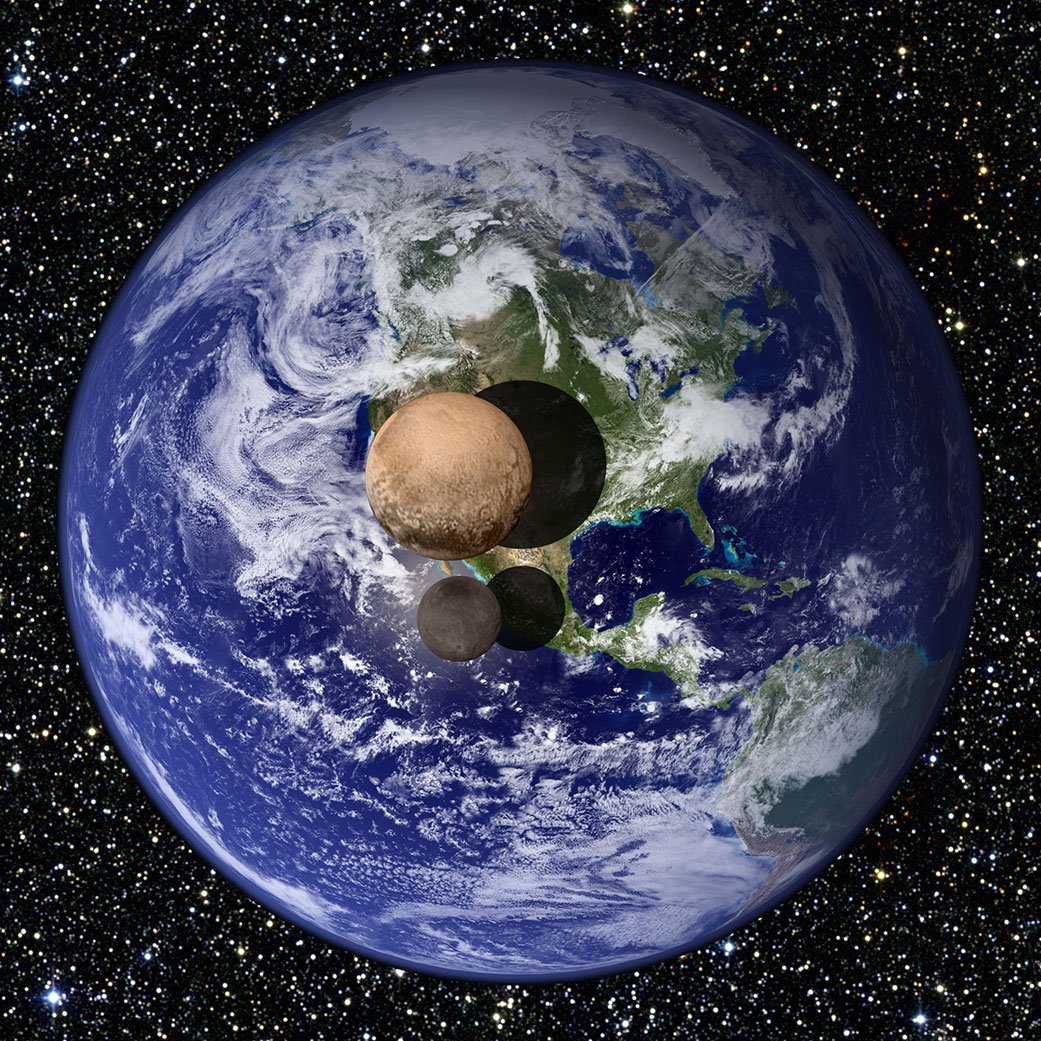

    New Horizons Settles Decades-Long Debate on How Big Is Pluto
    This graphic presents a view of Pluto and Charon as they would appear if placed slightly above Earth’s surface and viewed from a great distance. Recent measurements obtained by New Horizons indicate that Pluto has a diameter of 2,370 km (1,472 mi), 18.5% that of Earth’s, while Charon has a diameter of 1,208 km (751 mi), 9.5% that of Earth’s.

    Sizes of Pluto’s Moons Nix and Hydra
    The approximate sizes of Pluto’s moons Nix and Hydra compared to Denver, Colorado. While Nix and Hydra are illustrated as circles in this diagram, mission scientists anticipate that future observations by New Horizons will show that they are irregular in shape. Credit: JHUAPL/Google

    Never miss a breakthrough: Join the SciTechDaily newsletter.
    Follow us on Google and Google News.

    Astronomy Charon Hydra NASA New Horizons Nix Planetary Science Pluto Styx
    Share. Facebook Twitter Pinterest LinkedIn Email Reddit

    Related Articles

    NASA’s New Horizons Spacecraft Observes Pluto’s Smallest Moon

    New Horizons Reveals Charon’s Colorful and Violent History

    New Horizons Views Pluto’s Smaller Moons

    Latest New Horizons Portrait of Pluto and Charon

    Astrophysicist Scott Kenyon Shares His Thoughts and Reactions on New Horizons’ Flyby of Pluto

    NASA’s New Horizons Spacecraft Reveals First Close-Up View of Pluto

    New Horizons Spots Small Moons Orbiting Pluto

    New ScienceCast Video Previews What New Horizons May See on Pluto

    New ScienceCast Video – Countdown to Pluto

    Leave A Reply Cancel Reply

    • Facebook
    • Twitter
    • Pinterest
    • YouTube

    Don't Miss a Discovery

    Subscribe for the Latest in Science & Tech!

    Trending News

    Monster Storms on Jupiter Unleash Lightning Beyond Anything on Earth

    Scientists Create “Liquid Gears” That Spin Without Touching

    The Simple Habit That Could Help Prevent Cancer

    Millions Take These IBS Drugs, But a New Study Finds Serious Risks

    Scientists Unlock Hidden Secrets of 2,300-Year-Old Mummies Using Cutting-Edge CT Scanner

    Bread Might Be Making You Gain Weight Even Without Eating More Calories

    Scientists Discover Massive Magma Reservoir Beneath Tuscany

    Europe’s Most Active Volcano Just Got Stranger – Here’s Why Scientists Are Rethinking It

    Follow SciTechDaily
    • Facebook
    • Twitter
    • YouTube
    • Pinterest
    • Newsletter
    • RSS
    SciTech News
    • Biology News
    • Chemistry News
    • Earth News
    • Health News
    • Physics News
    • Science News
    • Space News
    • Technology News
    Recent Posts
    • Simple Blood Test May Predict Alzheimer’s Years Before Brain Scans Show Signs
    • Scientists Say Adding This Unusual Seafood to Your Diet Could Reverse Signs of Aging
    • U.S. Waste Holds $5.7 Billion Worth of Crop Nutrients
    • Scientists Say a Hidden Structure May Exist Inside Earth’s Core
    • Doctors Surprised by the Power of a Simple Drug Against Colon Cancer
    Copyright © 1998 - 2026 SciTechDaily. All Rights Reserved.
    • Science News
    • About
    • Contact
    • Editorial Board
    • Privacy Policy
    • Terms of Use

    Type above and press Enter to search. Press Esc to cancel.