

Lighting the Way: A new method to detect light in the brain sets the stage for next-gen optical brain devices.
Researchers from the Italian Institute of Technology (IIT) and the University of Salento, both in Lecce, Italy, and Harvard Medical School in Boston have developed a new light-based method to capture and pinpoint the epicenter of neural activity in the brain. The study was published on Nature Methods.
The team used an optical fiber in the shape of a narrow cone with a tip so thin and so precise that it is capable of capturing light from single neurons along regions as long as 2 millimeters (0.07 inches).
The approach, described in Nature Methods, lays the foundation for novel ways to map connections across different brain regions—an ability that can enable the design of devices to image various areas of the brain and even treat conditions that arise from malfunctions in cells inhabiting these regions, the researchers said.
The work was led by Bernardo Sabatini, the Alice and Rodman W. Moorhead III Professor of Neurobiology in the Blavantik Institute at Harvard Medical School, and Ferruccio Pisanello at IIT, and Massimo De Vittorio at IIT and University of Salento, and funded by the European Research Council and by the National Institutes of Health in the United States.
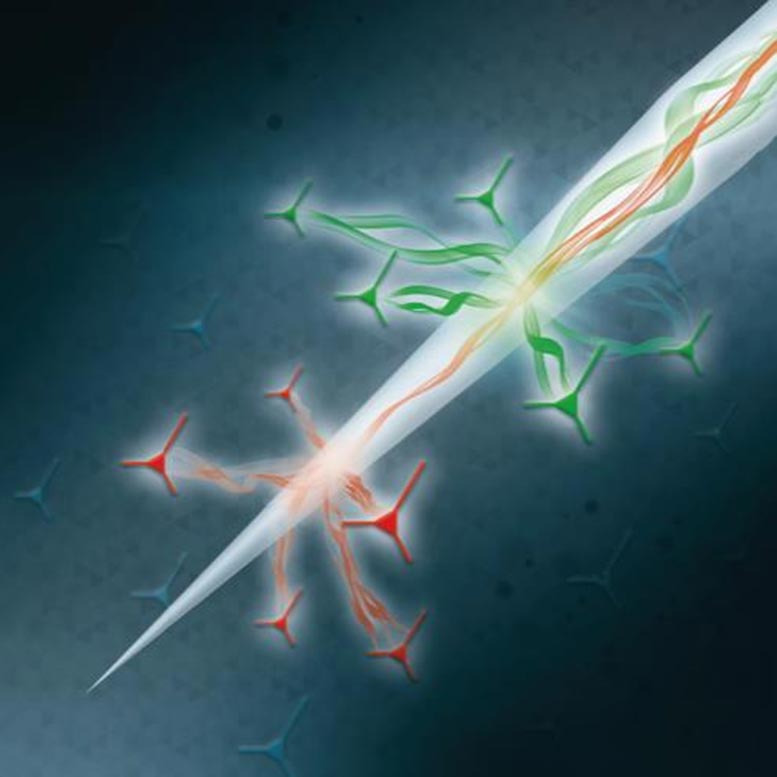
One of the central challenges in modern neuroscience is recording the exchange of information between different regions of the brain, as well as between different cell types. The new method overcomes this challenge by allowing the simultaneous collection of signals from various brain regions through the use of a tapered optical probe.
The study marks the first instance of successfully using light to decode the activity of specific neuronal populations as well as manipulation of different brain regions with the use of a single probe. The approach relies on bringing fluorescent molecules into specific nerve cells in order to track their electric activity and to measure the level of neurotransmitters—molecules that act as chemical messengers across neurons.
To achieve this, the team used an optical fiber in the shape of a narrow cone with a tip so thin and so precise that it is capable of capturing light from single neurons along regions as long as 2 millimeters (0.07 inches).
The researchers inserted the light-sensing probe inside the striatum, a region of the brain involved in planning movements, and used it to track the release of dopamine, a critical neurotransmitter involved in motor control which also plays a key role in the development of disorders like Parkinson’s disease, schizophrenia, and depression.
The device successfully captured neural activity in specific sub-regions of the striatum involved in the release of dopamine during specific behaviors.
The approach has effectively allowed scientists to capture how nerve signals travel in time and space and to gauge the concentration of specific neurotransmitters during specific actions. The method enriches researchers’ methodological repertoire and augments their ability to study the central nervous system and probe the molecular causes of neurological disorders.
Reference: “Depth-resolved fiber photometry with a single tapered optical fiber implant” by Filippo Pisano, Marco Pisanello, Suk Joon Lee, Jaeeon Lee, Emanuela Maglie, Antonio Balena, Leonardo Sileo, Barbara Spagnolo, Marco Bianco, Minsuk Hyun, Massimo De Vittorio, Bernardo L. Sabatini and Ferruccio Pisanello, 7 October 2019, Nature Methods.
DOI: 10.1038/s41592-019-0581-x
The work was supported by the European Research Council under the European Union’s Horizon 2020 research and innovation program (grants 677683 and 692943) and from the National Institutes of Health (grants U01NS0941901 and UF1NS108177-01).
Sileo, De Vittorio, Sabatini, and Pisanello are founders and hold private equity in OptogeniX, a company that develops, produces and sells technologies to deliver light into the brain. Tapered fibers commercially available from OptogeniX were used as tools in the research.
Never miss a breakthrough: Join the SciTechDaily newsletter.
Follow us on Google and Google News.