
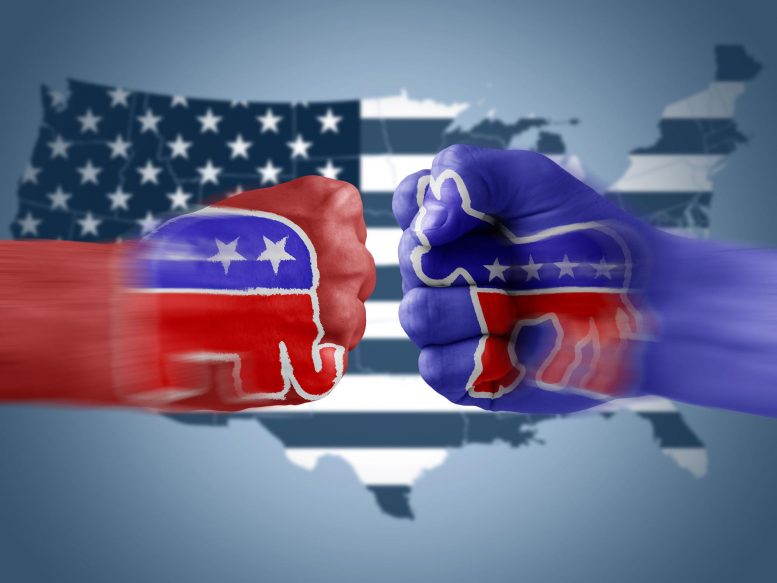
“When ideals and policies matter less than dominating foes, government becomes dysfunctional,” researchers say.
The bitter polarization between the Republican and Democratic parties in the U.S. has been on the rise since Newt Gingrich’s partisan combat against President Bill Clinton in the 1990s. But according to a new Northwestern University-led study, disdain for the opposing political party now — and for the first time on record — outweighs affection for one’s own party.
The study, titled “Political sectarianism in America,” was published on October 3, 2020, by the journal Science. The authors provide a broad survey of current scientific literature to interpret the current state of politics.
The paper introduces the construct of “political sectarianism” to describe the phenomenon. Political sectarianism has the hallmarks of religious fervor, such as sin, public shaming, and apostasy. But unlike traditional sectarianism, where political identity is secondary to religion, political identity is primary.
“The current state of political sectarianism produces prejudice, discrimination, and cognitive distortion, undermining the ability of government to serve its core functions of representing the people and solving the nation’s problems,” said lead author Eli Finkel. “Along the way, it makes people increasingly willing to support candidates who undermine democracy and to favor violence in support of their political goals.”
Finkel is a professor of social psychology with appointments in Northwestern’s Weinberg College of Arts and Sciences and the Kellogg School of Management.
To ensure that their synthesis captured the collective knowledge base, Finkel recruited coauthors from six academic disciplines: political science, psychology, sociology, economics, management, and computational social science.
A systematic review of dozens of published research studies led the authors to identify three key ingredients of political sectarianism, which, when combined, form the “poisonous cocktail” seen today. They include seeing the other side as different (othering), as dislikeable (aversion), and as immoral (moralization).
Using nationally representative survey data since the 1970s, the authors calculated the difference between Americans’ warm feelings toward their fellow partisans and their cold feelings toward opposing partisans. While feelings toward fellow partisans have remained consistently warm, feelings toward opposing partisans have chilled further from tepid to frosty. Indeed, those feelings have grown so frigid that they now exceed warm feelings toward fellow partisans, turning out-party hate into the dominant feeling in American politics.
“Things have gotten much more severe in the past decade, and there is no sign we’ve hit bottom,” said co-author James Druckman, Payson S. Wild Professor of political science and Institute for Policy Research fellow at Northwestern. “As much as the parties differ from one another, partisans perceive even greater differences, believing, for example, that the other party is ideologically extreme, engaged and hostile. Correcting these types of misperceptions could partially vitiate sectarianism.”
The researchers identify the multiple causes of political sectarianism and suggest potential approaches to address and mitigate it. The three causes include:
- Identity alignment, meaning political party identities have sorted into a “mega-identity” separated along racial, religious, educational and geographic lines;
- The rise of partisan media, impacted by the termination of the FCC “fairness doctrine” in 1987, which required broadcasters to discuss controversial topics in an unbiased way; and
- Elite ideological polarization, with Republican politicians moving further right and Democratic politicians moving further left — and politicians in both parties becoming increasingly reliant on ideologically extreme donors
A proposed behavioral intervention includes correcting misperceptions of opposing partisans and encouraging people to engage in cross-party interactions.
“If the differences between Democrats and Republicans really were as extreme as Americans believe, that could help to explain the contempt,” Finkel observes. “But these differences exist more in people’s heads than in reality. There’s a whole lot of common ground, but Americans struggle to see it.”
Finkel offers that simply reminding people of what they have in common reduces out-party hate.
The researchers advise that structural fixes are also required, including tweaking social media algorithms to limit the reach of false or hyperpartisan content and incentivizing politicians to appeal to a broader proportion of Americans. Reforms around campaign finance and partisan gerrymandering are suggested as ways to reduce sectarianizing behaviors and to generate more robust competition in the marketplace of ideas.
Reference: “Political sectarianism in America” by Eli J. Finkel, Christopher A. Bail, Mina Cikara, Peter H. Ditto, Shanto Iyengar, Samara Klar, Lilliana Mason, Mary C. McGrath, Brendan Nyhan, David G. Rand, Linda J. Skitka, Joshua A. Tucker, Jay J. Van Bavel, Cynthia S. Wang and James N. Druckman, 30 October 2020, Science.
DOI: 10.1126/science.abe1715
Additional co-authors include Christopher A. Bail, Duke University; Mina Cikara, Harvard University; Peter H. Ditto, University of California-Irvine; Shanto Iyengar, Stanford University; Samara Klar, University of Arizona, Tucson; Lilliana Mason, University of Maryland; Mary C. McGrath, Northwestern University; Brendan Nyhan, Dartmouth College; David G. Rand, Massachusetts Institute of Technology; Linda J. Skitka, University of Illinois–Chicago; Joshua A. Tucker, New York University; Jay J. Van Bavel, New York University; and Cynthia S. Wang, Northwestern University.
Never miss a breakthrough: Join the SciTechDaily newsletter.
Follow us on Google and Google News.
1 Comment
When a two party system dissolves and one party takes over then you no longer have a democracy.