
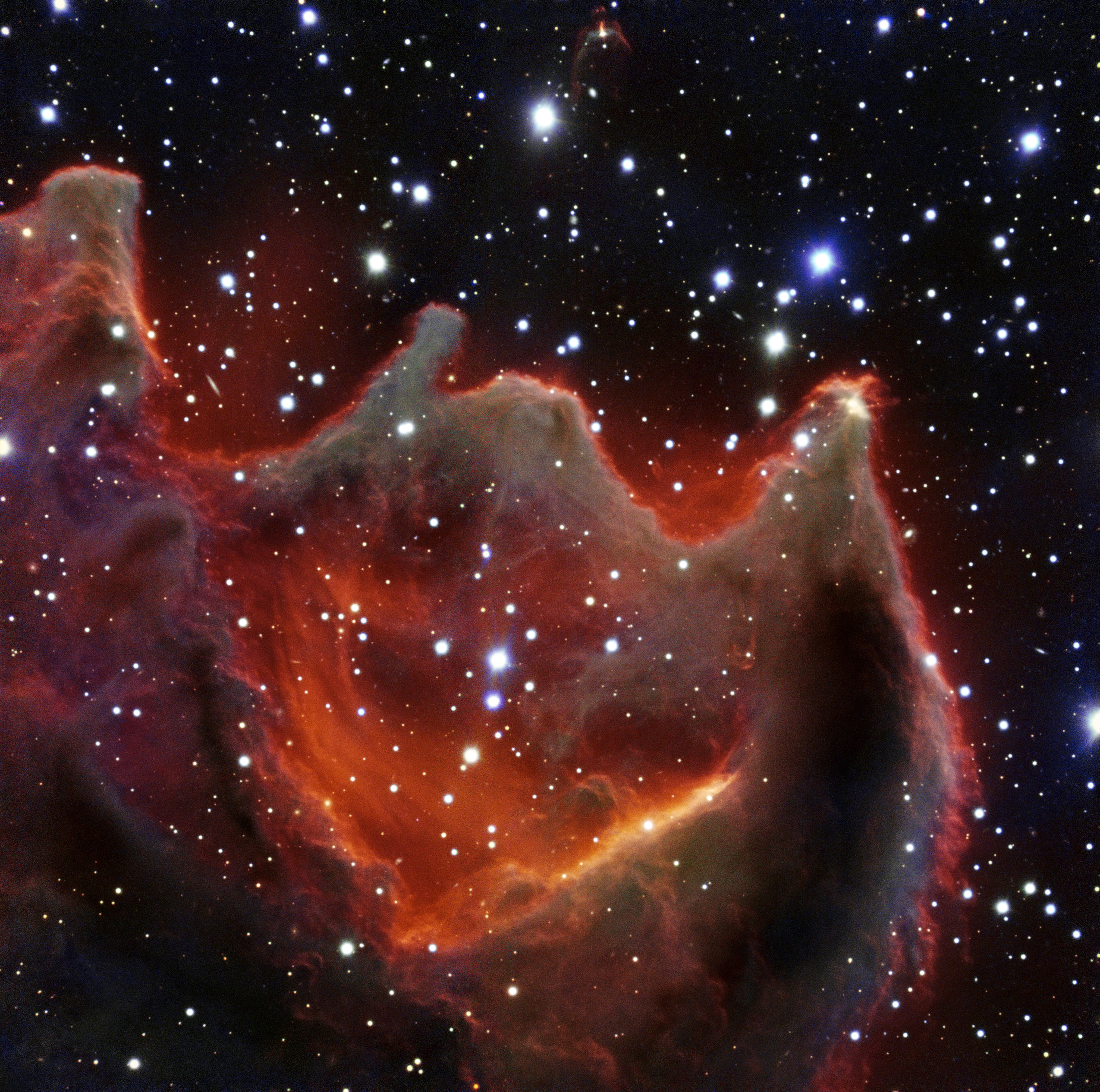
This newly released image from ESO’s Very Large Telescope shows cometary globule CG4, which is located about 1300 light-years from Earth.
Like the gaping mouth of a gigantic celestial creature, the cometary globule CG4 glows menacingly in this new image from ESO’s Very Large Telescope. Although it appears to be big and bright in this picture, this is actually a faint nebula, which makes it very hard for amateur astronomers to spot. The exact nature of CG4 remains a mystery.
In 1976 several elongated comet-like objects were discovered in pictures taken with the UK Schmidt Telescope in Australia. Because of their appearance, they became known as cometary globules even though they have nothing in common with comets. They were all located in a huge patch of glowing gas called the Gum Nebula. They had dense, dark, dusty heads and long, faint tails, which were generally pointing away from the Vela supernova remnant located at the center of the Gum Nebula. Although these objects are relatively close by, it took astronomers a long time to find them as they glow very dimly and are therefore hard to detect.
The object shown in this new picture, CG4, which is also sometimes referred to as God’s Hand, is one of these cometary globules. It is located about 1300 light-years from Earth in the constellation of Puppis (The Poop, or Stern).
The head of CG4, which is the part visible on this image and resembles the head of the gigantic beast, has a diameter of 1.5 light-years. The tail of the globule — which extends downwards and is not visible in the image — is about eight light-years long. By astronomical standards this makes it a comparatively small cloud.
The relatively small size is a general feature of cometary globules. All of the cometary globules found so far are isolated, relatively small clouds of neutral gas and dust within the Milky Way, which are surrounded by hot ionized material.
The cometary globule CG4 glows menacingly, like the gaping mouth of a gigantic celestial creature, in this pan video based on an image from ESO’s Very Large Telescope. What looks huge and bright in this image is actually a faint nebula and not easy to observe. The exact nature of CG4 remains a mystery. Credit: ESO. Music: movetwo
The head part of CG4 is a thick cloud of gas and dust, which is only visible because it is illuminated by the light from nearby stars. The radiation emitted by these stars is gradually destroying the head of the globule and eroding away the tiny particles that scatter the starlight. However, the dusty cloud of CG4 still contains enough gas to make several Sun-sized stars, and indeed, CG4 is actively forming new stars, perhaps triggered as radiation from the stars powering the Gum Nebula reached CG4.
Why CG4 and other cometary globules have their distinct form is still a matter of debate among astronomers and two theories have developed. Cometary globules, and therefore also CG4, could originally have been spherical nebulae, which were disrupted and acquired their new, unusual form because of the effects of a nearby supernova explosion. Other astronomers suggest, that cometary globules are shaped by stellar winds and ionizing radiation from hot, massive OB stars. These effects could first lead to the bizarrely (but appropriately!) named formations known as elephant trunks and then eventually cometary globules.
To find out more, astronomers need to find out the mass, density, temperature, and velocities of the material in the globules. These can be determined by the measurements of molecular spectral lines which are most easily accessible at millimeter wavelengths — wavelengths at which telescopes like the Atacama Large Millimeter/submillimeter Array (ALMA) operate.
This picture comes from the ESO Cosmic Gems program, an outreach initiative to produce images of interesting, intriguing, or visually attractive objects using ESO telescopes, for the purposes of education and public outreach. The program makes use of telescope time that cannot be used for science observations. All data collected may also be suitable for scientific purposes, and are made available to astronomers through ESO’s science archive.
Never miss a breakthrough: Join the SciTechDaily newsletter.
Follow us on Google and Google News.
1 Comment
Is that real ? ? ?? ? :O