
Close Menu
    Facebook X (Twitter) Instagram
    SciTechDaily
    • Biology
    • Chemistry
    • Earth
    • Health
    • Physics
    • Science
    • Space
    • Technology
    Facebook X (Twitter) Pinterest YouTube RSS
    SciTechDaily
    Home»Health»Next COVID-19 Drug Target: Viral “Molecular Scissor”
    Health

    Next COVID-19 Drug Target: Viral “Molecular Scissor”

    By University of Texas Health Science Center at San AntonioOctober 17, 2020No Comments4 Mins Read
    Facebook Twitter Pinterest Telegram LinkedIn WhatsApp Email Reddit
    Share
    Facebook Twitter LinkedIn Pinterest Telegram Email Reddit
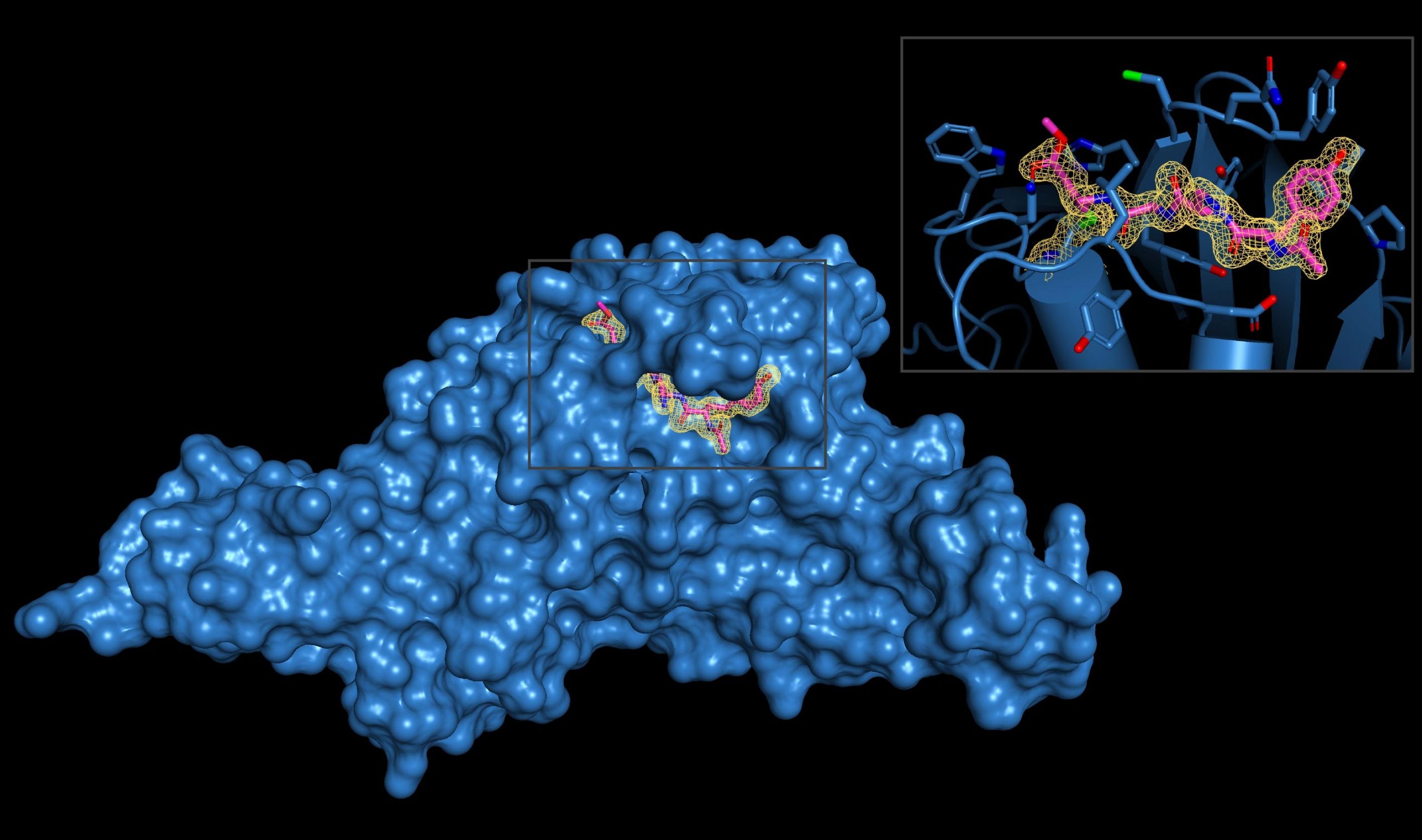
    Disabling Viral Molecular Scissor
    The SARS-CoV-2-PLpro enzyme is visualized with an inset of viral inhibitor interaction. Blocking the enzyme’s effects may prove fruitful in stopping coronavirus infections. Credit: Image courtesy Shaun K. Olsen, PhD, laboratory at The University of Texas Health Science Center at San Antonio (Joe R. and Teresa Lozano Long School of Medicine)

    Coronavirus uses enzymatic cutter for virus production and to disable essential immune proteins.

    American and Polish scientists, reporting October 16, 2020, in the journal Science Advances, laid out a novel rationale for COVID-19 drug design — blocking a molecular “scissor” that the virus uses for virus production and to disable human proteins crucial to the immune response.

    The researchers are from The University of Texas Health Science Center at San Antonio (UT Health San Antonio) and the Wroclaw University of Science and Technology. Information gleaned by the American team helped Polish chemists to develop two molecules that inhibit the cutter, an enzyme called SARS-CoV-2-PLpro.

    SARS-CoV-2-PLpro promotes infection by sensing and processing both viral and human proteins, said senior author Shaun K. Olsen, PhD, associate professor of biochemistry and structural biology in the Joe R. and Teresa Lozano Long School of Medicine at UT Health San Antonio.

    Shaun K. Olsen
    Shaun K. Olsen, PhD, studies the enzyme SARS-CoV-2-PL pro and is collaborating with Polish chemists who have developed inhibitors of the enzyme. Dr. Olsen is a faculty researcher in the Joe R. and Teresa Lozano Long School of Medicine at The University of Texas Health Science Center at San Antonio. Credit: UT Health San Antonio

    “This enzyme executes a double-whammy,” Dr. Olsen said. “It stimulates the release of proteins that are essential for the virus to replicate, and it also inhibits molecules called cytokines and chemokines that signal the immune system to attack the infection,” Dr. Olsen said.

    SARS-CoV-2-PLpro cuts human proteins ubiquitin and ISG15, which help maintain protein integrity. “The enzyme acts like a molecular scissor,” Dr. Olsen said. “It cleaves ubiquitin and ISG15 away from other proteins, which reverses their normal effects.”

    Dr. Olsen’s team, which recently moved to the Long School of Medicine at UT Health San Antonio from the Medical University of South Carolina, solved the three-dimensional structures of SARS-CoV-2-PLpro and the two inhibitor molecules, which are called VIR250 and VIR251. X-ray crystallography was performed at the Argonne National Laboratory near Chicago.

    “Our collaborator, Dr. Marcin Drag, and his team developed the inhibitors, which are very efficient at blocking the activity of SARS-CoV-2-PLpro, yet do not recognize other similar enzymes in human cells,” Dr. Olsen said. “This is a critical point: The inhibitor is specific for this one viral enzyme and doesn’t cross-react with human enzymes with a similar function.”

    Specificity will be a key determinant of therapeutic value down the road, he said.

    The American team also compared SARS-CoV-2-PLpro against similar enzymes from coronaviruses of recent decades, SARS-CoV-1 and MERS. They learned that SARS-CoV-2-PLpro processes ubiquitin and ISG15 much differently than its SARS-1 counterpart.

    “One of the key questions is whether that accounts for some of the differences we see in how those viruses affect humans, if at all,” Dr. Olsen said.

    By understanding similarities and differences of these enzymes in various coronaviruses, it may be possible to develop inhibitors that are effective against multiple viruses, and these inhibitors potentially could be modified when other coronavirus variants emerge in the future, he said.

    Reference: “Activity profiling and crystal structures of inhibitor-bound SARS-CoV-2 papain-like protease: A framework for anti–COVID-19 drug design” by Wioletta Rut, Zongyang Lv, Mikolaj Zmudzinski, Stephanie Patchett, Digant Nayak, Scott J. Snipas, Farid El Oualid, Tony T. Huang, Miklos Bekes, Marcin Drag and Shaun K. Olsen, 16 October 2020, Science Advances.
    DOI: 10.1126/sciadv.abd4596

    Never miss a breakthrough: Join the SciTechDaily newsletter.
    Follow us on Google and Google News.

    COVID-19 Infectious Diseases University of Texas at San Antonio Virology
    Share. Facebook Twitter Pinterest LinkedIn Email Reddit

    Related Articles

    Antibody Neutralizes SARS and COVID-19 Coronaviruses – On Accelerated Path Toward Clinical Trials

    Study Shows Treatment With Interferon-α2b Speeds Up Recovery of COVID-19 Patients

    Experts Dire Warning: 250,000,000 People in Africa Will Catch Coronavirus and Up to 190,000 Will Likely Die

    New Genetic Analysis Shows COVID-19 Coronavirus Did Not Spill Over From Pangolins (Scaly Anteaters)

    Team of Biochemists and Virologists Discover Potential Targets for COVID-19 Therapy

    How COVID-19 Kills: New Study Explains the Mechanisms of the New Coronavirus

    Vitamin D Linked to Low Coronavirus Death Rate

    Infection Researchers Identify How Coronaviruses From Animals Need to Change to Spread to Humans

    Progress on AAVCOVID, A Gene-Based Experimental COVID-19 Vaccine

    Leave A Reply Cancel Reply

    • Facebook
    • Twitter
    • Pinterest
    • YouTube

    Don't Miss a Discovery

    Subscribe for the Latest in Science & Tech!

    Trending News

    Scientists Discover Cheap, Natural Remedy for High Blood Pressure

    Earth’s Upper Atmosphere Is Cooling Fast and Scientists Finally Know Why

    32,000 Olympic Pools of Magma Nearly Erupted Beneath Atlantic Island

    Exercise Changes the Heart in a Way Researchers Never Expected

    Too Much Sleep May Age Your Body Faster, New Study Warns

    Scientists Uncover Promising New Strategy To Stop Parkinson’s in Its Tracks

    Experts Reveal the Surprising Cancer Link Behind a Common Vitamin

    This Strange “Golden Orb” Found 2 Miles Deep Stumped Scientists for Years

    Follow SciTechDaily
    • Facebook
    • Twitter
    • YouTube
    • Pinterest
    • Newsletter
    • RSS
    SciTech News
    • Biology News
    • Chemistry News
    • Earth News
    • Health News
    • Physics News
    • Science News
    • Space News
    • Technology News
    Recent Posts
    • Scientists Discover Surprising Way Cranberry Juice Could Fight Antibiotic Resistance
    • Researchers Discover the Body’s Hidden “Off Switch” for Inflammation
    • Scientists Discover Metformin Doesn’t Work the Way We Thought
    • Tea or Coffee? Your Daily Choice Could Affect Osteoporosis Risk
    • Scientists Discover Brain Pathway That May Slow Parkinson’s Disease – but Only in Women
    Copyright © 1998 - 2026 SciTechDaily. All Rights Reserved.
    • Science News
    • About
    • Contact
    • Editorial Board
    • Privacy Policy
    • Terms of Use

    Type above and press Enter to search. Press Esc to cancel.