
Close Menu
    Facebook X (Twitter) Instagram
    SciTechDaily
    • Biology
    • Chemistry
    • Earth
    • Health
    • Physics
    • Science
    • Space
    • Technology
    Facebook X (Twitter) Pinterest YouTube RSS
    SciTechDaily
    Home»Space»Planets Around a Black Hole? Calculations Show Possibility of Bizarre Worlds of Astonishing Scale
    Space

    Planets Around a Black Hole? Calculations Show Possibility of Bizarre Worlds of Astonishing Scale

    By National Institutes of Natural SciencesNovember 25, 20191 Comment3 Mins Read
    Facebook Twitter Pinterest Telegram LinkedIn WhatsApp Email Reddit
    Share
    Facebook Twitter LinkedIn Pinterest Telegram Email Reddit
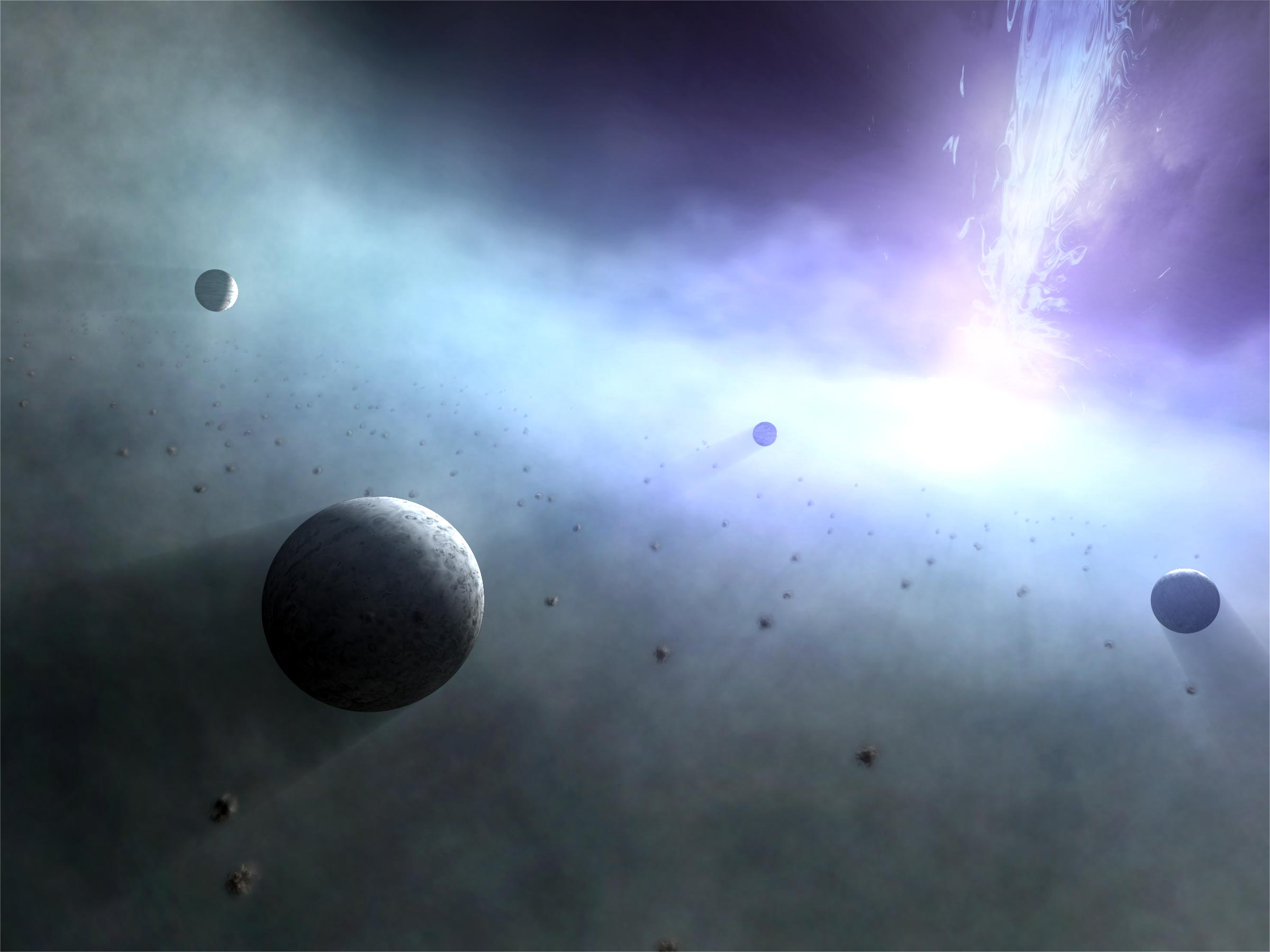
    Artist Impression Planets Orbiting Black Hole
    This is an artist’s impression of planets orbiting a supermassive black hole. Credit: Kagoshima University

    “I have seen the dark universe yawning,
    Where the black planets roll without aim;
    Where they roll in their horror unheeding, without knowledge or lustre or name.”
    –H.P. Lovecraft, Nemesis

    Theoreticians in two different fields defied the common knowledge that planets orbit stars like the Sun. They proposed the possibility of thousands of planets around a supermassive black hole.

    “With the right conditions, planets could be formed even in harsh environments, such as around a black hole,” says Keiichi Wada, a professor at Kagoshima University researching active galactic nuclei which are luminous objects energized by black holes.

    “Around black holes there might exist planetary systems of astonishing scale.” — Eiichiro Kokubo

    According to the latest theories, planets are formed from fluffy dust aggregates in a protoplanetary disk around a young star. But young stars are not the only objects that possess dust disks. In a novel approach, the researchers focused on heavy disks around supermassive black holes in the nuclei of galaxies.

    “Our calculations show that tens of thousands of planets with 10 times the mass of the Earth could be formed around 10 light-years from a black hole,” says Eiichiro Kokubo, a professor at the National Astronomical Observatory of Japan who studies planet formation. “Around black holes there might exist planetary systems of astonishing scale.”

    Some supermassive black holes have large amounts of matter around them in the form of a heavy, dense disk. A disk can contain as much as a hundred thousand times the mass of the Sun worth of dust. This is a billion times the dust mass of a protoplanetary disk.

    In a low temperature region of a protoplanetary disk, dust grains with ice mantles stick together and evolve into fluffy aggregates. A dust disk around a black hole is so dense that the intense radiation from the central region is blocked and low temperature regions are formed. The researchers applied the planet formation theory to circumnuclear disks and found that planets could be formed in several hundred million years.

    Currently, there are no techniques to detect these planets around black holes. However, the researchers expect this study to open a new field of astronomy.

    Reference: “Planet Formation around Super Massive Black Holes in the Active Galactic Nuclei” by Keiichi Wada, Yusuke Tsukamoto and Eiichiro Kokubo, The Astrophysical Journal.
    DOI: 10.3847/1538-4357/ab4cf0
    arXiv: 1909.06748

    Never miss a breakthrough: Join the SciTechDaily newsletter.
    Follow us on Google and Google News.

    Astrophysics Black Hole National Institutes of Natural Sciences Popular
    Share. Facebook Twitter Pinterest LinkedIn Email Reddit

    Related Articles

    Across Time and Space: Mysterious Star’s Epic Journey to Heart of Milky Way

    Cosmic Alchemy – New Findings Demonstrate That Supermassive Black Holes Alter Galactic Chemistry

    Mysterious Cosmic Tadpole: A Strange Gas Cloud Dances With a Colossal Black Hole

    New Origin of Supermassive Black Holes Revealed by Supercomputer Simulation

    Data Reveals Swift J1644+57’s QPO Cycle

    Intermediate-Mass Black Hole Candidates Discovered at the Center of the Milky Way

    Gamma-Ray Beams Suggest Milky Way’s Central Black Hole Had Active Past

    Scientists Convene to Take a Picture of the Supermassive Black Hole at the Center of the Milky Way

    Black Hole Fires Cosmic Bullets of Ionized Gases

    1 Comment

    1. TheHeck on January 3, 2024 2:15 am

      The article uses the term “black hole”, but it should be specified that this applies to supermassive black holes, ie. the kind of black holes found at the centers of most galaxies.

      Reply
    Leave A Reply Cancel Reply

    • Facebook
    • Twitter
    • Pinterest
    • YouTube

    Don't Miss a Discovery

    Subscribe for the Latest in Science & Tech!

    Trending News

    Scientists Discover How Coffee Impacts Memory, Mood, and Gut Health

    Why Did the Neanderthals Disappear? Scientists Reveal Humans Had a Hidden Advantage

    Physicists Propose Strange Experiment Where Time Goes Quantum

    Magnesium Magic: New Drug Melts Fat Even on a High-Fat, High-Sugar Diet

    Weight-Loss Drugs Like Ozempic May Come With an Unexpected Cost

    Mezcal “Worm” in a Bottle Mystery: DNA Testing Reveals a Surprise

    New Research Reveals That Your Morning Coffee Activates an Ancient Longevity Switch

    This Is What Makes You Irresistible to Mosquitoes

    Follow SciTechDaily
    • Facebook
    • Twitter
    • YouTube
    • Pinterest
    • Newsletter
    • RSS
    SciTech News
    • Biology News
    • Chemistry News
    • Earth News
    • Health News
    • Physics News
    • Science News
    • Space News
    • Technology News
    Recent Posts
    • This Popular Supplement May Boost Your Brain, Not Just Your Muscles
    • What Happened in Childhood Could Be Causing Your Gut Issues Today
    • Scientists Say This Simple Supplement May Actually Reverse Heart Disease
    • Scientists Just Captured Killer T Cells in Action Inside Tumors
    • Alaska’s Sky Explodes With Swirling Clouds and a Hidden Polar Storm
    Copyright © 1998 - 2026 SciTechDaily. All Rights Reserved.
    • Science News
    • About
    • Contact
    • Editorial Board
    • Privacy Policy
    • Terms of Use

    Type above and press Enter to search. Press Esc to cancel.