
A new study reveals that some proposed signatures of quantum gravity may have an unexpected classical explanation.
Imagine placing an object in two locations at once. Quantum mechanics allows such a possibility, at least for sufficiently small systems. But if the object occupies multiple positions, what happens to the gravity surrounding it?
That question lies at the center of one of physics’ most persistent problems. Quantum mechanics describes atoms, particles, and other microscopic systems with remarkable accuracy, while Einstein’s theory of gravity explains planets, stars, black holes, and the expansion of the Universe. Physicists still lack a single theory of “quantum gravity” that can describe both realms together.
Quantum mechanics allows an object to become delocalized, meaning its possible location is spread across more than one place. Experiments have demonstrated this behavior with atoms and even small pieces of metal. Einstein’s theory, meanwhile, treats gravity as the shape of space and time itself. Spacetime can curve, remain flat, or carry waves, as gravitational wave detectors have confirmed.
If an object can occupy several quantum states at once, many physicists expect the surrounding spacetime to do the same. The difficulty is determining what evidence would distinguish that possibility from ordinary gravity acting on a quantum object.
But what would such a situation actually look like?
Quantum gravity may have a lookalike
Researchers from Kyushu University, the University of Waterloo, and Stockholm University addressed this problem by examining how proposed quantum gravity experiments can be interpreted. Their work, published in npj Quantum Information, shows that some apparently quantum forms of gravity may have an alternative description.
They developed a theoretical framework showing that many situations labeled a “quantum superposition of gravity” can also be understood as quantum particles occupying superpositions while moving through ordinary gravity and spacetime. Under that second description, the particles behave quantum mechanically, but gravity itself does not need to display an observable quantum signature.
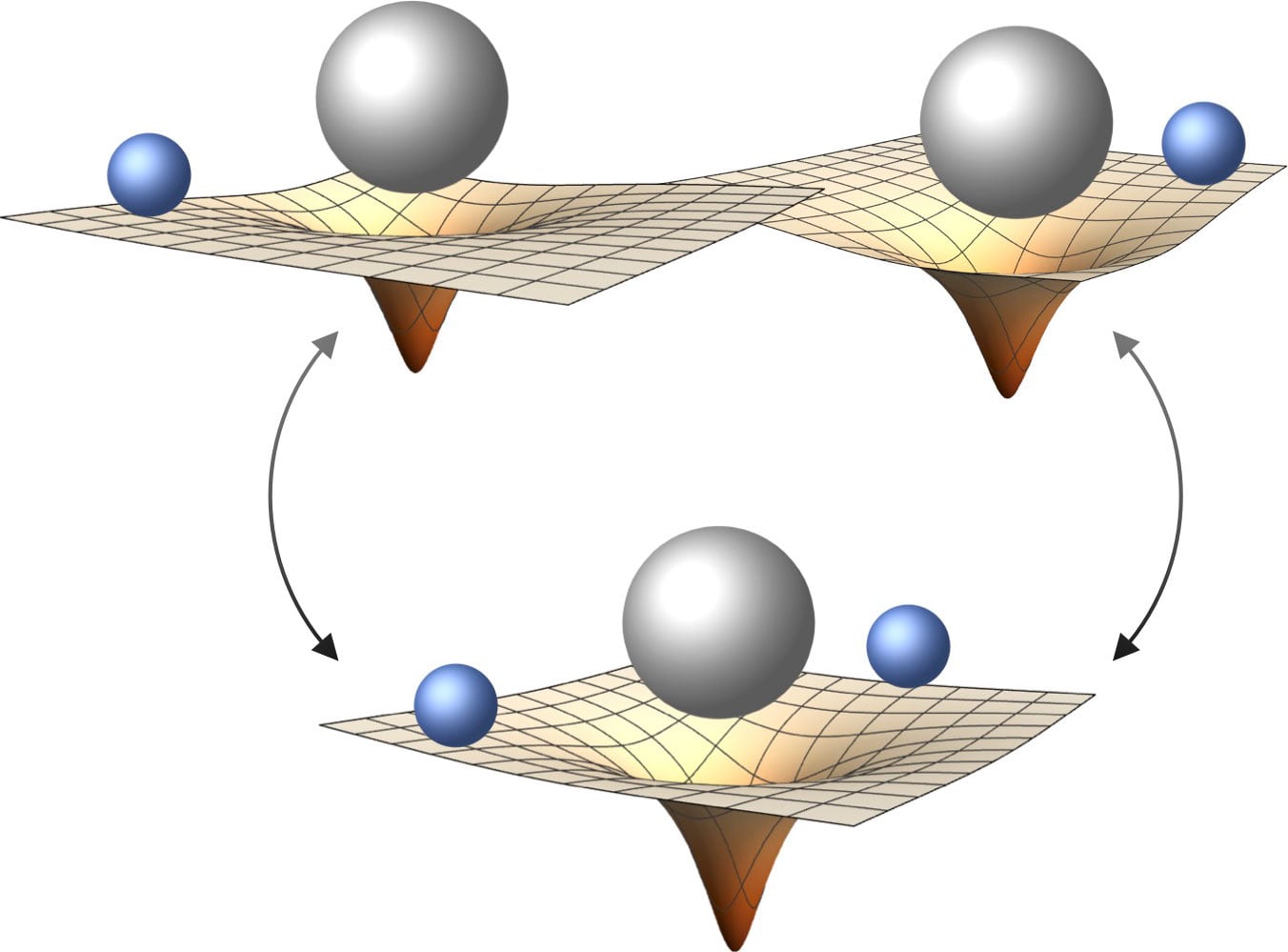
This equivalence creates a challenge for experiments. A result that appears to show gravity occupying several states might also emerge from familiar spacetime combined with the quantum behavior of matter.
“Many researchers have proposed experiments that could potentially reveal the quantum nature of gravity,” explains Associate Professor Joshua Foo of Kyushu University’s Institute for Advanced Study and lead author of the study. “What we found is that some of these scenarios can be viewed from two equally valid perspectives. One interpretation describes gravity as being in a quantum superposition, while the other describes quantum particles moving in an ordinary gravitational field.”
Two descriptions can fit one result
The researchers call the concept the “Relativity of Spacetime Superpositions.” The central idea is that the same physical situation can sometimes be represented in two different ways, much as different map projections can depict the same landscape.
From one perspective, gravity and spacetime appear to occupy a quantum superposition. From another, gravity remains classical while each particle’s movement is assigned the appropriate quantum state. Although the mathematical descriptions differ, they can lead to the same observable result.
That does not establish that gravity is classical, and it does not argue against quantum gravity. Instead, it exposes a problem of interpretation. An experiment may produce a result consistent with quantum gravity without showing that a quantum description of gravity is the only possible explanation.
“Our work does not tell us that such experiments rule out quantum gravity,” says Magdalena Zych of Stockholm University and a co-author on the paper. “Rather, it helps us identify which experimental signatures would genuinely require a quantum description of gravity and which ones could arise from more familiar physics. That distinction is crucial for designing future experiments.”
Future tests must rule out classical gravity
The framework gives physicists a clearer standard for evaluating proposed tests. Rather than asking only whether a result can be described using quantum gravity, researchers must determine whether ordinary gravity combined with quantum matter could produce the same observation.
That distinction can help narrow the experimental search. Measurements that remain explainable through classical spacetime cannot provide unambiguous evidence that gravity itself follows quantum rules. More decisive tests will need to isolate signatures that no classical description can reproduce.
The immediate goal is theoretical, but research into fundamental physics has often produced practical consequences that were not apparent at the outset. GPS navigation depends on Einstein’s theory of gravity, while lasers and modern electronics grew from advances in quantum physics.
For now, the framework serves as a guide for designing and interpreting experiments aimed at one of modern physics’ most difficult questions. By identifying where classical and quantum explanations overlap, it helps researchers focus on observations that could genuinely separate them.
“Understanding how gravity and quantum mechanics fit together is one of the greatest challenges in physics,” concludes Foo. “Before we can test gravity’s quantum nature, we first need to know what evidence would prove that we’ve found it. Our work helps clarify that question.”
Reference: “Relativity and decoherence of spacetime superpositions” by Joshua Foo, Cendikiawan Suryaatmadja, Robert B. Mann and Magdalena Zych, 13 May 2026, npj Quantum Information.
DOI: 10.1038/s41534-026-01234-x
Never miss a breakthrough: Join the SciTechDaily newsletter.
Follow us on Google and Google News.
15 Comments
The mainstream physics community is starting to hit a wall with overly complex “quantum geometry” models that require infinite unobservable parameters. Papers like this signal a growing realization that gravity might be far simpler, smoother, and more strictly geometric than standard quantum field theory assumed—a core principle that has driven the Torsion Hill concept from the start.
The mainstream physics attempted to stage an absurd drama—featuring infinitely many independent actors (vibrational modes)—upon an idealized, infinitely divisible, and utterly structureless continuous spacetime stage. When the stage itself is shown to be constituted by discrete, topologized vortex units at the microscopic scale, the scriptural premise of this drama collapses.
—— Excerpted from https://zhuanlan.zhihu.com/p/2062808500313626237.
We believe that mainstream physics set up a deep-seated institutional resistance to questioning the ontological premises that underlie all of contemporary fundamental physics—premises that have never been empirically verified.
—— Excerpted from https://zhuanlan.zhihu.com/p/2062808500313626237.
“Understanding how gravity and quantum mechanics fit together is one of the greatest challenges in physics,” concludes Foo.
VERY GOOD.
Two sets of cobalt-60 rotating in opposite directions are two objects that are mirror images of each other, which is also one of the greatest challenges in mainstream physics.
Mainstream physics has long been misled by some so-called peer-reviewed publications, and no longer knows what is dirty, ugly, and shameful.
Honesty has nothing to do with those so-called peer-reviewed publications. Their shameful behavior has seriously hindered the progress and development of science. The following Picture shows those so-called peer-reviewed publications themselves lifting the sheets and performing naked in front of the public.
Picture: https://pic2.zhimg.com/v2-4127b0b58fe8b88feb27c189fb705029_1440w.jpg?source=172ae18b.
—— Excerpted from https://zhuanlan.zhihu.com/p/2062808500313626237 and https://scitechdaily.com/microscope-spacecrafts-most-precise-test-of-key-component-of-the-theory-of-general-relativity/#comment-721618.
Such case for quantum gravity is described by existent research of Quantum Computer and AI;as,presented here in some complementarý path using superposition and decoherence, alongwith existing concept that external source of gravitation influencing the entanglement.
The “history of the solution” to the ultraviolet catastrophe profoundly reveals a fork in the road for the evolution of theoretical physics: should we “pile patches upon patches” within the old paradigm, or bravely dig deeper and replace the “physical substrate” of the theory? Those recent works attempting to patch the Rayleigh-Jeans formula or its quantum extensions with more sophisticated mathematical techniques, even if they achieve phenomenological success, remain lingering on the wrong path.
—— Excerpted from https://zhuanlan.zhihu.com/p/2062808500313626237.
Quantum gravity is facing the same catastrophe.
Popular science websites often struggle to explain deep theoretical physics without distorting the truth, and *SciTechDaily’s* summary of this paper is a prime example. While the underlying research is a sophisticated study about how we choose our reference frames in physics, the online summary turns it into a misleading narrative about the nature of gravity.
The problem starts right at the top with the sensational headline: *”Quantum Gravity May Be Far Less Quantum Than Physicists Expected.”* This implies that scientists discovered gravity itself is somehow smoother or less quantum than everyone thought. In reality, the research says no such thing. The authors weren’t claiming that gravity is fundamentally classical; they were issuing a warning to experimental physicists. They showed that certain tabletop experiments meant to “prove” quantum gravity can actually be explained using ordinary physics if you simply change how you write down your equations. It is a lesson in how to design better tests, not a statement that quantum gravity isn’t real.
This points to the summary’s biggest conceptual blunder: treating a change in mathematical perspective as if it were a choice between two different physical realities. The article makes it sound like nature is deciding whether to make spacetime quantum or classical. But in theoretical physics, changing your reference frame—what experts call a Quantum Reference Frame transformation—is simply like switching map projections or translating a sentence from one language to another. The underlying physical reality stays identical. By framing these equivalent mathematical descriptions as competing theories, the website leads readers to believe physicists found a way to “turn off” quantum gravity, when all they really did was demonstrate a mathematical duality.
The article’s visual diagrams and conclusions only deepen this confusion. By depicting “quantum gravity” and “classical gravity” as two separate diagrams, it hides the central mechanism at play: physical entanglement between the observer and the source. Furthermore, the text repeatedly confuses *our inability to prove something in a specific test* with *that thing not existing*. Just because a low-energy experiment can be mathematically mapped onto a classical background doesn’t mean gravity is classical—it just means that particular experiment isn’t clever enough to isolate a true, unambiguous quantum signature. Ultimately, *SciTechDaily* traded a subtle lesson about mathematical relativity for a catchy but fundamentally flawed headline.
Thank you for browsing and commenting.
You are right. Popular science websites often struggle to explain deep theoretical physics without distorting the truth. CP violation seriously undermines the foundation on which physics has relied for centuries. The theory of topological vortices (TVT) calls for contemporary physics to return to the fundamental principle of parity conservation as soon as possible. Experiments controlled by humans can only simulate nature and cannot deny nature.
Unfortunately, what you have in many of these ideas is a ‘superposition’ of half-thought out math.
You propose a Gordian Knot and then get carried away on whether the other side of the knot is in a different dimension – then two knots in two universes – when it was just a knot – and you got carried away with math.
The odd little catcher here is: math comes out. It fools you into to thinking it represents what your psychology believes. Exchange potatoes and onions for whatever your math is placed to describe – and Wal-la! It still works! Because it is mechanics. And Quantum mechanics is just math – too.
Thank you for browsing and commenting.
The physical phenomena directly observed in scientific experiments are always superficial and not the essence of things. Since mainstream physics has used two sets of artificially rotated cobalt-60 in opposite directions as mirrors, they have become no different from fetishism.
Quantum Mechanics and Particle Physics have, not by chance, together reached the unenviable position of being the latest incarnation of “how many angels can you fit on the head of a pin” levels of theoretical nonsense.
Thank you for browsing and commenting.
The public is not fools. The nonsense, absurdity, dirtiness, and ugliness of some so-called peer-reviewed publications in mainstream physics have long been deeply abhorred.
وقتی چیزی را از روی حواس پرتی گممیکنم برای پیدا کردن آن همه جا را زیر رو میکنم آن چیز گم شده گاهی اوقات در جلوز چشمان قرار دارند وما آنرا نمی بینیم.گرانش حکمآن شیئی گمشده را دارد.گرانش بقدری ساده و زیباست و با دلربایی به ما میگوید….هی به پن نگاه کن من اینجا هستم با ریاضیات و معادلات پیچیده خودت را خسته نکن.
سلام