
Close Menu
    Facebook X (Twitter) Instagram
    SciTechDaily
    • Biology
    • Chemistry
    • Earth
    • Health
    • Physics
    • Science
    • Space
    • Technology
    Facebook X (Twitter) Pinterest YouTube RSS
    SciTechDaily
    Home»Physics»Quantum Physics Provides a Way to Hide Ignorance – Counterintuitive Idea From Quantum Theory Successfully Verified
    Physics

    Quantum Physics Provides a Way to Hide Ignorance – Counterintuitive Idea From Quantum Theory Successfully Verified

    By University of QueenslandAugust 29, 20204 Comments3 Mins Read
    Facebook Twitter Pinterest Telegram LinkedIn WhatsApp Email Reddit
    Share
    Facebook Twitter LinkedIn Pinterest Telegram Email Reddit
    Quantum Physics Hide Ignorance
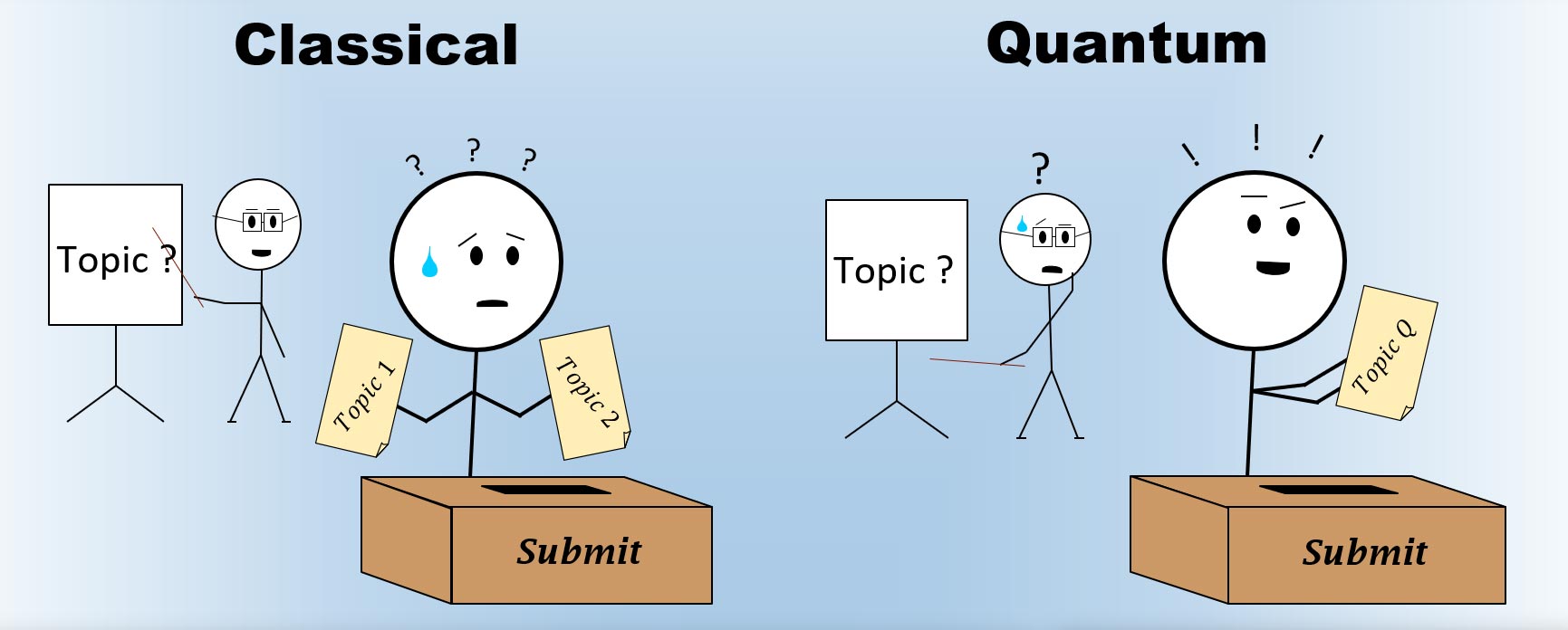
    In the classical world, the student’s ignorance is revealed by the teacher’s questions. In the quantum world, the student hides their ignorance using hints written in a quantum alphabet. Credit: Michael Kewming

    Students can hide their ignorance and answer questions correctly in an exam without their lack of knowledge being detected by teachers – but only in the quantum world.

    University of Queensland researchers have successfully verified a counterintuitive idea from quantum theory – that ignorance of the whole does not necessarily imply ignorance of the parts – in the lab.

    UQ physicist Dr. Jacqui Romero from the ARC Centre of Excellence for Engineered Quantum Systems (EQUS) said the team’s findings would be important when evaluating security in quantum encryption.

    “What’s also really nice is that we provide an accessible, real-world interpretation of a statement that comes from pure probability theory,” Dr. Romero said.

    According to classical intuition, ignorance can be traced to a source – if a student’s knowledge of a book is incomplete, a teacher can design a test to probe which parts of the book are unknown to the student.

    UQ PhD candidate and EQUS experimental physicist Michael Kewming said that this wasn’t always the case in the quantum world.

    “Our results confirm that the student’s source of ignorance can be concealed from the teacher using quantum systems,” Mr. Kewming said. “When we communicate, we use special symbols called letters that form an alphabet. In our study, we do the same thing but we use light to create a quantum alphabet.”

    According to Mr. Kewming quantum alphabets have strange properties.

    “Let’s say the student is sitting an exam that covers two topics, and although they haven’t studied they’ve been given a single hint by a knowledgeable friend,” he said. “In the classical situation, this hint can only be so helpful – providing information about only one topic – and the teacher can still uncover which topic the student is ignorant of.

    “But a hint written using our quantum alphabet could simultaneously contain information about both topics, despite appearing to be about only one. As a result, the teacher cannot determine the source of the student’s ignorance because the hint is always useful to the student.”

    The UQ research team was able to verify this in a physical experiment by writing information in the shape of single photons – the particles that make up light.

    “Our result has implications for the security of quantum-based encryption because we have shown that what is true for classical hints is not true for quantum hints,” Dr. Romero said.

    Unfortunately for students preparing for exams, quantum hints won’t be available outside the lab anytime soon.

    The results are published in Physical Review Letters.

    Reference: “Hiding Ignorance Using High Dimensions” by M. J. Kewming, S. Shrapnel, A. G. White and J. Romero, 22 June 2020, Physical Review Letters.
    DOI: 10.1103/PhysRevLett.124.250401

    Never miss a breakthrough: Join the SciTechDaily newsletter.
    Follow us on Google and Google News.

    Quantum Physics University of Queensland
    Share. Facebook Twitter Pinterest LinkedIn Email Reddit

    Related Articles

    Is Reality a Game of Quantum Mirrors? A New Theory Helps Explain Schrödinger’s Cat

    Major Scientific Leap: Quantum Microscope Created That Can See the Impossible

    Navigating a High-Dimensional Treasure Map to Uncover Quantum Gold

    Quantum Paradox Experiment Puts Einstein to the Test – May Lead to More Accurate Clocks and Sensors

    Quantum Interference Shown Experimentally in Larger Molecules

    Simulating Quantum Walks in Two Dimensions

    Molecules as Antennas Transmit Signals of Single Photons

    Evidence of Elusive Majorana Fermions Raises Possibilities for Quantum Computing

    Higgs Boson Signals Gain Strength at Large Hadron Collider

    4 Comments

    1. xABBAAA on August 30, 2020 7:42 am

      …
      When it comes to a quantum physics it is a questionable at least for few stuff>
      – where does the Uncertainty principle emerges from,
      – why there is entanglement,
      – how those things at small scale really have such strange properties…
      Those are just few to mention, and those properties need to be there with a reason…

      Reply
    2. ყავა on August 30, 2020 8:39 am

      What caused information based syatem for universe for the start? Or is it just us? And we just have our fun with only one aspect of the universe completely ignoring another(s)?

      Reply
    3. Michael on August 30, 2020 9:40 am

      There was a lot of emphasis on the classroom metaphor here that made it difficult for me to grasp exactly how and why the experiment was done. When I try to abstract a computerized observer watching a simulated quantum event I’ve had very much difficulty making the connections to a hypothetical human situation. This seems to get in the way of my understanding of the quantum rules, because I assume the act of human observation is far different and more complicated than its computer simulated counterpart.

      Reply
    4. nonW00t on August 30, 2020 3:36 pm

      lmao Research time well spent.

      Reply
    Leave A Reply Cancel Reply

    • Facebook
    • Twitter
    • Pinterest
    • YouTube

    Don't Miss a Discovery

    Subscribe for the Latest in Science & Tech!

    Trending News

    One of the Universe’s Largest Stars May Be Getting Ready To Explode

    Scientists Discover Enzyme That Could Supercharge Ozempic-Like Weight Loss Drugs

    Popular Sweetener Linked to DNA Damage – “It’s Something You Should Not Be Eating”

    Ancient “Rock” Microbes May Reveal How Complex Life Began

    Researchers Capture Quantum Interference in One of Nature’s Rarest Atoms

    “A Plague Is Upon Us”: The Mass Death That Changed an Ancient City Forever

    Scientists Discover Game-Changing New Way To Treat High Cholesterol

    This Small Change to Your Exercise Routine Could Be the Secret to Living Longer

    Follow SciTechDaily
    • Facebook
    • Twitter
    • YouTube
    • Pinterest
    • Newsletter
    • RSS
    SciTech News
    • Biology News
    • Chemistry News
    • Earth News
    • Health News
    • Physics News
    • Science News
    • Space News
    • Technology News
    Recent Posts
    • Scientists Prove There Are Just Six Degrees of Separation in a Social Network
    • Bee Bacteria Could Fix a Major Flaw in Plant-Based Milk
    • Scientists Discover a Surprising Way To Make Bread Healthier and More Nutritious
    • Natural Compounds Boost Bone Implant Success While Killing Bacteria and Cancer Cells
    • After 60 Years, Scientists Uncover Unexpected Brain Effects of Popular Diabetes Drug Metformin
    Copyright © 1998 - 2026 SciTechDaily. All Rights Reserved.
    • Science News
    • About
    • Contact
    • Editorial Board
    • Privacy Policy
    • Terms of Use

    Type above and press Enter to search. Press Esc to cancel.