
Close Menu
    Facebook X (Twitter) Instagram
    SciTechDaily
    • Biology
    • Chemistry
    • Earth
    • Health
    • Physics
    • Science
    • Space
    • Technology
    Facebook X (Twitter) Pinterest YouTube RSS
    SciTechDaily
    Home»Space»Rare Corona of the Planet Jupiter Caught in Stunning Image
    Space

    Rare Corona of the Planet Jupiter Caught in Stunning Image

    By European Southern ObservatoryFebruary 17, 2020No Comments2 Mins Read
    Facebook Twitter Pinterest Telegram LinkedIn WhatsApp Email Reddit
    Share
    Facebook Twitter LinkedIn Pinterest Telegram Email Reddit
    Jupiter's Corona
    (Click image for full view.) This picture of Jupiter’s corona was taken by Petr Horálek some 100 kilometers south of the Chajnantor Plateau, which is home to the Atacama Large Millimetre/submillimetre Array (ALMA). Credit: ESO/P. Horálek

    Stars are surrounded by something known as a corona — a diffuse aura of plasma that appears to surround them in the sky. For the Sun, we can best see this corona during a solar eclipse, when the Moon passes in front of the Sun and covers our star’s face. The solar corona then appears as a bright ring surrounding the eclipsed Sun. An image of the Sun’s corona as seen during a 1999 eclipse can be seen below.
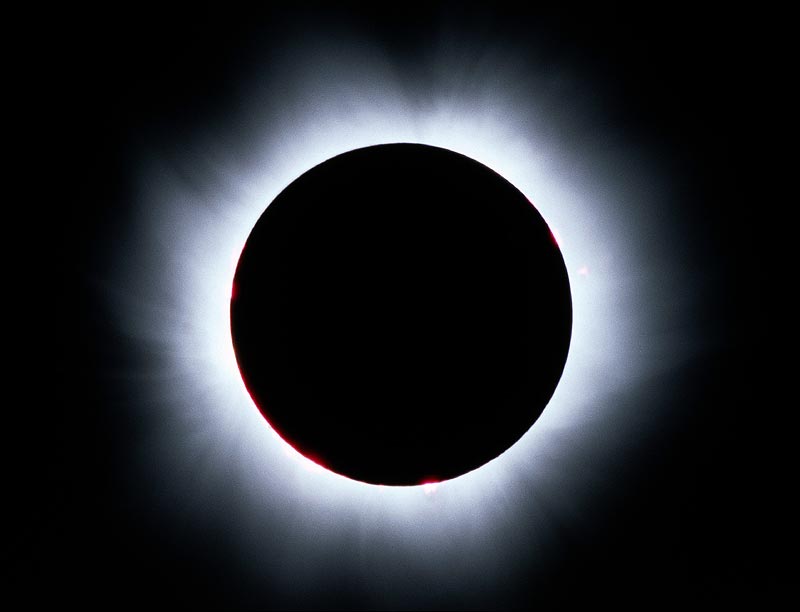
    Sun's Corona
    Photo of the Sun’s corona, obtained during the solar eclipse on August 11, 1999. Credit: Philippe Duhoux – ESO

    However, there is also the optical phenomenon of a corona, caused by the diffraction of light from a bright object — such as the Sun, other stars, the Moon, and bright planets — by water drops or ice crystals in the Earth’s atmosphere. This is occurring in this unusual image, where a rare corona of the planet Jupiter can be seen above the Atacama Desert in Chile. The beautiful red and green colors in the sky are due to atmospheric airglow, another light-related optical phenomenon. Airglow is explained in detail in this ESOcast 78 (video embedded below.)

    This image was taken by Petr Horálek some 100 kilometers (62 miles) south of the Chajnantor Plateau, which is home to the Atacama Large Millimetre/submillimetre Array (ALMA).


    ESO’s La Silla Observatory on a moonless night, deep in the Atacama Desert of Chile. It should be very dark — but strange green and red colors can be seen to shimmer in the sky. What are these mysterious glows? And why do they seem to be getting more frequent? Find out more in this episode.

    Never miss a breakthrough: Join the SciTechDaily newsletter.
    Follow us on Google and Google News.

    Astronomy European Southern Observatory Jupiter
    Share. Facebook Twitter Pinterest LinkedIn Email Reddit

    Related Articles

    New Discovery Reveals the True Composition of Jupiter’s Clouds

    “Meteorological Beast in Our Solar System” – Powerful Stratospheric Winds Measured on Jupiter for the First Time

    ESO Astronomers View a Great Cold Spot on Jupiter

    Quasar 3C 279 Shown in Unprecedented Sharpness

    Scientists Detect Dark Galaxies for the First Time

    Gas Cloud Headed Towards Milky Way’s Supermassive Black Hole

    Study Finds a Mixture of Both Deep and Shallow Heating on Io

    No Evidence of Dark Matter Around the Sun

    Astronomers Combine Hundreds of Images of Carina Nebula to Reveal Thousands of Stars in Stellar Nursery

    Leave A Reply Cancel Reply

    • Facebook
    • Twitter
    • Pinterest
    • YouTube

    Don't Miss a Discovery

    Subscribe for the Latest in Science & Tech!

    Trending News

    This Copper Drug Clears Alzheimer’s Brain Toxins and Boosts Memory

    Adults Over 65 Lost Massive Amounts of Weight With Ozempic

    How Flocking Birds “Defy” One of Physics’ Most Fundamental Laws

    Physicists Create a New Kind of Schrödinger’s Cat State From Exotic Quantum Building Blocks

    Your Diet Could Be Missing the Key Ingredient for Heart Protection

    Researchers Warn Widely Prescribed Blood Pressure Drugs Could Be Harming Diabetic Kidneys

    James Webb Spots Something Strange Between Day and Night on an Alien Planet

    How Ancient People Moved a 6-Ton Stone 700 Kilometers to Stonehenge

    Follow SciTechDaily
    • Facebook
    • Twitter
    • YouTube
    • Pinterest
    • Newsletter
    • RSS
    SciTech News
    • Biology News
    • Chemistry News
    • Earth News
    • Health News
    • Physics News
    • Science News
    • Space News
    • Technology News
    Recent Posts
    • 2,000-Year-Old Grape Seeds Rewrite the History of Italian Wine
    • Why You Flinch When Someone Else Gets Hurt
    • This Deadly Disease Was Wiping Out Humans 5,500 Years Ago
    • Scientists Uncover Cause of Inflammatory Bowel Disease Solving Decades-Old Mystery
    • The Surprising Reason Swimming Could Be Better for Your Heart Than Running
    Copyright © 1998 - 2026 SciTechDaily. All Rights Reserved.
    • Science News
    • About
    • Contact
    • Editorial Board
    • Privacy Policy
    • Terms of Use

    Type above and press Enter to search. Press Esc to cancel.