
Close Menu
    Facebook X (Twitter) Instagram
    SciTechDaily
    • Biology
    • Chemistry
    • Earth
    • Health
    • Physics
    • Science
    • Space
    • Technology
    Facebook X (Twitter) Pinterest YouTube RSS
    SciTechDaily
    Home»Biology»Researchers Discover Molecular Key to How Cancer Spreads
    Biology

    Researchers Discover Molecular Key to How Cancer Spreads

    By William Weir, Yale UniversityJune 26, 20191 Comment3 Mins Read
    Facebook Twitter Pinterest Telegram LinkedIn WhatsApp Email Reddit
    Share
    Facebook Twitter LinkedIn Pinterest Telegram Email Reddit
    Researchers Discover Molecular Key to How Cancer Spreads
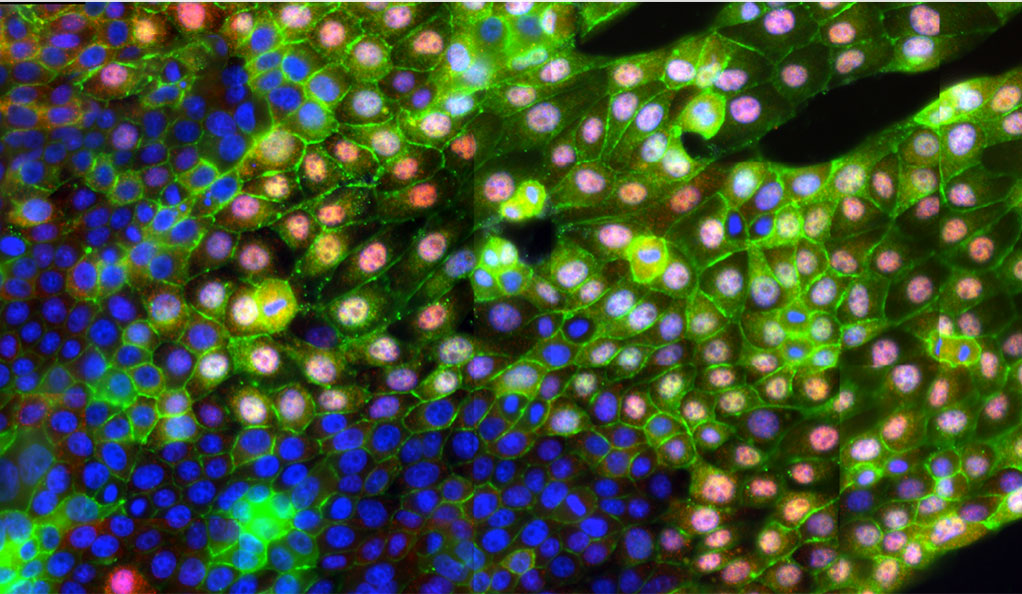
    Normal or cancer cells can initiate EMT, a process that sets them in motion, on aligned matrix fibers, changing the activity of many molecules, similar to a switch. Shown are YAP (red), beta-catenin (green), and cell nuclei (blue). (Image courtesy of the Levchenko lab)

    Yale researchers have discovered how metastasis, the spread of cancer cells throughout the body, is triggered on the molecular level, and have developed a tool with the potential to detect those triggers in patients with certain cancers. The discovery could lead to new ways of treating cancer.

    The study was led by Andre Levchenko, the John C. Malone Professor of Biomedical Engineering and director of the Yale Systems Biology Institute at Yale’s West Campus. It was published on June 26 in the journal Nature Communications. Levchenko is a member of the Yale Cancer Center.

    One way metastasis occurs is through epithelial-mesenchymal transition (EMT), a process that breaks neighboring cells apart from each other and sets them in motion. It’s been long assumed that chemical signals or genetic changes in the cells trigger EMT. But Levchenko’s research team found that it could be caused by a simple change in the texture of the extracellular matrix (ECM), which acts as a scaffold for cells. They discovered that an alignment of the matrix’s fibers (a common biological occurrence) can trigger the EMT process without other stimuli.

    “It became clear that in some cancers before the cells move away from the tumor and spread, there’s a change in the environment,” Levchenko said. “When these fibers in the matrix align, they create tracks in which the cells move, and we found how it is controlled by complex molecular networks.”

    With a method they devised that mimics the cell environment, the researchers explored the EMT process at the molecular level and discovered two separate feedback mechanisms ­— that is, two or more molecules inhabiting or activating each other. One connected the protein known as YAP to the gene regulator WT1, causing cells to break from each other. The other connected YAP to the protein TRIO, triggering the cells into motion and even increasing their speed.

    Combining experimental analysis and clinical data, the researchers confirmed that this mechanism is active in kidney cancers.

    “This information can potentially be used to develop new prognostic tests and pave the way for more personalized clinical interventions,” said Levchenko.

    The discovery could also lead to new treatments for cancer by targeting the molecules with drugs and other means to discourage the cells from undergoing the EMT process, he said. “That would be a very big deal because most of the fatal outcomes we see in cancer are due to metastasis, and therefore, often the EMT process.”

    This study looked specifically at renal cancer, but Levchenko said they have evidence that the same mechanisms control the invasive spread of cells in other cancers, such as glioblastoma.

    Reference: “Switch-like enhancement of epithelial-mesenchymal transition by YAP through feedback regulation of WT1 and Rho-family GTPases” by by JinSeok Park, Deok-Ho Kim, Sagar R. Shah, Hong-Nam Kim, Kshitiz, Peter Kim, Alfredo Quiñones-Hinojosa and Andre Levchenko, 26 June 2019, Nature Communications.
    DOI: 10.1038/s41467-019-10729-5

    Never miss a breakthrough: Join the SciTechDaily newsletter.
    Follow us on Google and Google News.

    Cancer Yale University
    Share. Facebook Twitter Pinterest LinkedIn Email Reddit

    Related Articles

    Yale Develops a Faster and Less Expensive Way to Analyze Gene Activity

    Scientists Uncover a Pathway for Silencing Tumor Suppressor Genes

    New Genome Analysis Reveals Dozens of Cancer Triggers

    Cancer Scientists Prove Long-Standing Theory on How Cancer Spreads

    Combination of Immune Stimulating Antibodies Shows Promising Results Against Advanced Melanoma

    DNA Sequencing Technologies Help Characterized the Mutational Landscape of Melanoma

    Nanoparticles Stop Lymphoma in Mice

    A Potential Therapeutic Target for Treating Pulmonary Fibrosis

    Immune System May Trigger Melanoma Growth

    1 Comment

    1. Raymond Rowlands on June 27, 2019 12:29 am

      Thats fantastic news

      Reply
    Leave A Reply Cancel Reply

    • Facebook
    • Twitter
    • Pinterest
    • YouTube

    Don't Miss a Discovery

    Subscribe for the Latest in Science & Tech!

    Trending News

    The Universe Is Expanding Too Fast and Scientists Can’t Explain Why

    “Like Liquid Metal”: Scientists Create Strange Shape-Shifting Material

    Early Warning Signals of Esophageal Cancer May Be Hiding in Plain Sight

    Common Blood Pressure Drug Shows Surprising Power Against Deadly Antibiotic-Resistant Superbug

    Scientists Uncover Dangerous Connection Between Serotonin and Heart Valve Disease

    Scientists Discover a “Protector” Protein That Could Help Reverse Hair Loss

    Bone-Strengthening Discovery Could Reverse Osteoporosis

    Scientists Uncover Hidden Trigger Behind Stem Cell Aging

    Follow SciTechDaily
    • Facebook
    • Twitter
    • YouTube
    • Pinterest
    • Newsletter
    • RSS
    SciTech News
    • Biology News
    • Chemistry News
    • Earth News
    • Health News
    • Physics News
    • Science News
    • Space News
    • Technology News
    Recent Posts
    • The Most Powerful Neutrino Ever Detected May Have a Surprising Cosmic Source
    • Newton’s 300-Year-Old Law Passes Its Biggest Cosmic Test Yet
    • Monster Storms on Jupiter Unleash Lightning Beyond Anything on Earth
    • Scientists Overcome Major Quantum Bottleneck, Potentially Transforming Teleportation and Computing
    • Quantum Physics’ Strangest Problem May Hold the Key to Time Itself
    Copyright © 1998 - 2026 SciTechDaily. All Rights Reserved.
    • Science News
    • About
    • Contact
    • Editorial Board
    • Privacy Policy
    • Terms of Use

    Type above and press Enter to search. Press Esc to cancel.