
Close Menu
    Facebook X (Twitter) Instagram
    SciTechDaily
    • Biology
    • Chemistry
    • Earth
    • Health
    • Physics
    • Science
    • Space
    • Technology
    Facebook X (Twitter) Pinterest YouTube RSS
    SciTechDaily
    Home»Health»Risk for Psychotic Disorders Could Be Detected by Neurological Brain Markers
    Health

    Risk for Psychotic Disorders Could Be Detected by Neurological Brain Markers

    By Eric Stann, University of Missouri-ColumbiaAugust 27, 2019No Comments4 Mins Read
    Facebook Twitter Pinterest Telegram LinkedIn WhatsApp Email Reddit
    Share
    Facebook Twitter LinkedIn Pinterest Telegram Email Reddit
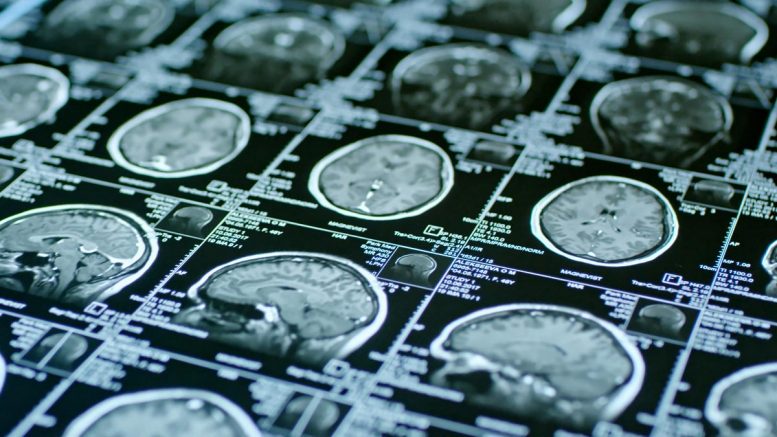
    Examples of MRI scans
    Researchers at the University of Missouri used MRI scans similar to this photo to find neurological markers in the human brain. These markers can be used to detect people at-risk for developing psychotic disorders and to understand when this risk has been successfully treated. Credit: University of Missouri

    Findings from the University of Missouri study could help identify people at-risk.

    Help may be on the way for people who might lose contact with reality through a psychotic disorder, such as schizophrenia.

    People who may hear and see things that are not there could have symptoms of psychosis, better known as psychotic disorders. Now, researchers at the University of Missouri have found neurological markers in the human brain that can be used to detect people at-risk for developing psychotic disorders and to understand when this risk has been successfully treated.

    John Kerns MU
    John Kerns is a professor of psychology in the MU College of Arts and Science. Credit: University of Missouri

    “Psychotic disorders like schizophrenia are often lifelong and disabling for individuals,” said John Kerns, professor of psychology in the MU College of Arts and Science. “These disorders have major public health and societal costs greater than cancer. A major goal of our current research is to understand the nature of psychosis risk so we can prevent years of suffering.”

    Researchers said psychotic disorders are associated with increased levels of dopamine — a chemical released by nerve cells — in a subregion of the brain called the striatum. This area is wired to process positive versus negative feedback for learning, often resulting in a person’s thoughts and actions based on what they’ve experienced in the past. Therefore, researchers suggest that psychotic disorders involve a faulty feedback in learning that then drives a person’s faulty beliefs and perceptions. However, measuring levels of dopamine in people is costly, invasive,  and not feasible in everyday clinical practice. In this new study, MU researchers used an MRI at MU’s Brain Imaging Center and found that people at risk for psychotic disorders exhibit evidence of dysfunction in the striatum.

    “This dysfunction is most evident when performing tasks where people need to learn from positive and negative feedback,” Kerns said. “For instance, we have found that the risk for psychotic disorders involves increased activation in the striatum for positive feedback, and negative feedback involves decreased activation in the same subregion of the brain.”

    Researchers believe this pattern of activation could explain symptoms of psychotic disorders. For example, activation resulting from increased positive feedback could make a person’s assumption seem truer than it really is, meanwhile activation from decreased negative feedback could make someone less likely to discard negative ideas. The team will conduct future research to examine how well an MRI can predict the risk of psychotic disorders and whether prevention treatments can ‘normalize’ MRI scans. They hope that their research will help prevent psychotic disorders, improve the lives of millions of people and greatly reduce public health costs.

    Reference: “Striatum-related functional activation during reward- versus punishment-based learning in psychosis risk” by Nicole R. Karcher, Jessica P. Y. Hua and John G. Kerns, 4 July 2019, Neuropsychopharmacology.
    DOI: 10.1038/s41386-019-0455-z

    Other authors on the study are two former graduate students at MU. Nicole Karcher is now a postdoctoral fellow at the Washington University School of Medicine; and Jessica Hua is currently on a predoctoral clinical fellowship at the Veterans Affairs Medical Center in San Francisco. Funding was provided by MU research funds. The content is solely the responsibility of the authors and does not necessarily represent the official views of the funding agencies.

    Never miss a breakthrough: Join the SciTechDaily newsletter.
    Follow us on Google and Google News.

    MRI Neuroscience Psychology Schizophrenia University of Missouri-Columbia
    Share. Facebook Twitter Pinterest LinkedIn Email Reddit

    Related Articles

    Research Reveals Drug Targets for Memory Enhancement – Treatments for Alzheimer’s, Schizophrenia and More

    Study Shows “Harsh Parenting” May Lead to Smaller Brains

    Some Brain Disorders – Such As Autism and Schizophrenia – Exhibit Similar Circuit Malfunctions

    Schizophrenia: Brain Capillary Structures Show a Correlation With Their Neuron Structures

    Study Shows MRI Detects Early Signs of Schizophrenia

    Study Shows Hypertension Medication May Help Smokers Quit

    Noninvasive Arterial Spin Labeling MRI Detects Evidence of Cognitive Decline Before Symptoms Appear

    Psychology and Public Health Experts Claim Regular Marijuana Use Bad for Teens’ Brains

    ‘Healthy Neuroticism’ Lowers Risk of Chronic Disease

    Leave A Reply Cancel Reply

    • Facebook
    • Twitter
    • Pinterest
    • YouTube

    Don't Miss a Discovery

    Subscribe for the Latest in Science & Tech!

    Trending News

    JWST Finds a “Star” 100 Billion Times Brighter Than Any Star Should Be

    Scientists Find a Hidden Biological Link Across Different Forms of Autism

    Astronomers Discover a Ghostly River of Stars That Could Reveal Dark Matter

    Why Is Colorectal Cancer Rising in People Under 50? New Clues Point to the Environment

    Quantum Fluctuations Break a Crystal’s Symmetry Rules

    Why Does an Irregular Heartbeat Strike 40 Years Early in Some People?

    Scientists Reveal How ADHD Could Fuel Creative Thinking

    Scientists Find Just 3 Minutes of Sprinting Can Transform Blood Chemistry

    Follow SciTechDaily
    • Facebook
    • Twitter
    • YouTube
    • Pinterest
    • Newsletter
    • RSS
    SciTech News
    • Biology News
    • Chemistry News
    • Earth News
    • Health News
    • Physics News
    • Science News
    • Space News
    • Technology News
    Recent Posts
    • A Vast Clean Energy Source May Be Hiding Beneath Australia’s Red Soil
    • Scientists Uncover Signs of an Ancient Climate “Tipping Point”
    • Cleaner Cars May Be Hiding a New Pollution Problem
    • Common Plant Chemical Linked to Widespread Organ Damage in Aquatic Animals
    • Scientists Discover a Hidden Baobab Species in Madagascar
    Copyright © 1998 - 2026 SciTechDaily. All Rights Reserved.
    • Science News
    • About
    • Contact
    • Editorial Board
    • Privacy Policy
    • Terms of Use

    Type above and press Enter to search. Press Esc to cancel.