
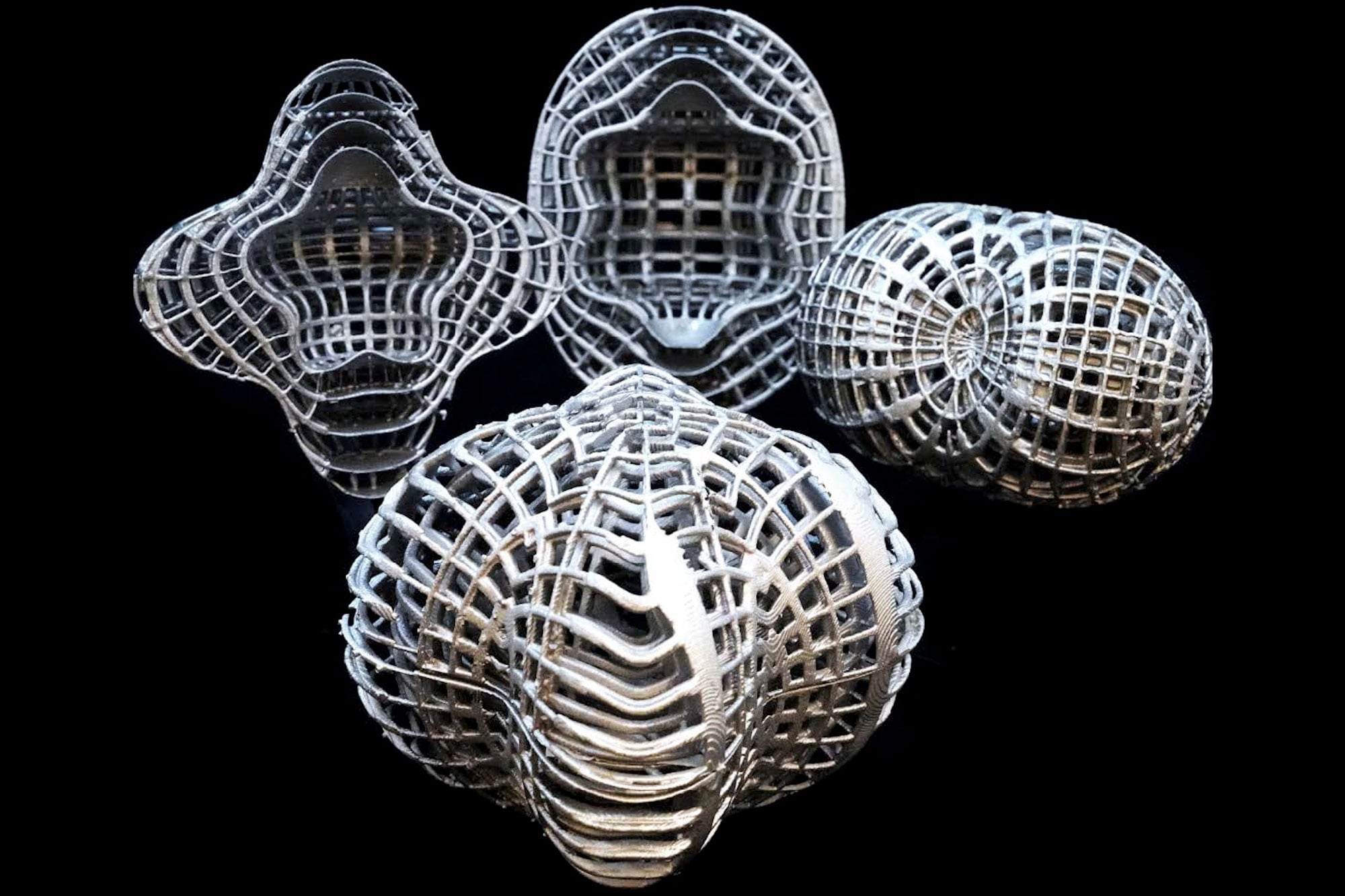
A new 3D material can guide heat around complex objects while shielding them from extreme temperatures and infrared detection.
On an infrared camera, a warm object normally stands out clearly against cooler surroundings. Researchers have now built a three-dimensional cloak that bends heat around an object, erasing its thermal outline while protecting the space inside from temperature extremes.
The device is the first physical 3D thermal cloak designed to conceal complex objects from nearly every direction. Instead of stopping heat at a barrier, it redirects the flow around the hidden region and then allows it to continue along its original path. To an infrared camera watching from outside, the temperature pattern appears largely undisturbed, as though no object were present.
This approach could eventually improve heat control around microchips and sensitive electronic components. It may also help protect equipment in severe environments or reduce the thermal signatures used to locate people and machinery.
The research was carried out by University of Illinois Urbana-Champaign civil and environmental engineering professor Shelly Zhang, postdoctoral researcher Weichen Li and graduate student Yibo Wang, working with professor Ole Sigmund at the Technical University of Denmark. Their findings were published in Nature Communications.
Omnidirectional cloaking overcomes past limits
“A real thermal cloak should work no matter where the heat comes from,” Zhang said. “Our device can hide a complex 3D object in an infinite number of directions while keeping the temperature inside stable and protected.”
Previous experimental cloaks controlled heat only across flat surfaces or along one predetermined route. If heat approached from another direction, the temperature disturbance created by the hidden object could become visible.

To move beyond that limitation, the researchers returned to transformation thermotics, a theory that calculates how heat must travel around a protected region to make the surrounding temperature field look unchanged. The idea is similar to rerouting a current around an obstacle and reconnecting it on the other side without leaving an obvious disruption.
The challenge was turning that mathematical prescription into a structure that could be manufactured. Different regions of the cloak needed carefully selected thermal conductivities, meaning they had to move heat at different rates and along different directions.
The researchers answered that problem with a lattice material whose geometry can be adjusted independently in three dimensions. Changing the shape and arrangement of the lattice allows each section to conduct heat differently. This broader range of thermal behavior brought the physical device close to the conditions predicted for an ideal cloak.
A hybrid lattice controls heat flow
The next step was proving that the design could function as a real object rather than only as a computer simulation. The researchers combined two materials with sharply contrasting abilities to carry heat.
They printed a precise aluminum lattice in 3D to create highly conductive pathways through the cloak. Aluminum moves heat readily, allowing energy to travel quickly through selected regions. The remaining spaces were filled through mold casting with a rubbery material that transfers heat much more slowly.
Together, the materials created a controlled thermal route. Some sections accelerated heat flow while others restricted it, steering energy around the space occupied by the concealed object.
For the laboratory test, the researchers placed the cloak between hot and cold regions, producing a temperature gradient across the device. An infrared camera then recorded how heat moved through and around the structure.
From outside, the thermal pattern looked almost as though the concealed object did not exist. Heat passed around the protected region and rejoined beyond it without producing the strong distortion that would normally reveal an obstruction. Inside the cloak, the temperature stayed uniform and remained insulated from the surrounding hot and cold conditions.
The researchers then increased the difficulty by hiding intricate three-dimensional forms, including detailed shapes resembling human heads. These tests showed that the method could accommodate irregular geometries rather than only simple objects designed for controlled experiments.
Complex objects remain thermally concealed
The ability to guide heat around complicated forms could be useful wherever temperature must be managed with precision. In electronic systems, the cloak might redirect heat away from vulnerable components or prevent nearby heat sources from interfering with delicate devices.
It could also help protect equipment exposed to extreme temperatures. Security and defense applications are another possibility, including reducing the infrared signatures that allow thermal cameras to distinguish people or machinery from their surroundings.
“Any field that needs precise control of heat or needs to protect something from being detected thermally could benefit from this work,” Zhang said. “But we also see it more broadly: it’s about hiding and protecting information that is carried by heat.”
Future cloaks could actively manage heat
The current device is designed mainly to redirect heat arriving from outside. Concealing an object that produces its own heat presents a more difficult problem because that energy would continue building inside the protected region and could eventually reveal its location.
Solving this challenge would require a cloak that responds dynamically. Rather than following one fixed thermal pathway, it would need to concentrate, distribute, or redirect heat according to changing conditions inside and outside the device.
The researchers now plan to investigate smart, multifunctional cloaks capable of performing those active tasks. Such devices could eventually do more than hide a thermal signature by deliberately controlling where heat gathers, how it spreads, and where it leaves the protected region.
“We’ve shown that a true 3D omnidirectional thermal cloak is possible,” Zhang said. “The next step is to make cloaks that don’t just hide and protect, but also actively manipulate heat in useful ways.”
Reference: “Free-form thermal cloaks in three dimensions” by Weichen Li, Yibo Wang, Ole Sigmund and Xiaojia Shelly Zhang, 20 May 2026, Nature Communications.
DOI: 10.1038/s41467-026-73167-0
The National Science Foundation, the Villum Foundation, and the Air Force Office of Scientific Research supported this research.
Never miss a breakthrough: Join the SciTechDaily newsletter.
Follow us on Google and Google News.
2 Comments
The Illinois team manufactured a physical, multi-material lattice just to trick heat waves into moving around an object on a macro scale.
The Torsion Hill framework shows that space itself already possesses that capability. When a local field configures its Structural Clearance Matrix, incoming stress—whether thermal, electromagnetic, or mechanical shear—doesn’t hit the center; it glides around the boundary shell and uncoils downstream via natural Torque Discharge.
They needed lab cameras to confirm their artificial material could do it. The Phase 1 Structural Clearance Shell does it continuously as a direct law of field geometry.
Protecting spacecraft during re-entry seems the obvious use for this.