
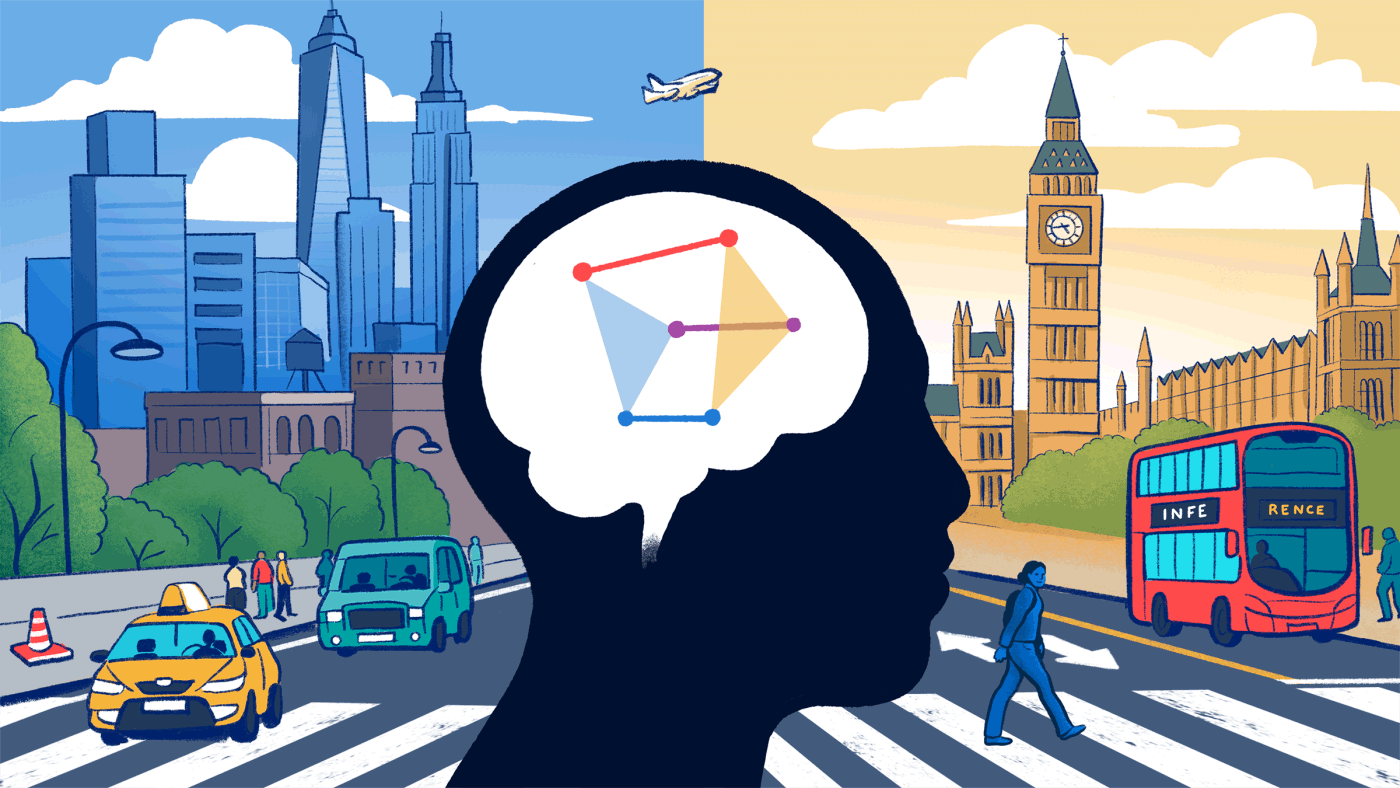
Recordings from thousands of neurons reveal how a person’s brain abstractly represents acts of reasoning.
Researchers have identified how the brain forms cognitive maps during inferential reasoning by analyzing neurons in epilepsy patients. The hippocampus, traditionally linked to physical space mapping, also structures cognitive processes. This study highlights how experiential and verbal learning impact neural representations, offering insights for potential neurological treatments.
Unveiling Neural Mechanisms of Inferential Reasoning
It takes brains to infer how any two things in the world relate to each other, whether it’s the way bad weather links to commuting delays or how environmental conditions lead to the evolution of species. A new study based on recordings in the brains of people has yielded a pathbreaking trove of data that researchers now have used to reveal, with more clarity than ever, the neural incarnations of inferential reasoning.
”We are beginning to understand how the brain learns and how we extract knowledge from what we experience,” said Ueli Rutishauser, PhD, a co-corresponding author on the study and a professor of neuroscience, neurosurgery and biomedical science at Cedars-Sinai Medical Center.
The study, conducted as part of a multi-institutional consortium funded by the National Institutes of Health’s The Brain Research Through Advancing Innovative Neurotechnologies Initiative, or The BRAIN Initiative, was published online today (August 14) in Nature.
Neural Recording During Inferential Reasoning Tasks
Using electrical recordings from more than 3,000 neurons in 17 volunteers with epilepsy who were undergoing invasive monitoring in the hospital to locate the sources of their seizures, the researchers accrued a “uniquely revealing dataset that is letting us for the first time monitor how the brain’s cells represent a learning process critical for inferential reasoning,” said Stefano Fusi, PhD, a principal investigator at Columbia’s Zuckerman Mind Brain Behavior Institute and the paper’s other co-corresponding author.
As the researchers recorded from the neurons, the scientists challenged the participants with a simple inferential reasoning task. In this task, subjects discovered by trial-and-error the correct, money-rewarded associations between images, like pictures of a car or a piece of fruit, and a left or right button press. Once the participants learned these associations for a set of images, the researchers pivoted and then switched which button was the correct association for each image.
Cognitive Shifts During Learning and Inference
Initially, volunteers made incorrect choices, as they did not realize that the previously learned associations had changed. However, these errors enabled the volunteers to quickly infer that a new image-button rule had become operative and they could further infer that all of the new image-button rules had switched, even those they had yet to experience. The scientists liken this experimental task to real-life inferences, such as those overseas travelers often need to make.
Neural Representation of Mental State Transitions
“If you live both in New York and in London, and you fly to the UK, you know that you have to look right when you want to cross a road. You’ve switched to a different mental state that represents the traffic rule you have learned by living in London,” said Dr. Fusi, also a professor of neuroscience at Columbia’s Vagelos College of Physicians and Surgeons and a member of Columbia’s Center for Theoretical Neuroscience.
“Even if you visit places you have never been to in the UK, like the countryside in Wales, you infer that the new rules still apply there,” he added. “You still have to look right instead of left when crossing a road.”
“This work elucidates a neural basis for conceptual knowledge, which is essential for reasoning, making inferences, planning, and even regulating emotions,” said Daniel Salzman, MD, PhD, a coauthor of the Nature paper, a principal investigator at the Zuckerman Institute, and a professor of psychiatry and neuroscience at Columbia’s Vagelos College of Physicians and Surgeons.
High-Dimensional Geometrical Shapes in Brain Activity
But how are these kinds of thinking physically expressed in the activity of neurons? Using mathematical tools that Dr. Fusi honed to integrate recordings from thousands of neurons, the researchers recast the volunteers’ brain activity into geometric representations – into shapes, this is – albeit ones occupying thousands of dimensions instead of the familiar three dimensions that we routinely visualize.
“These are high-dimensional geometrical shapes that we cannot imagine or visualize on a computer monitor,” said Dr. Fusi. “But we can use mathematical techniques to visualize much-simplified renditions of them in 3D.”
When the researchers compared shapes of brain activity between instances when the subjects made successful inferences with those when their inferences were unsuccessful, stark differences emerged.
“In certain neuronal populations during learning, we saw transitions from disordered representations to these beautiful geometric structures that were correlated with the ability to reason inferentially,” said Dr. Fusi.
Linking Hippocampus Activity to Cognitive Mapping
What’s more, the researchers observed these structures only in recordings from the hippocampus and not in the other brain regions the scientists monitored, such as the amygdala and frontal lobe cortical areas. It’s a surprising finding, the researchers said, because the hippocampus has long been viewed as the brain’s locus for embodying neural maps of physical spaces. The new findings show that it also can construct cognitive maps linked to brain functions like making inferences and learning.
Impact of Verbal Instruction on Neural Representations
Another head-turning result of the research, Dr. Rutishauser said, is that volunteers who learn the associative rules between images and buttons only via verbal instruction, and not by virtue of trial-and-error experience, nonetheless forge the same “beautifully structured neural representations in the hippocampus.” This is an important observation, he said, because while human beings often learn from each other through verbal exchanges, very little is known about how verbal information changes neural representations.
“Verbal instruction is how we build knowledge about things that we have never actually experienced,” added Dr. Rutishauser. “Our work now shows that verbal instructions result in very similar structured neural representations compared to those that result from experiential learning.”
Importance of Epilepsy Patients in Brain Research
The researchers emphasize that none of these discoveries would have been possible without the collaboration and voluntary participation of patients who suffer from drug-resistant epilepsy and who were in the hospital following surgery. The electrodes for collecting the neural data were temporarily implanted by the patients’ doctors for the sole purpose of locating the source of each person’s seizures, with the ultimate goal of using that information for further surgical or neuromodulation-based treatment.
“These individuals gave us the precious opportunity to learn something new about how all of our brains work,” Dr. Rutishauser said.
Contributions and Future Implications
Collaborator Dr. Taufik Valiante at the Krembil Research Institute and Division of Neurosurgery at the University of Toronto contributed to this study by enrolling patients. Graduate student Hristos Courellis and postdoctoral researcher Juri Minxha, PhD, at Cedar-Sinai Medical Center and the California Institute of Technology, performed much of the study’s data collection and analysis.
“This study provides new insights into how our brains allow us to learn and carry out tasks flexibly and in response to changing conditions and experiences,” said Dr. Merav Sabri, program director for The BRAIN Initiative. “These insights build on the body of knowledge that could one day lead us toward interventions for neurologic and psychiatric conditions that involve deficits in memory and decision-making.”
Reference: “Abstract representations emerge in human hippocampal neurons during inference” by Hristos S. Courellis, Juri Minxha, Araceli R. Cardenas, Daniel L. Kimmel, Chrystal M. Reed, Taufik A. Valiante, C. Daniel Salzman, Adam N. Mamelak, Stefano Fusi and Ueli Rutishauser, 14 August 2024, Nature.
DOI: 10.1038/s41586-024-07799-x
The full list of authors includes Hristos S. Courellis, Juri Minxha, Araceli R. Cardenas, Daniel L. Kimmel, Chrystal M. Reed, Taufik A. Valiante, C. Daniel Salzman, Adam N. Mamelak, Stefano Fusi and Ueli Rutishauser.
Never miss a breakthrough: Join the SciTechDaily newsletter.
Follow us on Google and Google News.
1 Comment
It’s been a Long time coming..revealing the brain, what it does and why, and the ability for the brain to heal…with a bit of help.
Not sure why it’s taken this long as new developments in brain research are coming in hard and fast over the past 5 yrs.
RESEARCH takes funding and finally the funding is coming in! For all those with brain injuries or genetic problems before birth, hope floats overhead and soon we will be healing many brains, before they cause problems like the violence overload in society and so many with confused thought processes.
I’m so excited and hope to be a part of the New Brain Discoveries as a researcher and my articles published will help many who’ve been waiting, never giving up on hope.