
A new study shows that the cerebral cortex predicts the future by detecting novel stimuli and forming short-term memory traces called “echoes.” This mechanism, confirmed through neural network modeling, plays a key role in perception and learning.
The cerebral cortex is the largest part of a mammal’s brain and plays a crucial role in various cognitive functions. In humans, it is responsible for perception, thought, memory storage, and decision-making. One hypothesis suggests that the cortex’s primary function is to predict future events by processing new sensory information and comparing it to prior expectations.
A newly published study in Neuron provides significant evidence supporting this hypothesis. The research, led by Yuriy Shymkiv, a postdoctoral fellow in Professor Rafael Yuste’s lab, marks a major step forward in understanding the predictive role of the cortex.
“We found that the cortex acts like a memory machine, encoding new experiences, and predicting the very near future,” Shymkiv said.
“This study gives a great deal of insight into the role of the cerebral cortex, and into diseases like schizophrenia where the cortex seems to be malfunctioning,” Yuste said, noting that it also helps clarify important processes in the normal brain. “Novelty is the difference between what you predicted will happen and what actually occurred. This research shows that the cerebral cortex is continuously detecting novel stimuli, in order to change and improve its predictions of the future. Novelty detection is a critical function for humans and other animals.”
How the Brain Responds to Novelty
The team began their research by designing a study to identify how mice responded to a mix of familiar and new sensory stimuli. The stimuli in the experiment were sounds played at different pitches. After imaging the auditory cortex of mice, a part of the cerebral cortex that processes sound, they found that groups of neurons responded not only to what sound was played, but also how novel it was.
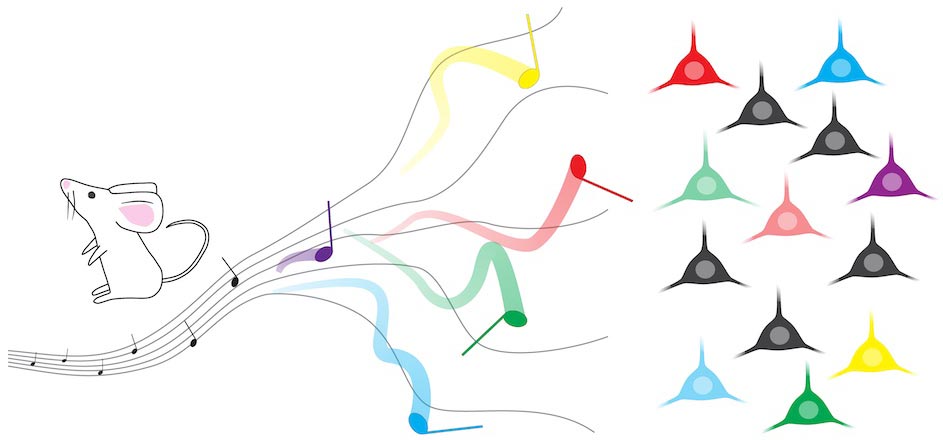
Intriguingly, they found that each sound left a trail of neuronal activity, which they refer to as an “echo,” which tracked sensory inputs over time, and formed short-term memories of recent inputs. These activity echoes not only made sure that every incoming stimulus led to a unique response, but also served to select stimuli that are new, resulting in those responses becoming much stronger.
Modeling the Brain’s Prediction Abilities
To deepen their understanding of these findings, the team built a neural network model of the auditory cortex and trained it to detect stimuli that are new. It replicated what that they had seen in mice, showing that networks of neurons also used activity “echoes” to store a model of the environment, and used it to detect change. They concluded that the way the cortex is wired, with loops of connected neurons, makes novelty detection an automatic emergent property of the network.
“This is a leap forward in understanding how the brain does such a good job of detecting novelty,” said Yuste, noting that the model that Shymkiv created builds on the ideas of John Hopfield, who won the Nobel Prize last year for building neural network models and pioneering artificial intelligence.
The research also offers new insight on the primary role that the cerebral cortex plays in schizophrenia. Clinicians have known for many years that people with schizophrenia are not adept at distinguishing new information from old information. Scientists tried to account for those findings by interpreting the behavior of individual neurons but ended up running into difficulties. One of this paper’s primary insights is its discovery that novelty detection isn’t the work of single neurons but of neural networks.
“We’re very excited that these findings can deepen our understanding of this crucial part of the brain and also potentially offer important insight into cases where those functions go wrong– and ways to fix it,” Yuste said.
Reference: “Slow cortical dynamics generate context processing and novelty detection” by Yuriy Shymkiv, Jordan P. Hamm, Sean Escola and Rafael Yuste, 10 February 2025, Neuron.
DOI: 10.1016/j.neuron.2025.01.011
Funding: National Institute of Neurological Disorders and Stroke, National Eye Institute, National Institute of Mental Health,
Never miss a breakthrough: Join the SciTechDaily newsletter.
Follow us on Google and Google News.
2 Comments
Interesting article I will make this short though when parents change sexs on there children do they understand they are undermining the force that brought them together & future of this child has been signaled into a diverse group that hardly exists & only in certain areas which is like a ant hill only?? Oh my what ever happen ??
Certainly complications certainly worse then learning of cancer or some other rare disease. Personal if they are concerned about what is between the legs & suggest the parent has procedure done first!! Then they will really have a coffee club.. year pass to a zoo works quite well!! Relocate the family to a area of survival is needed at any expense-! Same for Doctors
Totally fiction & I best not be or family be Footing these procedures.. wrung necks!!
Cosmopolitan krazy
Prediction is based to action potential spike trains compairing to memory bit string in microtubules. Memory bit is saved when MT is polymerized at 650Hz frequency. If only hundred bit fit the MT relax and play qualia as Bose Einstein condensate of total memory bit string.