

A new AI-driven model exposes how complex magnetic domain patterns shape energy loss in electric motors.
The rapid rise in electric vehicle use has brought new attention to a key challenge: how efficiently electric motors convert energy. One major source of energy loss in these motors is iron loss, also called magnetic hysteresis loss. This occurs when magnetic fields repeatedly flip direction inside the motor core, which is made of soft magnetic materials.
These motors also operate under high temperatures, where heat can partially weaken magnetization and make energy losses harder to control. At the same time, the arrangement of magnetic domains (tiny magnetic regions) within these materials plays a major role in determining their behavior, including how they respond to heat and how much energy they lose.
Magnetic domains can take on a wide range of structures. In certain soft magnetic materials, they form complex zig-zag patterns known as maze domains. These patterns change in complicated ways as temperature shifts, and those changes can strongly influence energy loss.
However, studying these structures is difficult. Existing models struggle to capture the full picture because many factors are involved, including the material’s internal structure, thermal effects, and overall energy stability.
A New Modeling Approach
To overcome these challenges, a team led by Professor Masato Kotsugi and Dr. Ken Masuzawa from the Tokyo University of Science worked with researchers from the University of Tsukuba, Okayama University, and Kyoto University. They developed a new model called the entropy-feature-eXtended Ginzburg-Landau (eX-GL) framework.
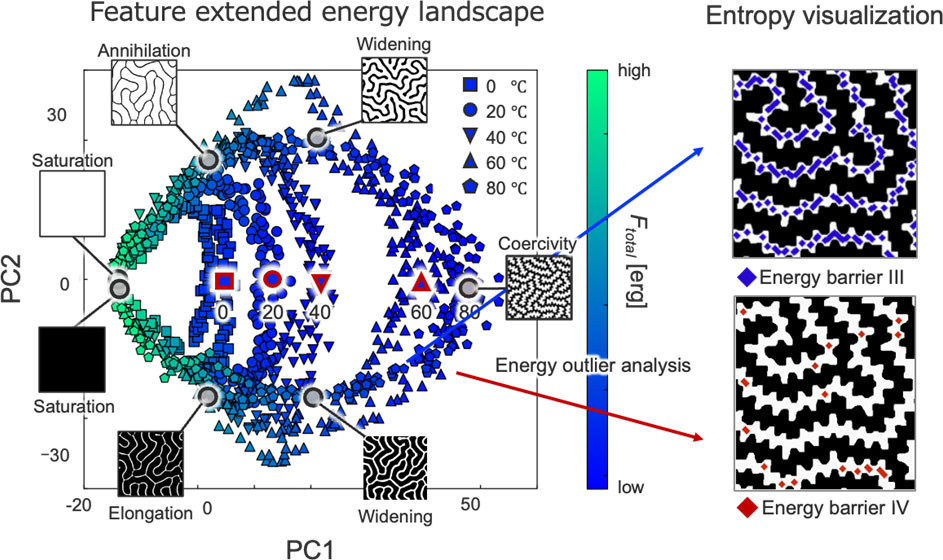
The researchers used this model to explore the energy landscape of maze domains in a rare-earth iron garnet (RIG). “Conventional simulations oversimplify real materials, while experiments reveal complexity without a clear way to quantify cause and effect,” explains Prof. Kotsugi. “Our physics-based explainable artificial intelligence framework addresses these limitations and is designed to mechanistically explain temperature-dependent magnetization reversal process.”
Their findings were published in Scientific Reports.
From Images to Energy Landscapes
To study how magnetization changes with temperature, the team captured microscopic images of magnetic domains in the RIG sample at different temperatures. These images served as input for the eX-GL model.
The process begins with persistent homology (PH), a method that detects patterns in complex data, to identify structural variations in the domain images. Machine learning is then used to highlight the most important features in this data. This information is used to build a digital free energy landscape that tracks how domain structures evolve as energy changes.
Finally, mathematical analysis connects these microscopic patterns to large-scale magnetization behavior.
Key Findings and Energy Barriers
Using this method, the researchers identified a key feature called PC1 that represents the magnetization reversal process. By linking PC1 to physical properties, they uncovered four major energy barriers that shape how magnetization changes.
A detailed analysis of these barriers showed how different forms of energy interact during the process. The team measured how energy moves between exchange interactions, demagnetizing effects, and entropy.
They also found that longer domain walls lead to more complex maze patterns. This effect is driven by the interaction between entropy and exchange forces. These insights help explain how maze domains behave during magnetization reversal.
“Our eX-GL approach effectively automates the interpretation of complex magnetization reversal processes and enables identification of hidden mechanisms, difficult to discern using conventional methods,” says Prof. Kotsugi. “In addition, since free energy is a universal thermodynamic metric, our model can be extended to other systems with similar characteristics.”
Overall, the study provides a clearer understanding of maze domain behavior and introduces a broader method for studying complex energy landscapes in magnetic and similar physical systems.
Reference: “Explainable analysis of the complex maze magnetic domain structure through extension of the Landau free energy model by adding an entropy feature” by K. Masuzawa, A. L. Foggiatto, S. Kunii, R. Nagaoka, M. Taniwaki, T. Yamazaki, C. Mitsumata, I. Obayashi, Y. Hiraoka and M. Kotsugi, 11 February 2026, Scientific Reports.
DOI: 10.1038/s41598-026-39617-x
This work was supported by a Japan Society for the Promotion of Science (KAKENHI) Grant-in-Aid for Scientific Research (A) (21H04656). This work was partially supported by JST-CREST (Grant No. JPMJCR21O1). C. Mitsumata is supported by Tsukuba Research Center for Energy Materials Science (TREMS), University of Tsukuba.
Never miss a breakthrough: Join the SciTechDaily newsletter.
Follow us on Google and Google News.
1 Comment
thanks