

A new study reveals that dual-atom catalysts behave in a fundamentally different way than scientists previously thought, challenging a long-standing model used to predict catalytic performance.
For decades, scientists have relied on a simple rule of thumb to design better catalysts: there is one “sweet spot” where performance peaks. But new research suggests that assumption may not hold for a promising class of materials that could help lower the cost of hydrogen fuel cells.
Researchers at Tohoku University have uncovered a new catalyst design principle that explains why dual-atom catalysts often outperform their single-atom counterparts. By revealing a previously unknown pattern called “dual-Sabatier optima,” the study challenges a long-standing framework in catalyst science and could accelerate the search for cheaper, more efficient materials for clean energy technologies.
Fuel cells are considered a promising tool for creating a low-carbon society because they can produce electricity from hydrogen with clean emissions. Yet many still depend on costly precious metals, including platinum, to power the oxygen reduction reaction (ORR), a key process that affects both performance and cost.
Scientists have been studying atomically dispersed catalysts as a possible replacement. Single-atom catalysts use individual metal atoms, while dual-atom catalysts (DACs) rely on pairs of atoms that work together. Although experiments have often found that DACs perform better than single-atom catalysts, the reason has remained unclear.
Why Dual-Atom Catalysts Outperform
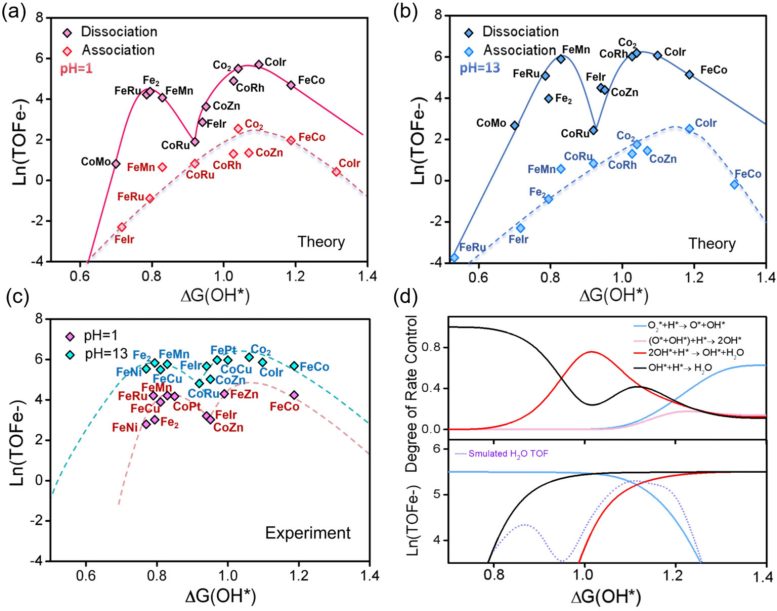
Catalyst activity has traditionally been explained using a “single-peak volcano” model. This model suggests that the best catalysts fall within a narrow range of chemical properties. But when the researchers examined large experimental datasets from the Digital Catalysis Platform (DigCat), they found that DACs did not follow this expected pattern.
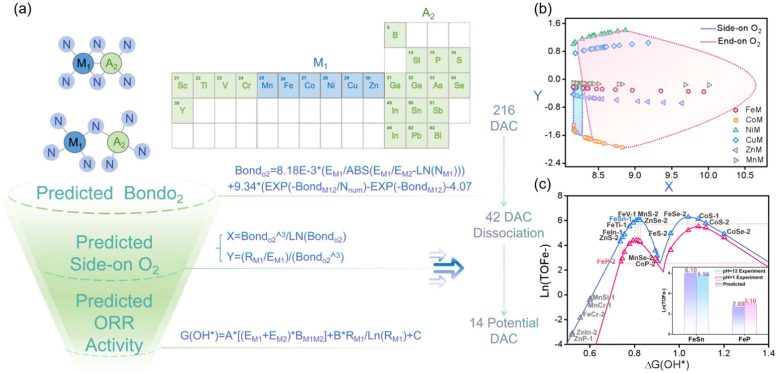
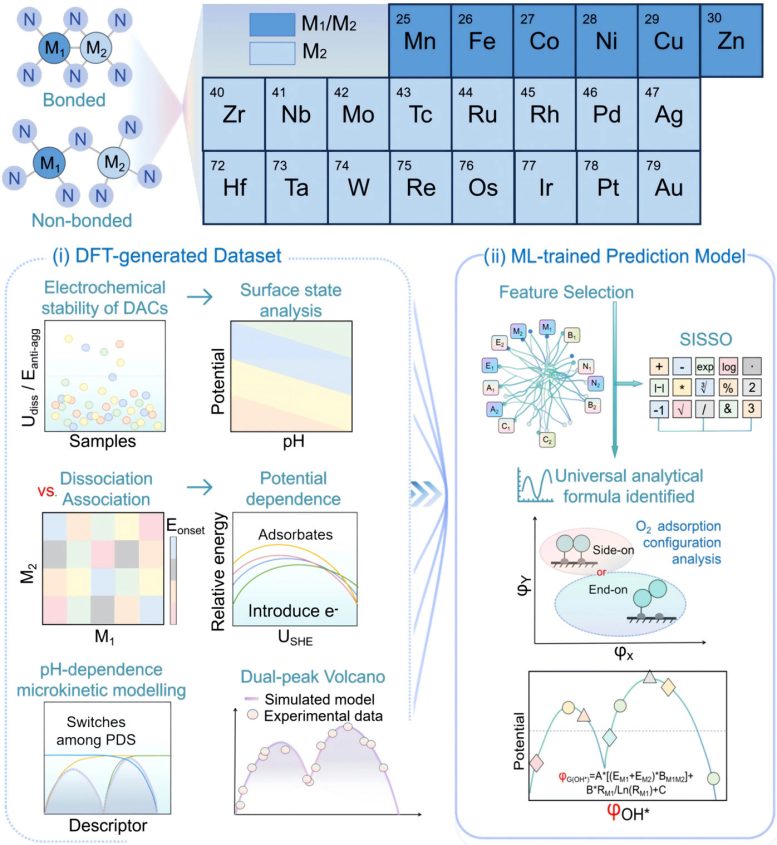
The team then studied more than 200 dual-atom catalysts using advanced theoretical simulations, microkinetic modeling, and machine learning. The results showed that DACs are mainly controlled by a reaction pathway called the dissociative mechanism, rather than the associative mechanism usually seen in single-atom catalysts.
This change has a major effect on how catalyst activity appears. Rather than having one best performance peak, DACs showed two separate optimal regions, which the researchers call “dual-Sabatier optima.” These two peaks form because the rate-limiting step shifts during the reaction, moving among oxygen dissociation, oxygen protonation, and hydroxyl protonation.
Discovery of the Dual-Sabatier Optima
The researchers found that this principle applies across many catalyst types, including systems made with transition metals, metal-like elements, and even non-metal atoms. By combining interpretable machine learning with theoretical modeling, they built a predictive framework that can quickly and accurately identify promising catalyst structures.
“This discovery changes the way we think about catalyst design,” said Hao Li, Distinguished Professor at Tohoku University’s Advanced Institute for Materials Research (WPI-AIMR). “For a long time, researchers assumed that dual-atom catalysts followed the same activity rules as single-atom catalysts. Our work shows that entirely different mechanisms can emerge when two atoms cooperate together, opening new opportunities for designing highly efficient materials for clean energy technologies.”
The implications could extend beyond fuel cells. The researchers say the findings may also guide the development of catalysts for other energy conversion and chemical production processes. The work also shows how artificial intelligence can reveal hidden scientific rules in existing experimental data, helping speed up the search for new materials.
Next, the team aims to apply the method to more complex multimetallic catalysts and other energy-related reactions beyond ORR. By combining AI agents, machine learning, and electrochemical simulations in the DigCat platform, they hope to create a fully autonomous digital system for rapidly designing next-generation catalysts for sustainable energy.
Reference: “Dual-Sabatier Optima: How Reaction Mechanism Determines Activity Volcano Map of Dual-Atom Catalysts for Oxygen Reduction Reaction” by Jin Liu, Hao Li, Haoxiang Xu and Daojian Cheng, 27 April 2026, Angewandte Chemie International Edition.
DOI: 10.1002/anie.8386838
Never miss a breakthrough: Join the SciTechDaily newsletter.
Follow us on Google and Google News.