

Close Menu
    Facebook X (Twitter) Instagram
    SciTechDaily
    • Biology
    • Chemistry
    • Earth
    • Health
    • Physics
    • Science
    • Space
    • Technology
    Facebook X (Twitter) Pinterest YouTube RSS
    SciTechDaily
    Home»Technology»SnS Crystals Open Pathway for Improved Next Generation Solar Cells
    Technology

    SnS Crystals Open Pathway for Improved Next Generation Solar Cells

    By Tohoku UniversityAugust 21, 2020No Comments2 Mins Read
    Facebook Twitter Pinterest Telegram LinkedIn WhatsApp Email Reddit
    Share
    Facebook Twitter LinkedIn Pinterest Telegram Email Reddit
    Next Generation Solar Cell Concept
    SnS, or tin monosulfide, is a promising material for future solar cells due to its non-toxic nature, abundance, and excellent photovoltaic properties.

    Tin monosulfide (SnS) is a promising material used for next generation solar cells because of its nontoxic characteristics and abundance, in addition to its excellent photovoltaic properties. Sakiko Kawanishi and Issei Suzuki led a team that has succeeded in growing large single crystals of SnS, which can provide a pathway for the fabrication of SnS solar cells with a high conversion efficiency.

    A p-n homojunction, which consists of p-type and n-type SnS, is key to obtaining SnS solar cells with high efficiency. The manufacturing of such solar cells has until now proved difficult due to the complexity of fabricating n-type SnS in contrast to the easily fabricable p-type SnS.
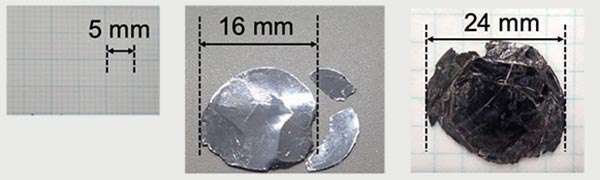
    SnS Crystals
    SnS crystals grown by flux growth technique. Large single crystals were obtained by halogen addition to the flux. Credit: Tohoku University

    To solve the problem, the team designed an original feed composition used for the flux growth of SnS crystals. This is something that had not been successfully trialed before. A dramatic change appeared in the grown crystals by halogen addition, that is, enlargement of the crystal size to a maximum 24 mm in width, in addition to including an n-type conduction characteristic. The larger crystals lower the stakes of trial manufacturing the SnS solar cells with p-n homojunction, which accelerates the development for practical application.

    These significant results were published in Crystal Growth & Design today (August 21, 2020).

    Reference: “Growth of large single crystals of n-type SnS from halogen-added Sn flux” by Sakiko Kawanishi, Issei Suzuki, Takeo Ohsawa, Naoki Ohashi, Hiroyuki Shibata, and Takahisa Omata, 21 August 2020, Crystal Growth & Design.
    DOI: 10.1021/acs.cgd.0c00617

    Never miss a breakthrough: Join the SciTechDaily newsletter.
    Follow us on Google and Google News.

    Energy Materials Science Solar Cells Tohoku University
    Share. Facebook Twitter Pinterest LinkedIn Email Reddit

    Related Articles

    International Data Fusion Approach Homing In on Longer-Lasting Perovskite Solar Cells

    Twisting, Flexible Crystals Key to Advanced New Solar Cells

    Luminescent Solar Waveguide Windows Generate Energy From Inside and Out

    Invisible Solar Panels: How Tomorrow’s Windows Will Generate Electricity

    World Record: Perovskite/Silicon Tandem Solar Cells on the Magic Threshold of 30% Efficiency

    Highly Efficient Eco-Friendly Perovskite Solar Cells With Enhanced Stability

    More Efficient Underwater Solar Cells With Optimal Materials

    Breakthrough Self-Assembly Innovation Enables Cheaper Solar Energy Production

    New Efficiency Record Set by Novel Multi-Material Solar Cells

    Leave A Reply Cancel Reply

    • Facebook
    • Twitter
    • Pinterest
    • YouTube

    Don't Miss a Discovery

    Subscribe for the Latest in Science & Tech!

    Trending News

    Largest-Ever Study Finds Medicinal Cannabis Ineffective for Anxiety, Depression, PTSD

    250-Million-Year-Old Egg Solves One of Evolution’s Biggest Mysteries

    Living With Roommates Might Be Changing Your Gut Microbiome Without You Knowing

    Century-Old Cleaning Chemical Linked to 500% Increased Risk of Parkinson’s Disease

    What if Your Memories Never Happened? Physicists Take a New Look at the Boltzmann Brain Paradox

    One of the Universe’s Largest Stars May Be Getting Ready To Explode

    Scientists Discover Enzyme That Could Supercharge Ozempic-Like Weight Loss Drugs

    Popular Sweetener Linked to DNA Damage – “It’s Something You Should Not Be Eating”

    Follow SciTechDaily
    • Facebook
    • Twitter
    • YouTube
    • Pinterest
    • Newsletter
    • RSS
    SciTech News
    • Biology News
    • Chemistry News
    • Earth News
    • Health News
    • Physics News
    • Science News
    • Space News
    • Technology News
    Recent Posts
    • Challenging the Narrative: New Study Shows U.S. Life Expectancy Is Rising Across All States
    • Mystery Illness Kills 5 in Burundi As Doctors Scramble for Answers
    • Bone-Strengthening Discovery Could Reverse Osteoporosis
    • The Most Elusive Number in Physics Just Got Even More Mysterious
    • Scientists Uncover Hidden Trigger Behind Stem Cell Aging
    Copyright © 1998 - 2026 SciTechDaily. All Rights Reserved.
    • Science News
    • About
    • Contact
    • Editorial Board
    • Privacy Policy
    • Terms of Use

    Type above and press Enter to search. Press Esc to cancel.