
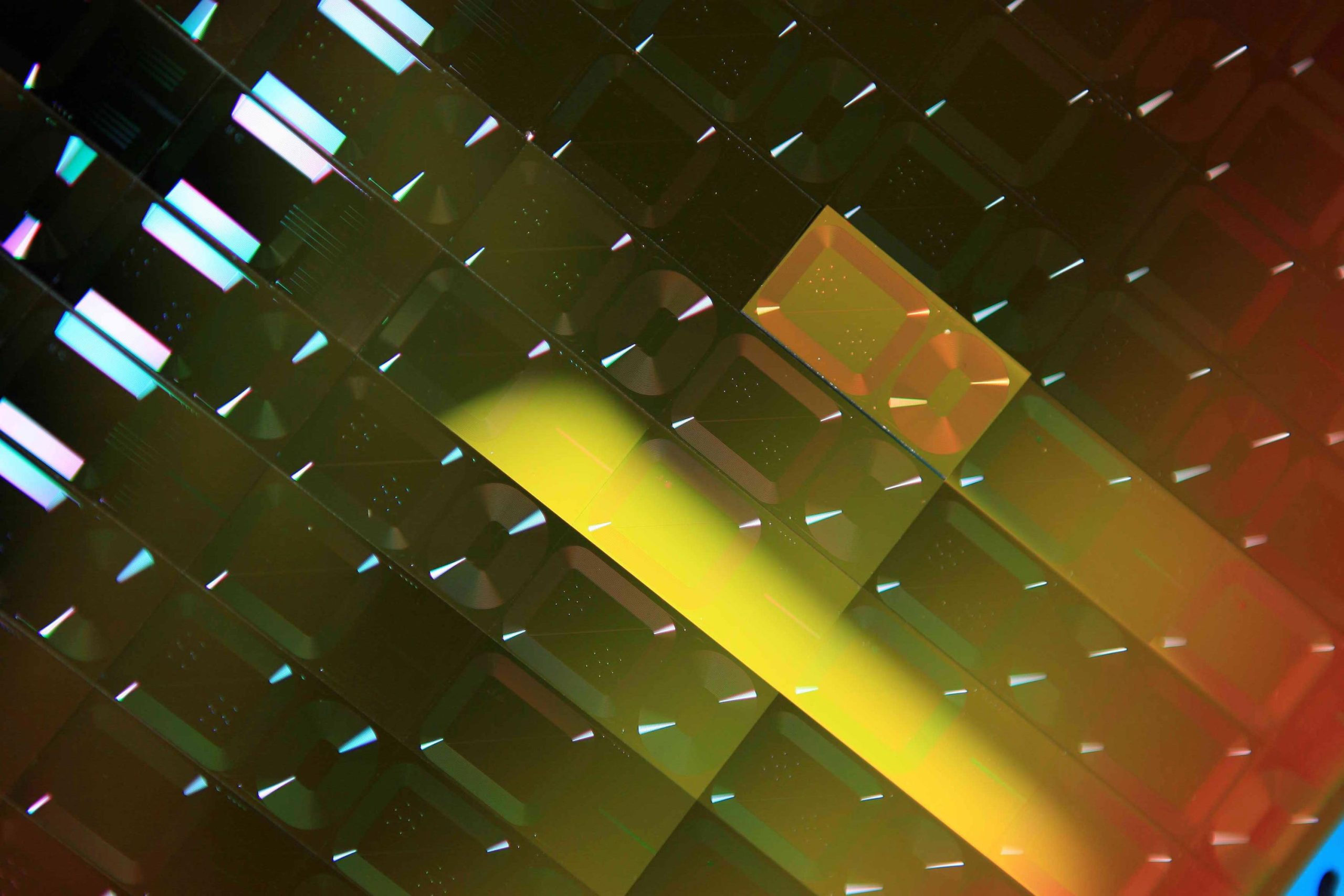
A breakthrough chip connection system using light instead of metal wiring could eliminate a major computing bottleneck, supercharging AI development.
Funded by a $2M NSF grant and backed by industry leaders, the project aims to make AI models faster and more efficient. By dynamically reconfiguring optical pathways, this innovation could revolutionize high-performance computing and redefine data transfer.
Breaking the “Memory Wall” with Light-Based Chip Connections
A new chip-connection system could help overcome the “memory wall,” a major bottleneck that slows computing speed and restricts AI model growth. Instead of relying on traditional electrical wires, this technology transfers data through reconfigurable light pathways, allowing for much faster and more efficient communication.
The project, led by the University of Michigan, is backed by a $2 million grant from the National Science Foundation’s Future of Semiconductors program. It brings together researchers from the University of Washington, the University of Pennsylvania, and Lawrence Berkeley National Laboratory, with guidance from industry leaders including Google, Hewlett Packard Enterprise, Microsoft, and Nvidia.
The Data Transfer Bottleneck Slowing AI Growth
While computing power has increased dramatically—processing speeds today are 60,000 times faster than they were 20 years ago—data transfer between memory and processors has lagged behind, improving only 30-fold. This growing gap has created a bottleneck, limiting the size of AI models, which have been expanding at an astonishing rate—400 times larger every two years since 1998. Faster data transfer is crucial to unlocking AI’s full potential.
“Our proposed technology could enable high-performance computing to keep up with the massive amount of data that’s being fed to rapidly growing AI models,” said Di Liang, U-M professor of electrical and computer engineering and lead principal investigator of the project. “With optical connections between chips, we think we can transfer tens of terabits per second, which is more than 100 times faster than state-of-the-art electric connections.”

The Limits of Hardwired Metal Connections
Today, data moves between multiple memory and processor chips via metal connections soldered onto a single physical package called an interposer, which is similar to a motherboard. Data can be transferred within a single interposer or across interposers on interconnected servers called computing nodes.
The metal connections are hardwired into the interposer, which limits data transfer bandwidth and signal integrity because faster electrical signals lose energy as heat and can electromagnetically interfere with neighboring connections. As a result, hardwiring connections to all of the different processors and memory chips isn’t tractable. A single supercomputer chip today can contain over 900,000 cores, or individual processing units, and that number will continue to grow with AI model size.
Why Optical Interposers Are the Future
“All of those processors will need to talk to a large amount of memory,” said Mo Li, professor of electrical and computer engineering at the University of Washington, and a co-principal investigator of the project. “Controlling the communication within the whole package is very important. In my view, optical connections will be the only tractable solution in the future.”
Light can travel farther than electrons and transfer a much larger amount of data with far less energy loss, and the researchers will tap into these properties in their new interposer design. Pulses of light will travel between chips through refractive channels in their interposer called optical waveguides. A receiver on each chip translates the data back into an electrical signal for the computer to interpret.

Dynamic Traffic Control for AI Workloads
The waveguide network can also be reconfigured—during manufacturing as well as inside a computer—thanks to a special phase-changing material in the interposer. When hit with a laser or exposed to a voltage, the material’s refractive index changes, meaning the light will be bent in different directions as it passes through the waveguide.
“It’s a bit like opening and closing roads,” said Liang Feng, professor of materials science and electrical and systems engineering at the University of Pennsylvania and a co-principal investigator. “If a company sells a chip based on this technology, they will be able to rewrite the connections on different batches of chips and servers without changing the layout of the other components.”
The researchers will design traffic-controlling software that monitors which parts of the interposer need to communicate at any given time and make the necessary voltage switch to create ideal connections on the fly.
“Changing the connections allows us to reconfigure the network based on what AI models we want to run, or whether we want to train or run a model,” said Reetuparna Das, associate professor of computer science and engineering and a co-investigator of the project.
Industry Collaboration and Hands-On Learning for Students
Beyond advancing technology, the project will also connect U-M students with industry partners and provide valuable real-world experience.
“These connections allow students to appreciate real-world challenges in designing rapidly evolving technology,” Liang said. “Textbooks don’t address these modern problems sufficiently because the rate of development makes it impossible for textbooks to keep up. The best way to gain relevant skills is by working with industry on the problems they care about.”
Never miss a breakthrough: Join the SciTechDaily newsletter.
Follow us on Google and Google News.
1 Comment
How about getting rid of AI instead? Use light, use the law, use dynamite, I don’t care.