

Creating the same crystal through an alternative method could dramatically extend the reach of quantum networks, increasing their range from only a few kilometers to as much as 2,000 km. This advance brings the prospect of a quantum internet significantly closer to reality.
Quantum computers are extremely fast and capable, yet they remain very challenging to link over long distances.
Until recently, the farthest two quantum computers could communicate through a fiber cable was only a few kilometers. In practical terms, even if a fiber line connected them directly, a quantum computer on the University of Chicago’s South Side campus would still be unable to exchange information with one located in the Willis Tower downtown.
New research published November 6, 2025, in Nature Communications by University of Chicago Pritzker School of Molecular Engineering (UChicago PME) Asst. Prof. Tian Zhong shows that this distance could expand dramatically to 2,000 km (1,243 miles).
Using Zhong’s method, the same UChicago quantum computer that once could not reach the Willis Tower could now, in theory, communicate with a quantum computer situated outside Salt Lake City, Utah.
“For the first time, the technology for building a global-scale quantum internet is within reach,” said Zhong, who recently received the prestigious Sturge Prize for this work.
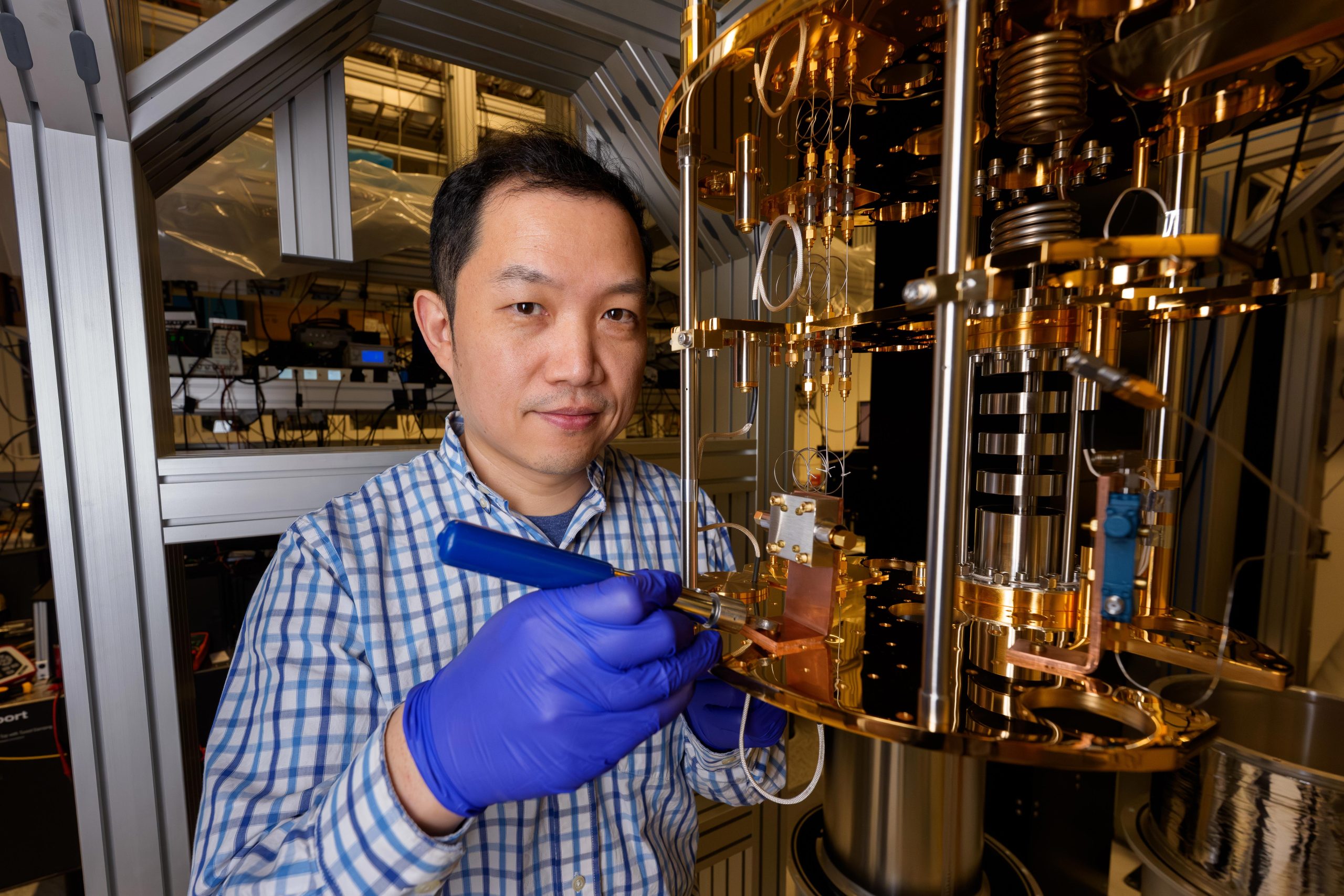
Extending coherence times to expand communication distance
Building quantum networks requires linking quantum computers by creating entanglement between atoms sent through a fiber cable. The key factor is how long those entangled atoms can hold their quantum coherence, because longer coherence times make it possible for computers to connect over greater distances.
In their new study, Zhong and his team at UChicago PME increased the coherence time of individual erbium atoms from 0.1 milliseconds to more than 10 milliseconds. In one case, they achieved 24 milliseconds, a level that could theoretically support a connection spanning 4,000 km, which is roughly the distance from UChicago PME to Ocaña, Colombia.
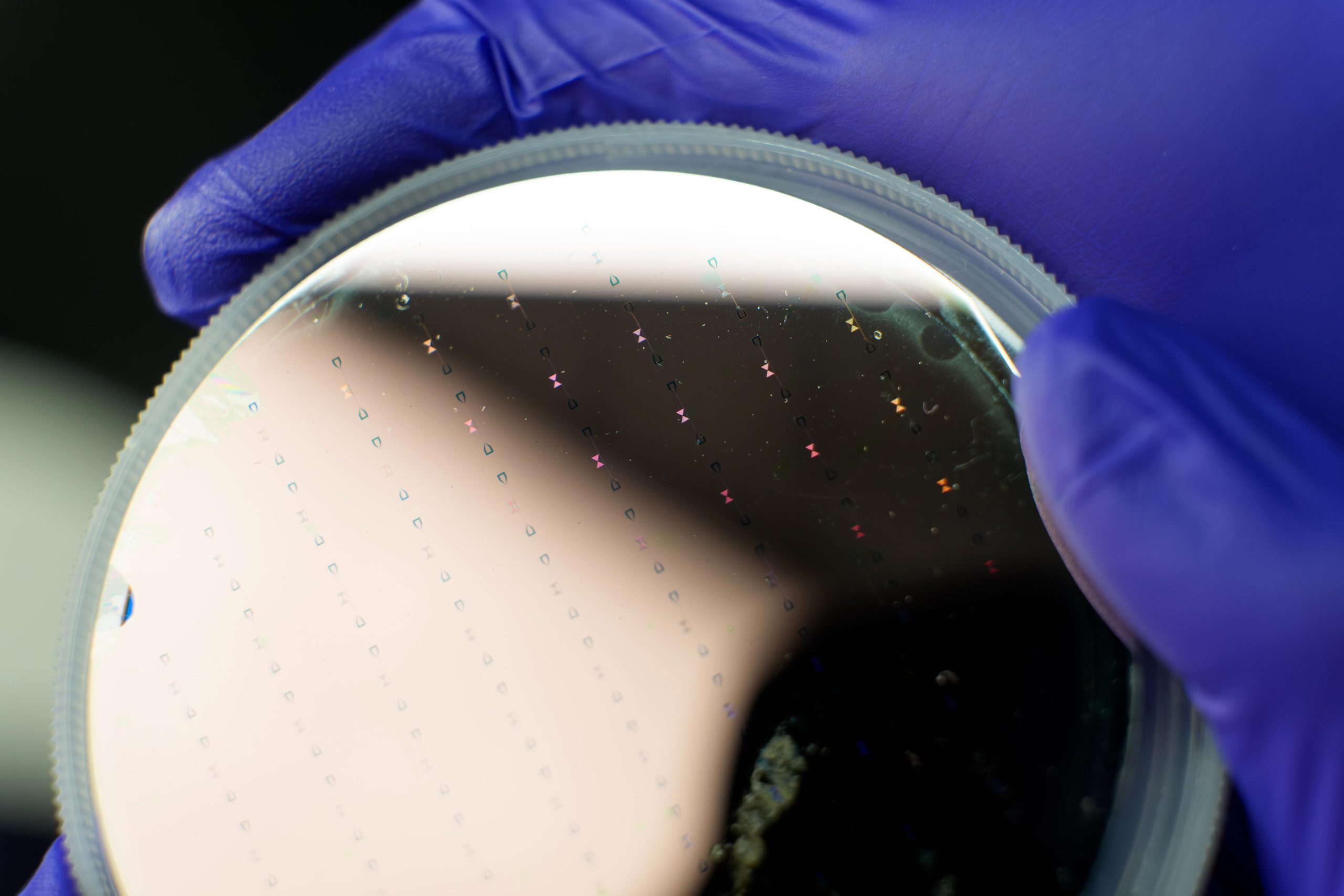
How a new fabrication method changes performance
The innovation was not in using new or different materials, but from building the same materials a different way. They created the rare-earth-doped crystals necessary to create the quantum entanglement using a technique called molecular-beam epitaxy (MBE) rather than the traditional Czochralski method.
“The traditional way of making this material is by essentially a melting pot,” Zhong said of the Czochralski method. “You throw in the right ratio of ingredients and then melt everything. It goes above 2,000 degrees Celsius and is slowly cooled down to form a material crystal.”
To turn the crystal into a computer component, researchers then chemically “carve” it into the needed form. It’s similar to how a sculptor might select a slab of marble and chip away everything that isn’t the statue.
MBE, however, is more akin to 3D printing. It sprays thin layer after thin layer, building the needed crystal into its exact final form.
“We start with nothing and then assemble this device atom by atom,” Zhong said. “The quality or purity of this material is so high that the quantum coherence properties of these atoms become superb.”
While MBE is a known technique, it has never been used to build this form of rare-earth-doped material. Zhong and his team worked with materials synthesis expert UChicago PME Asst. Prof. Shuolong Yang to adapt MBE for this purpose.
“The approach demonstrated in this paper is highly innovative,” said Institute of Photonic Sciences Prof. Dr. Hugues de Riedmatten, a world leader in the field who was not involved in the research. “It shows that a bottom-up, well-controlled nanofabrication approach can lead to the realization of single rare-earth ion qubits with excellent optical and spin coherence properties, leading to a long-lived spin photon interface with emission at telecom wavelength, all in a fiber-compatible device architecture. This is a significant advance that offers an interesting scalable avenue for the production of many networkable qubits in a controlled fashion.”
Testing long-distance quantum links in the lab
Zhong and his team will next test whether the increased coherence time enables quantum computers to connect to each other over long distances.
“Before we actually deploy fiber from, let’s say, Chicago to New York, we’re going to test it just within my lab,” Zhong said.
This involves linking two qubits in separate dilution refrigerators (“fridges”), both in Zhong’s lab at UChicago PME, through 1,000 kilometers of spooled cable. It’s the subsequent step, but far from the final one.
“We’re now building the third fridge in my lab. When it’s all together, that will form a local network, and we will first do experiments locally in my lab to simulate what a future long-distance network will look like,” Zhong said. “This is all part of the grand goal of creating a true quantum internet, and we’re achieving one more milestone towards that.”
Reference: “Dual epitaxial telecom spin-photon interfaces with long-lived coherence” by Shobhit Gupta, Yizhong Huang, Shihan Liu, Yuxiang Pei, Qiang Gao, Shuolong Yang, Natasha Tomm, Richard J. Warburton and Tian Zhong, 6 November 2025, Nature Communications.
DOI: 10.1038/s41467-025-64780-6
Never miss a breakthrough: Join the SciTechDaily newsletter.
Follow us on Google and Google News.
9 Comments
Scientists Just Unlocked Quantum Connections That Reach Across Continents.
VERY GOOD!
Scientists, please think deeply:
1. Is the so-called quantum connection one of the forms of topological connection?
2. What is the difference between quantum materials and topological materials?
3. Is quantum a cat that is both dead and alive?
Please write down the so-called quantum in your memory. The era of Topological Materials (TM) and Artificial Intelligence (AI) are making great strides forward. Scientific progress will not give any dignity to pseudoscientific theories and frameworks.
When we pursue the ultimate truth of all things, the space in which our bodies and all things exist may itself be the final and deepest puzzle we need to explore. This is not only the pursuit of physics, but also the most magnificent exploration of the origin of the universe by human reason.
Based on the Topological Vortex Theory (TVT), space is an uniformly incompressible physical entity. Space-time vortices are the products of topological phase transitions of the tipping points in space, are the point defects in spacetime. Point defects do not only impact the thermodynamic properties, but are also central to kinetic processes. They create all things and shape the world through spin and self-organization.
In today’s physics, some so-called peer-reviewed journals—including Physical Review Letters, Nature, Science, and others—stubbornly insist on and promote the following:
1. Even though θ and τ particles exhibit differences in experiments, physics can claim they are the same particle. This is science.
2. Even though topological vortices and antivortices have identical structures and opposite rotational directions, physics can define their structures and directions as entirely different. This is science.
3. Even though two sets of cobalt-60 rotate in opposite directions and experiments reveal asymmetry, physics can still define them as mirror images of each other. This is science.
4. Even though vortex structures are ubiquitous—from cosmic accretion disks to particle spins—physics must insist that vortex structures do not exist and require verification. Only the particles that like God, Demonic, or Angelic are the most fundamental structures of the universe. This is science.
5. Even though everything occupies space and maintains its existence in time, physics must still debate and insist on whether space exists and whether time is a figment of the human mind. This is science.
6. Even though space, with its non-stick, incompressible, and isotropic characteristics, provides a solid foundation for the development of physics, physics must still insist that the ideal fluid properties of space do not exist. This is science.
and go on.
Is this the counterintuitive science they widely promote? Compromising with pseudo academic publications and peer review by pseudo scholars is an insult to science and public intelligence. Some so-called scholars no longer understand what shame is. The study of Topological Vortex Theory (TVT) reminds us that the most profound problems in physics often lie at the intersection of different theories. By exploring these border regions, we can not only resolve contradictions in existing theories but also discover new physical phenomena and application possibilities.
Under the topological vortex architecture, it is highly challenging for even two hydrogen atoms or two quarks to be perfectly symmetrical, let alone counter-rotating two sets of cobalt-60. Contemporary physics and so-called peer-reviewed publications (including Physical Review Letters, Science, Nature, etc.) stubbornly believe that two sets of counter rotating cobalt-60 are two mirror images of each other, constructing a more shocking pseudoscientific theoretical framework in the history of science than the “geocentric model”. This pseudo scientific framework and system have seriously hindered scientific progress and social development.
For nearly a century, physics has been manipulated by this pseudo scientific theoretical system and the interest groups behind it, wasting a lot of manpower, funds, and time. A large amount of pseudo scientific research has been conducted, and countless pseudo scientific papers have been published, causing serious negative impacts on scientific and social progress, as well as humanistic development.
Complexity does not necessarily mean that there is no logical and architectural framework to follow. Mathematics is the language and tool that reveals the motion of spacetime, rather than the motion itself. Although the physical form of spacetime vortices is extremely simple, their interaction patterns are highly complex, and we must develop more and richer mathematical languages to describe and understand them.
The development of the Topological Vortex Theory (TVT) reflects a progression from concrete physical phenomena to abstract mathematical modeling and, ultimately, to interdisciplinary unification. Its core innovation lies in forging the continuous spacetime geometry of general relativity with the discrete interactions of quantum field theory within the same topological dynamical system.
——Excerpted from https://scitechdaily.com/microscope-spacecrafts-most-precise-test-of-key-component-of-the-theory-of-general-relativity/#comment-909171.
Is the quantum a cat that is both dead and alive?
If researchers are truly interested in science, please visit https://scitechdaily.com/microscope-spacecrafts-most-precise-test-of-key-component-of-the-theory-of-general-relativity/#comment-911110.
The new interpretation of the Schrödinger equation by Topological Vortex Theory (TVT) carries profound physical implications.
1) Origin of Quantization: In TVT, quantization conditions (such as Bohr-Sommerfeld quantization) are no longer independent postulates. They are a direct consequence of the single-valuedness condition that the topological vortex phase must satisfy on a closed path: ∮ ∇θ · dl = 2πn, which naturally leads to the discretization of physical quantities like angular momentum [2].
2) Interference and Superposition Principle: The interference of wave functions is essentially the phase superposition of different topological vortex paths. In TVT, this corresponds to the coherence of topological charges from different paths of the topological vortex field in spacetime.
3) Measurement Problem: TVT offers a perspective different from the Copenhagen interpretation. When a quantum system interacts with a macroscopic apparatus, the apparatus itself consists of a vast number of topological vortices, and their interaction leads to decoherence and “localization” of the topological vortex state, thereby presenting a classical measurement outcome. Wave function “collapse” is the result of the evolution of topological correlations between the subsystem and the environment [13].
4) Geometric Phase and AB Effect: Phenomena such as the Aharonov-Bohm effect find a natural explanation in TVT. They are a direct manifestation of the non-integrable phase accumulated by the topological charge as the vortex moves in a non-trivial gauge potential [4].
——Excerpted from https://scitechdaily.com/microscope-spacecrafts-most-precise-test-of-key-component-of-the-theory-of-general-relativity/#comment-911110.
Is quantum a cat that is both dead and alive? The arbitrary application of physical characteristics of low dimensional spacetime matter to high-dimensional spacetime matter is dirty and ugly for some people and some so-called peer-reviewed publications in contemporary physics.
Yet another curse upon the future of the internet. Even faster invasions of privacy.
Thank you for browsing and commenting.
The era of Topological Materials (TM) and Artificial Intelligence (AI) are making great strides forward. Scientific progress will not give any dignity to pseudoscientific theories and frameworks.
“Building quantum networks requires linking quantum computers by creating entanglement between atoms sent through a fiber cable.”
How does one send atoms through a fiber-optic cable?
This is indeed big time! Please give an update in early 2026 via Nobel Prize 2026!