

Close Menu
    Facebook X (Twitter) Instagram
    SciTechDaily
    • Biology
    • Chemistry
    • Earth
    • Health
    • Physics
    • Science
    • Space
    • Technology
    Facebook X (Twitter) Pinterest YouTube RSS
    SciTechDaily
    Home»Chemistry»Scientists Surprised as Crystal Structures Morph Into Super Catalysts
    Chemistry

    Scientists Surprised as Crystal Structures Morph Into Super Catalysts

    By Helmholtz-Zentrum Berlin für Materialien und EnergieJune 4, 2025No Comments4 Mins Read
    Facebook Twitter Pinterest Telegram LinkedIn WhatsApp Email Reddit
    Share
    Facebook Twitter LinkedIn Pinterest Telegram Email Reddit
    Chemistry Catalyst Concept
    Scientists have discovered that a unique class of crystalline materials unexpectedly transforms during electrolysis, unlocking remarkable catalytic properties. This surprising behavior could play a key role in advancing clean energy technologies. (Artist’s concept.) Credit: Stock Image

    Experiments at BESSY II show that during electrolysis, the structure breaks down into ultrathin nickel sheets, exposing the active catalytic centers to the electrolyte.

    Hydrogen can be produced through the electrolysis of water. When the electricity for this process comes from renewable sources, the resulting hydrogen is carbon-neutral. This “green” hydrogen is considered a key component of the future energy system and is also needed in large quantities as a raw material for the chemical industry.

    Electrolysis relies on two main reactions: hydrogen evolution at the cathode and oxygen evolution at the anode (OER). However, the oxygen evolution reaction tends to slow down the overall process. To accelerate hydrogen production, researchers must develop more efficient and durable catalysts for the OER step.
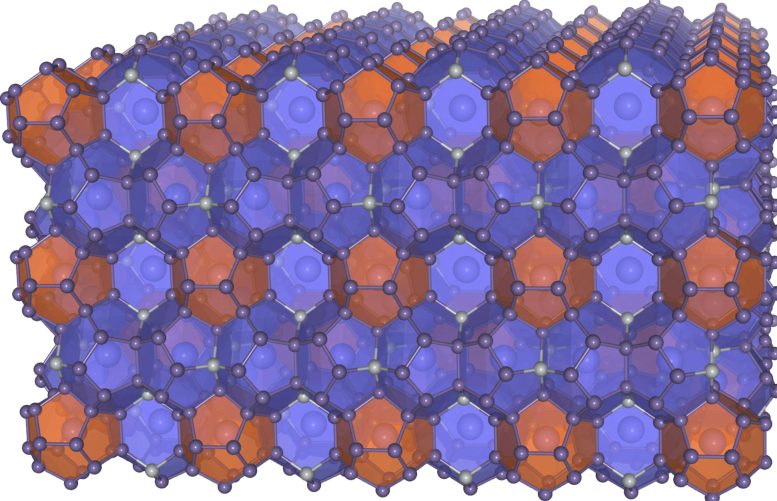
    Atomic Structure of Clathrate
    Ba8Ni6Ge40 consists of polyhedral cages made of nickel (gray) and germanium (purple), each containing a barium atom. Credit: Hongyuan Yang/HZB/TUB

    Clathrates, a structure built of cages

    Currently, nickel-based compounds are regarded as effective and affordable catalysts for the alkaline oxygen evolution reaction. This is the focus of Dr. Prashanth Menezes and his team.

    “The contact between the active nickel centers and the electrolyte plays a crucial role in the efficiency of a catalyst,” explains Menezes. In conventional nickel compounds, this contact surface is relatively limited. “We therefore wanted to test whether nickel-containing samples from the fascinating class of materials known as clathrates could be used as catalysts,” he says.
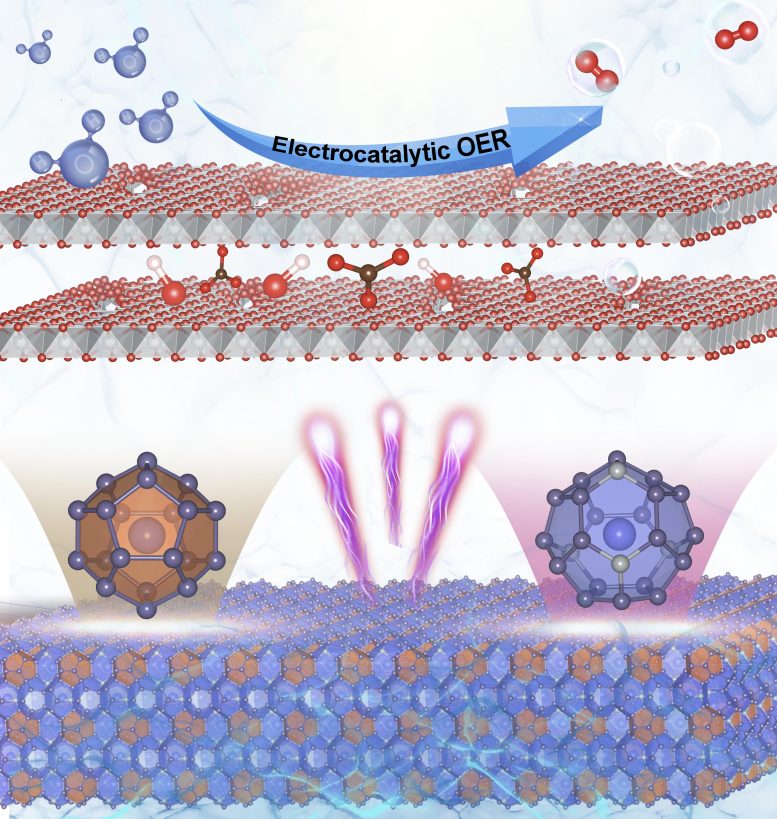
    Illustration of How Nanothin Sheets of Nickel Compounds Are Released From the Clathrate Structure
    The illustration shows schematically how nanothin sheets of nickel compounds are released from the clathrate structure, providing an extremely large surface area for the oxygen evolution reaction. Credit: Hongyuan Yang/HZB/TUB

    The materials are made of Ba8Ni6Ge40 and were produced at the Technical University of Munich. Like all clathrates, they are characterised by a complex crystalline structure of polyhedral cages, in this case, formed by germanium and nickel, enclosing barium.

    This structure gives clathrates special properties that make them interesting as thermoelectrics, superconductors, or battery electrodes. However, until now, no research group had considered of investigating clathrates as electrocatalysts.

    Experiments at universities and BESSY II

    The electrochemical measurements showed that the Ba₈Ni₆Ge₄₀ as a catalyst exceeded the efficiency of nickel-based catalysts at a current density of 550 mA cm⁻², a value also used in industrial electrolysis. The stability was also remarkably high: even after 10 days of continuous operation, the activity did not decrease significantly.
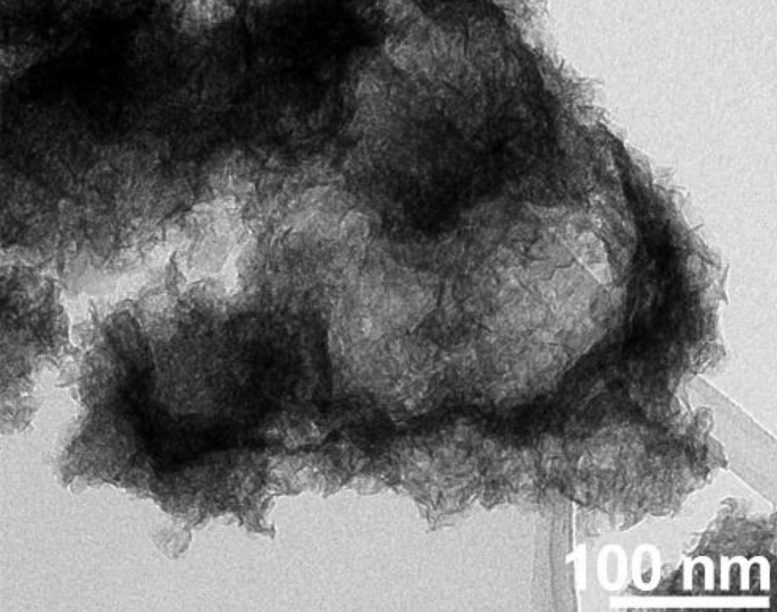
    Investigations Under the Transmission Electron Microscope
    Investigations under the transmission electron microscope of the Ba8Ni6Ge40 after 24 h as an OER catalyst show that the material has changed into a spongy Nickel network with a high surface area. The elemental analysis reveals that nearly all Germanium and Barium atoms have been washed out during this transformation. Credit: Hongyuan Yang/HZB/TUB

    The team used a combination of experiments to find out why the material is so remarkably well suited. At BESSY II, they studied the samples using in situ X-ray absorption spectroscopy (XAS), while basic structural characterization were carried out at the Freie and Technische Universität Berlin.

    From cage to sponge

    Their analysis showed that the Ba8Ni6Ge40 particles in the aqueous electrolyte undergo a structural transformation under an electric field: germanium and barium atoms dissolve out of the former three-dimensional framework.

    “The germanium and barium atoms make up almost 90 % of the clathrate starting material, and they are completely washed out, leaving behind highly porous, sponge-like nanolayers of the remaining 10 % nickel that offer a maximum surface area,” says Dr. Niklas Hausmann from Menezes’ team. This transformation brings more and more catalytically active nickel centres into contact with the electrolyte.

    “We were actually surprised by how well these samples work as OER catalysts. We expect that we can observe similar results with other transition metal clathrates and that we have discovered a very interesting class of materials for electrocatalysts,” says Menezes.

    Reference: “Ba-Ni-Ge Clathrate Transformation Maximizes Active Site Utilization of Nickel for Enhanced Oxygen Evolution Performance” by Ziliang Chen, Hongyuan Yang, J. Niklas Hausmann, Stefan Mebs, Viktor Hlukhyy, Holger Dau, Matthias Driess and Prashanth W. Menezes, 26 March 2025, Angewandte Chemie International Edition.
    DOI: 10.1002/anie.202424743

    Never miss a breakthrough: Join the SciTechDaily newsletter.
    Follow us on Google and Google News.

    Catalysts Helmholtz-Zentrum Berlin Hydrogen Sustainability
    Share. Facebook Twitter Pinterest LinkedIn Email Reddit

    Related Articles

    Department of Energy’s “Fairly Simple” Breakthrough Makes Accessing Stored Hydrogen More Efficient

    Producing Clean Hydrogen From Solar Power and Wood Chips

    Advanced New Catalysts for More Efficient Clean Hydrogen Production

    New Nanomaterial Produces Clean Energy Hydrogen Fuel From Seawater

    More Sustainable Conversion of Sunlight and Luminescent Materials With Manganese

    Unusual Property in Hydrogen Fuel Device Discovered – Could Be Ultimate Guide to Self-Improvement

    Unprecedented Nanoscale Look at Reaction That Limits the Efficiency of Generating Clean Hydrogen Fuel

    Efficient Seawater Desalination and Hydrogen Production Possible With New Catalyst

    Chemists Discover a New Way to Work with Heterogeneous Catalysts

    Leave A Reply Cancel Reply

    • Facebook
    • Twitter
    • Pinterest
    • YouTube

    Don't Miss a Discovery

    Subscribe for the Latest in Science & Tech!

    Trending News

    Millions Take These IBS Drugs, But a New Study Finds Serious Risks

    Scientists Unlock Hidden Secrets of 2,300-Year-Old Mummies Using Cutting-Edge CT Scanner

    Bread Might Be Making You Gain Weight Even Without Eating More Calories

    Scientists Discover Massive Magma Reservoir Beneath Tuscany

    Europe’s Most Active Volcano Just Got Stranger – Here’s Why Scientists Are Rethinking It

    Alzheimer’s Symptoms May Start Outside the Brain, Study Finds

    Millions Take This Popular Supplement – Scientists Discover a Concerning Link to Heart Failure

    The Universe Is Expanding Too Fast and Scientists Can’t Explain Why

    Follow SciTechDaily
    • Facebook
    • Twitter
    • YouTube
    • Pinterest
    • Newsletter
    • RSS
    SciTech News
    • Biology News
    • Chemistry News
    • Earth News
    • Health News
    • Physics News
    • Science News
    • Space News
    • Technology News
    Recent Posts
    • Simple Blood Test May Predict Alzheimer’s Years Before Brain Scans Show Signs
    • Scientists Say Adding This Unusual Seafood to Your Diet Could Reverse Signs of Aging
    • U.S. Waste Holds $5.7 Billion Worth of Crop Nutrients
    • Scientists Say a Hidden Structure May Exist Inside Earth’s Core
    • Doctors Surprised by the Power of a Simple Drug Against Colon Cancer
    Copyright © 1998 - 2026 SciTechDaily. All Rights Reserved.
    • Science News
    • About
    • Contact
    • Editorial Board
    • Privacy Policy
    • Terms of Use

    Type above and press Enter to search. Press Esc to cancel.