
Study suggests a new method for tracking electronic and vibrational dynamics in real time.
Within a few trillionths of a second after absorbing light, a molecule bends out of shape, shifts its electrons, and converts electronic energy into vibrations. These changes happen too quickly for ordinary instruments to follow, but flashes from the European XFEL allowed researchers to reconstruct the sequence atom by atom.
The measurements revealed that atoms within the same molecule can record different parts of a light-driven reaction. One may provide a clearer view of moving electrical charge, while another reflects how the molecular structure vibrates. The results also show that light excitation can make an atom more responsive to the motion of its neighbors.
This ability to distinguish electronic and structural changes in real time could improve investigations of fundamental processes driven by light. Possible areas of study include the mechanisms that protect DNA from light damage and the movement of energy through light-harvesting materials.
Different atoms reveal different changes
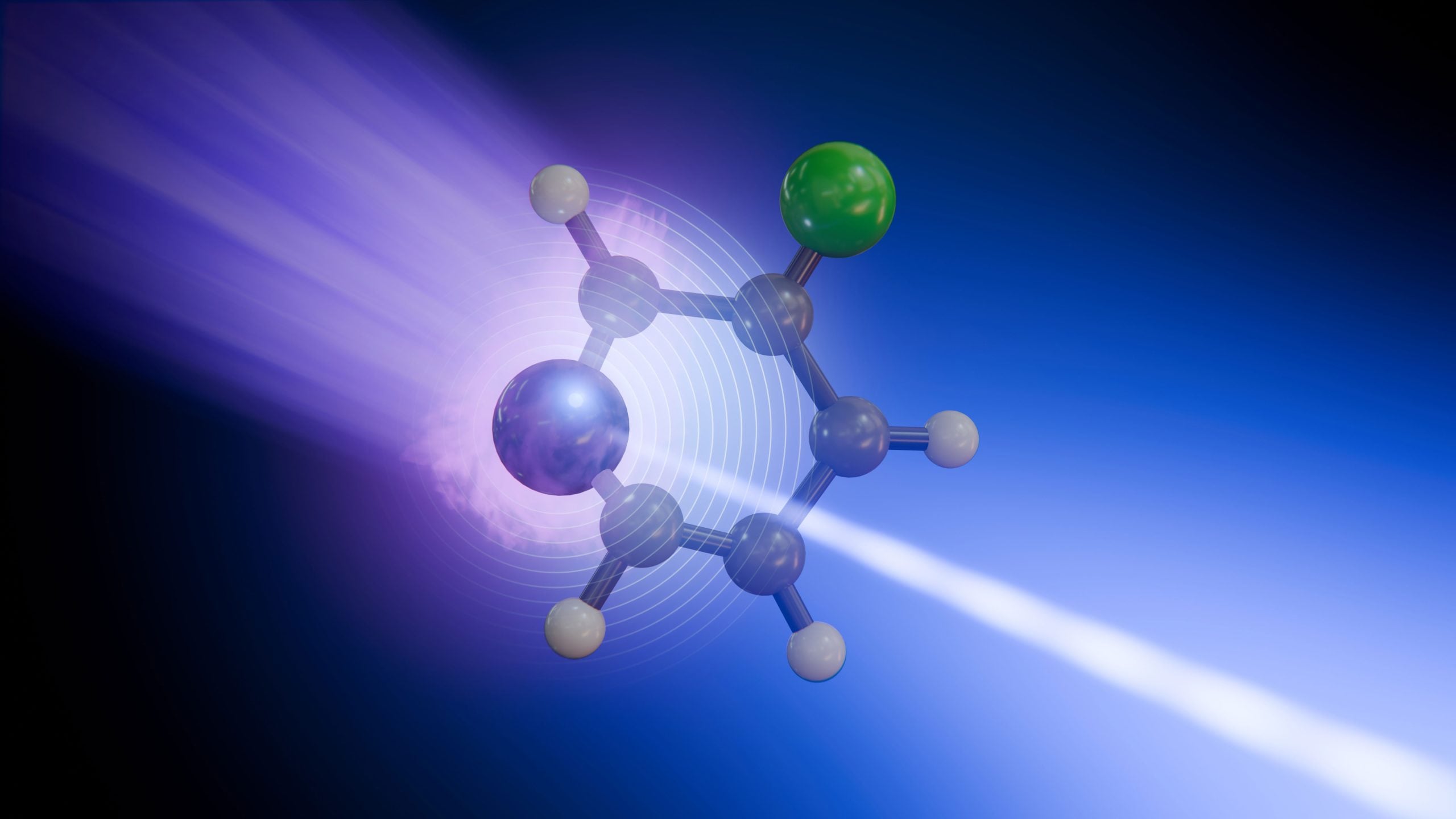
The researchers examined 3-fluoropyridine, a small molecule built around a ring of atoms. They selected it because its nitrogen and fluorine atoms could serve as separate observation points during the same reaction.
A brief ultraviolet laser pulse supplied the initial energy. After absorbing the light, the molecule entered an electronically excited state, meaning its electrons temporarily occupied a higher energy arrangement. Its normally flat structure then began to distort.
The molecule soon reached a conical intersection, a fleeting junction where two electronic energy states meet. At this point, the movements of the electrons and the atomic nuclei become closely connected, allowing the molecule to transfer between energy states rapidly.
After crossing this junction, 3-fluoropyridine returned to its ground state, its lowest electronic energy condition. The energy that had been stored electronically did not disappear. Instead, it became molecular vibration, causing the atoms to move relative to one another.
The signals from nitrogen and fluorine showed different parts of this transition. Fluorine served as a relatively clear indicator of vibrational relaxation, the process through which excess energy is redistributed through molecular motion. Nitrogen, which participated more directly in the original excitation, recorded a more complicated mixture of changing electron distribution and structural movement.
“We can now see that not every atomic site tells the same story in the signals we capture from our X-ray pulses,” says Antonio Picón from the Instituto de Ciencia de Materiales de Madrid Consejo Superior de Investigaciones Científicas (ICMM-CSIC), co-author of the study. “Some atoms report where the charge is going, while others reveal how the whole molecule vibrates.”
X-rays reconstruct a fleeting transition
To follow these changes, the researchers used time-resolved X-ray photoelectron spectroscopy (tr-XPS) at the Small Quantum Systems instrument (SQS) of European XFEL. The method works by removing tightly bound electrons from selected atoms and measuring the energy those electrons carry away. Changes in that energy reveal how the local chemical surroundings of each atom evolve.
First, an ultraviolet pulse excited the molecules. A soft X-ray pulse arrived after a carefully controlled delay and removed deeply bound electrons from either nitrogen or fluorine. Repeating the measurement at many delays produced a sequence of snapshots spanning only a couple of picoseconds (trillionths of seconds).
The researchers then combined these measurements with advanced simulations and models. This step was necessary to connect the shifting electron energies with the molecular changes responsible for them, allowing the researchers to reconstruct how charge and atomic motion developed over time.
Atomic detail broadens photochemistry research
The results demonstrate how the European XFEL’s brief, intense X-ray pulses can separate electronic changes from structural motion even when both unfold almost simultaneously. The measurements also show why examining several atomic sites can provide a fuller account than observing a molecule from only one location.
The approach is not limited to 3-fluoropyridine. It could be used to analyze light-induced structural changes in increasingly complex systems–from functional organic molecules to biomolecular building blocks and energy materials.
“This is what European XFEL was built to enable: watching chemical change where it begins, at specific atomic sites and on its natural timescale,” says Daniel Rivas, former instrument scientist, now guest scientist at SQS and co-author of the study. “By combining multi-site sensitivity with femtosecond resolution, we are opening a new window on the microscopic mechanisms that govern photochemistry.”
Reference: “Photoinduced Enhancement of Chemical Shift Sensitivity to Local Vibrations” by Ana Martínez Gutiérrez, Oliver Alexander, Pablo Estévez Alonso, Lorenzo Paoloni, Terry Mullins, André Al-Haddad, Thomas M. Baumann, Rebecca Boll, Christoph Bostedt, Simon Dold, Alberto De Fanis, Gianluca Geloni, Markus Ilchen, Iyas Ismail, Björn Lautenschlager, Tommaso Mazza, Dooshaye Moonshiram, Solène Oberli, Dawei Peng, Ralph Püttner, Svitozar Serkez, Marc Simon, Florian Trinter, Sergey Usenko, Michael Meyer, Jonathan P. Marangos, Jesús González-Vázquez, Daniel E. Rivas and Antonio Picón, 10 July 2026, Journal of the American Chemical Society.
DOI: 10.1021/jacs.6c06538
Never miss a breakthrough: Join the SciTechDaily newsletter.
Follow us on Google and Google News.
1 Comment
What’s fascinating about this X-ray experiment is how it moves us away from treating molecules as static, flat textbook diagrams. When a light pulse hits that ring, you’re watching a real-time mechanical energy sequence:
Input Stress: The laser injects a sudden spike of localized energy into the system.
Structural Shift: The ring distorts into a 3D shape to find a geometric path of least resistance (what the paper calls the “conical intersection”) where that stored energy can shift channels.
Task Division: The nitrogen node manages the immediate field redistribution while the fluorine node acts like a relief valve, bleeding off excess vibrational chatter.
Return to Equilibrium: The excess energy uncoils across the molecule’s structural pathways until the whole system settles back to baseline.