
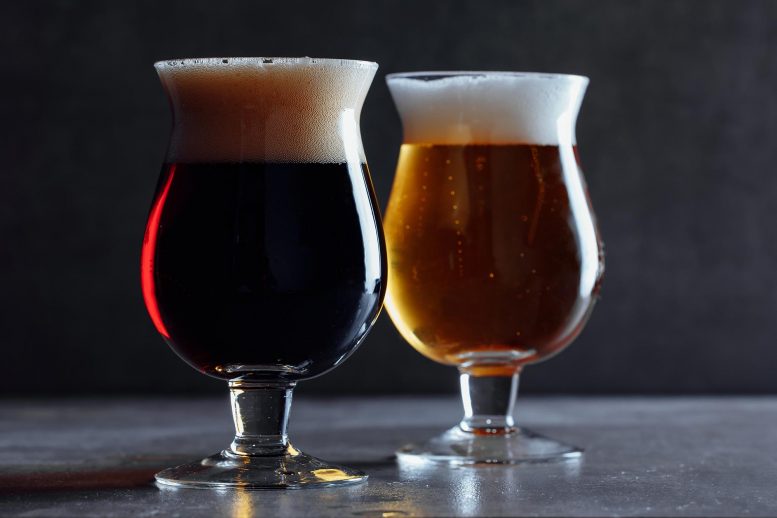
An international team of scientists, led by Prof. Kevin Verstrepen (VIB-KU-Leuven) and Prof. Steven Maere (VIB-UGent), has discovered that some of the most renowned classic Belgian beers, including Gueuze and Trappist ales, are fermented with a rare and unusual form of hybrid yeasts. These yeasts combine the DNA of the traditional ale yeast, Saccharomyces cerevisiae, with that of more stress-resistant feral yeasts such as Saccharomyces kudriavzevii.
Mixed origins
“These yeasts are hybrids between two completely different species” says Dr. Jan Steensels (VIB – KU Leuven Center for Microbiology), who coordinated the lab work of this study. “Think of lions and tigers making a super-baby.”
Such interspecific hybridizations are rare and seem to be favored by the domestication process. In this case, the new hybrid yeasts combined important characteristics of both parental species, with the fermentation capacity of normal beer yeasts and the stress tolerance and capacity to form special aromas of more feral ancient yeasts like S. kudriavzevii that haphazardly made their way into the brewery.
The team, from the VIB-KU Leuven Center for Microbiology and the University of Munich, supported by industrial partners, has spent five years characterizing the different yeasts used in today’s production of beer, wine, bread, and biofuels. The genetic analysis of these yeasts was quite a piece of work, because none of the existing pipelines for DNA sequencing can deal with such mixed origins.
For this the team could, surprisingly, count on the plant expertise of professor Steven Maere, a bioinformatics expert from the VIB-UGent Center for Plant Systems Biology. Maere explains: “Plants have some of the most complex genomes of all living organisms. It is fascinating that complex interspecific hybrids with doubled genomes feature prominently both among domesticated yeasts and domesticated plants.”
A surprise in DNA
“It was a bit of a surprise for us,” says Dr. Brigida Gallone (VIB-KU Leuven Center for Microbiology), the lead author on the paper that appeared in October 2019 in Nature Ecology and Evolution. “In 2016, we reported that most industrial yeasts belong to, or arose from the species Saccharomyces cerevisiae, the traditional baker’s and brewer’s yeast. We found that these industrial yeasts are quite different from their wild progenitors, with different subfamilies having adapted to beer, wine, and bakery environments. We also noticed that some of the yeasts that were isolated from ancient Belgian beer styles, like Gueuze and Trappist beers, are even more unusual and contained DNA of two different yeast species.”
“It really seems that these unique natural yeasts allowed the development of some of the most renowned beers that Belgium is so famous for,” says Dr. Philippe Malcorps, Senior Scientist at the Global Innovation and Technology Center of AB InBev, the world’s largest brewer. The team of Malcorps helped with the isolation of yeasts from some of their spontaneous fermentation beer cellars. Those natural super-yeasts are living witnesses of brewing from the pre-industrial ages, adapted to harsh conditions of fermentation of the strong Trappist beers, or survival in the long lagering typical for Gueuze beers.
“One could say that the unique habitat in wooden fermentation barrels created by adventurous Medieval Belgian brewers allowed these new species to thrive until today,” says Prof. Kevin Verstrepen (VIB-KU Leuven Center for Microbiology).
A history of yeasts
Apart from the special Belgian yeasts, the team also collected a large number of hybrids from S. eubayanus and S. cerevisiae, or from S. uvarum strongly adapted to cold fermentation. While it was already known that lager yeasts were hybrids, the complete DNA analysis of a large number of these yeasts showed how these specific hybrids originated in medieval Germany and later spread across different European breweries as the pilsner beers grew more popular.
“It is no coincidence that the origin of today’s beer yeasts lies in Belgium and Germany, arguably the two countries that are most associated with the art of brewing,” says Prof. Mathias Hutzler (TU Munich).
In addition to isolating and characterizing additional yeasts from classic breweries, the Verstrepen team is now also using these new insights to create novel hybrids that are even better at making flavorful beer. By crossing different natural yeasts isolated from all over the world, the team hopes to generate new beer yeasts that allow brewers to create new aroma patterns, or brew in a more ecological and sustainable way, for example by limiting cooling or allowing fermentation with a better use of local raw materials.
###
Reference: “Interspecific hybridization facilitates niche adaptation in beer yeast” by Brigida Gallone, Jan Steensels, Stijn Mertens, Maria C. Dzialo, Jonathan L. Gordon, Ruben Wauters, Florian A. Theßeling, Francesca Bellinazzo, Veerle Saels, Beatriz Herrera-Malaver, Troels Prahl, Christopher White, Mathias Hutzler, Franz Meußdoerffer, Philippe Malcorps, Ben Souffriau, Luk Daenen, Guy Baele, Steven Maere and Kevin J. Verstrepen, 21 October 2019, Nature Ecology & Evolution.
DOI: 10.1038/s41559-019-0997-9
Never miss a breakthrough: Join the SciTechDaily newsletter.
Follow us on Google and Google News.