
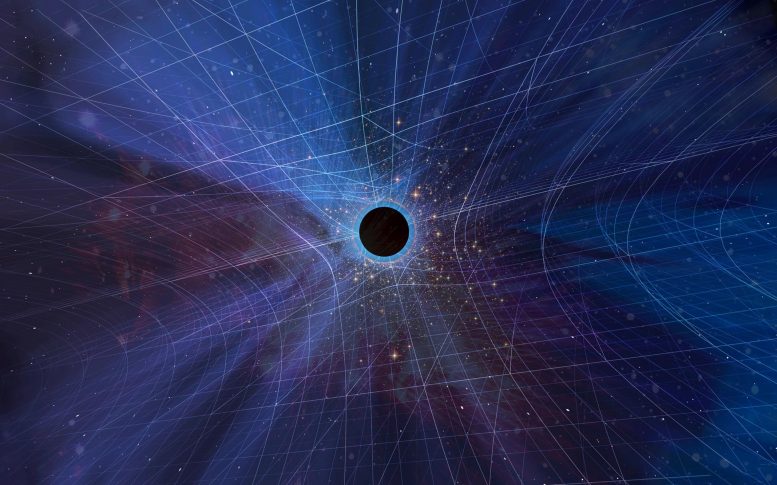
Black holes are among the most enigmatic objects in our universe. These mysterious celestial bodies do not emit any light of their own and are thus incredibly difficult to spot. In fact, one can only detect black holes based on the effects that they have on their surroundings.
Black holes come in various flavors and sizes, from ‘small’ stellar-mass black holes to supermassive black holes found in the center of galaxies. Stellar-mass black holes are the final remnants of massive stars, born more than 20 to 30 times the mass of our Sun, and should only form in certain mass ranges according to current theory. In this context, the claimed discovery, published in the distinguished journal Nature in November 2019, of a black hole 70 times more massive than our Sun caught the attention of the astronomical community.
The system in question, LS V +22 25 or LB-1 in short, was claimed to be a double-star system consisting of an 8 solar mass star and a 70 solar mass black hole that orbit around one another in just 80 days, very much the same way as planets orbit around stars. The data used in the original study showed two spectral signatures that moved in different ways: one clear signature belonging to the star and another, more subtle, that was interpreted as belonging to the material around the black hole, thus tracing its orbital motion. Based on the motion of these two signatures, the original authors reached their controversial conclusion.
“A stellar black hole this massive challenges everything we know about massive star evolution,” says Michael Abdul-Masih, a Ph.D. student from the KU Leuven Institute of Astronomy in Belgium. “Theory tells us that in this mass range, when a star dies it should completely annihilate itself without leaving anything behind, and certainly not such a massive black hole.”
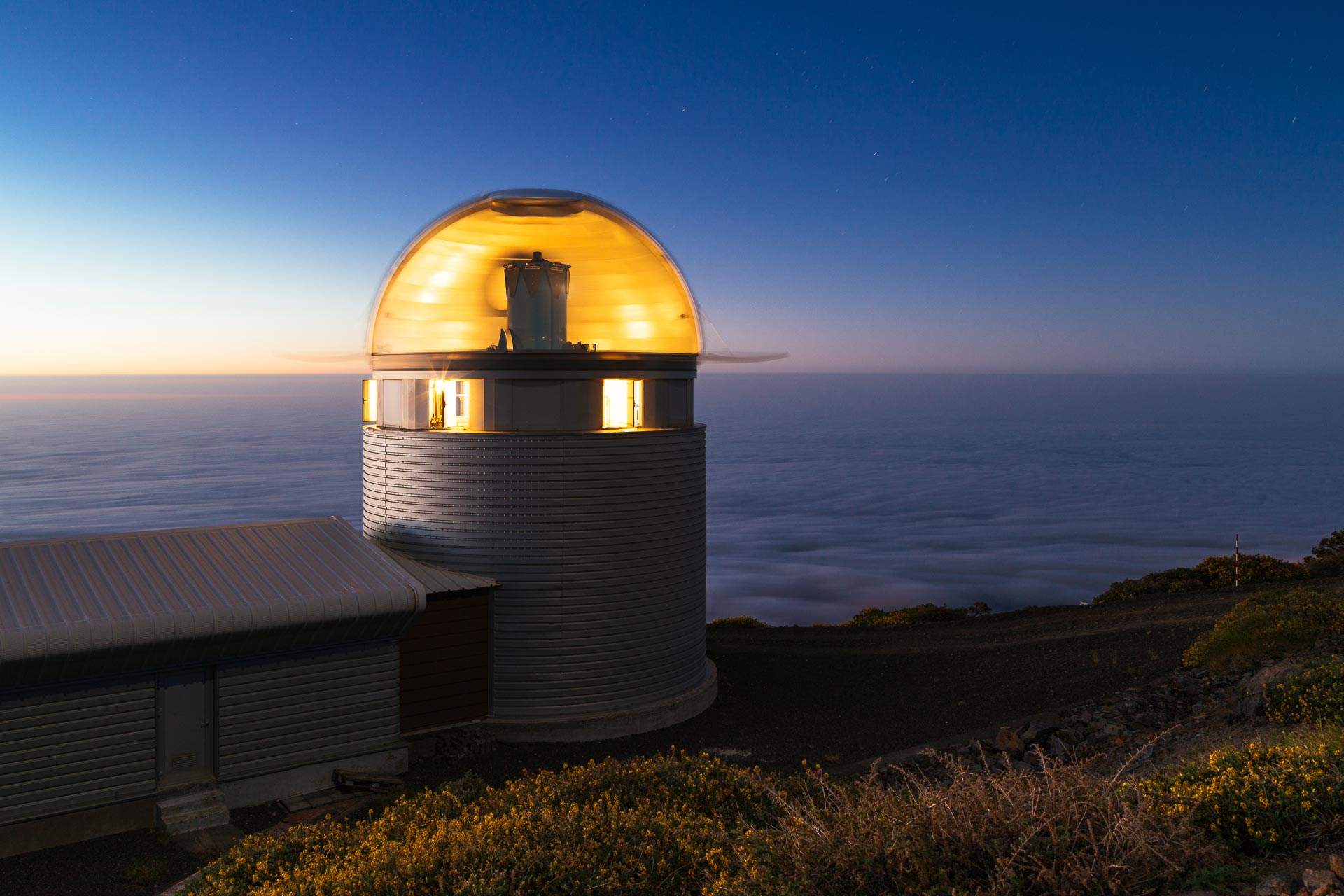
The interpretation of the second signature has since come under scrutiny. Using higher-resolution data from the Flemish-funded Mercator Telescope on the island of La Palma (Spain), the KU Leuven team ran several simulations and concluded that the original interpretation of the system was in fact incorrect.
“As we examined the available data more carefully, we began to realize that something didn’t seem quite right,” explains Michael Abdul-Masih. “The second signature did not behave as we expected it to. This is when I realized that maybe this second signature is not moving at all, but only appears to do so because of the movement of the star.” “It is a little like the fake impression of moving you get while sitting in a train and the train next to you starts moving while you are not,” explains Prof. Hugues Sana of KU Leuven further.
The team quickly tested this interpretation and found that it indeed was able to reproduce the observations without the need for such a massive black hole in the system.
“It was quite exciting when we first saw the results. The simulations matched the observations perfectly and we were able to prove that LB-1 does not contain a 70 solar mass black hole as originally thought,” concludes Julia Bodensteiner, another PhD student in the team of Prof. Sana.
The findings of Ph.D. student Abdul-Masih appear in the prestigious journal Nature this week and solve the riddle posed by the claimed presence of a massive black hole in LB1. Even though astronomers can breathe a sigh of relief that LB-1 does not violate stellar evolution theory, this system is indeed remarkable and will surely be the subject of additional studies in the future.
References:
“On the signature of a 70-solar-mass black hole in LB-1” by Michael Abdul-Masih, Gareth Banyard, Julia Bodensteiner, Emma Bordier, Dominic M. Bowman, Karan Dsilva, Matthias Fabry, Calum Hawcroft, Laurent Mahy, Pablo Marchant, Gert Raskin, Maddalena Reggiani, Tomer Shenar, Andrew Tkachenko, Hans Van Winckel, Lore Vermeylen and Hugues Sana, 29 April 2020, Nature.
DOI: 10.1038/s41586-020-2216-x
“A wide star–black-hole binary system from radial-velocity measurements” by Jifeng Liu, Haotong Zhang, Andrew W. Howard, Zhongrui Bai, Youjun Lu, Roberto Soria, Stephen Justham, Xiangdong Li, Zheng Zheng, Tinggui Wang, Krzysztof Belczynski, Jorge Casares, Wei Zhang, Hailong Yuan, Yiqiao Dong, Yajuan Lei, Howard Isaacson, Song Wang, Yu Bai, Yong Shao, Qing Gao, Yilun Wang, Zexi Niu, Kaiming Cui, Chuanjie Zheng, Xiaoyong Mu, Lan Zhang, Wei Wang, Alexander Heger, Zhaoxiang Qi, Shilong Liao, Mario Lattanzi, Wei-Min Gu, Junfeng Wang, Jianfeng Wu, Lijing Shao, Rongfeng Shen, Xiaofeng Wang, Joel Bregman, Rosanne Di Stefano, Qingzhong Liu, Zhanwen Han, Tianmeng Zhang, Huijuan Wang, Juanjuan Ren, Junbo Zhang, Jujia Zhang, Xiaoli Wang, Antonio Cabrera-Lavers, Romano Corradi, Rafael Rebolo, Yongheng Zhao, Gang Zhao, Yaoquan Chu and Xiangqun Cui, 27 November 2019, Nature.
DOI: 10.1038/s41586-019-1766-2
This research was presented in a Matters Arising, “On the signature of a 70-solar-mass black hole in LB-1,” appearing in Nature on Wednesday, April 29th, 2020.
The team is composed of Michael Abdul-Masih, Gareth Banyard, Julia Bodensteiner, Dominic M. Bowman, Karan Dsilva, Matthias Fabry, Calum Hawcroft, Laurent Mahy, Pablo Marchant, Gert Raskin, Maddalena Reggiani, Tomer Shenar, Andrew Tkachenko, Hans Van Winckel, and Hugues Sana, from KU Leuven, and Lore Vermeylen, from the Royal Observatory of Belgium.
Based on observations made with the HERMES spectrograph mounted on the Mercator Telescope. The Mercator Telescope is operated on the island of La Palma by the Flemish Community, at the Spanish Observatorio del Roque de los Muchachos of the Instituto de Astrofísica de Canarias. The HERMES spectrograph is supported by the Research Foundation – Flanders (FWO), Belgium, the Research Council of KU Leuven, Belgium, the Fonds National de la Recherche Scientifique (F.R.S.-FNRS), Belgium, the Royal Observatory of Belgium, the Observatoire de Genève, Switzerland and the Thüringer Landessternwarte Tautenburg, Germany.
The authors acknowledge support from the Fonds Wetenschappelijk Onderzoek (FWO, Research Foundation Flanders) under projects IDsG0F8H6N, G0B3818N, 12ZY520N, G0H5416N, GST-D6267-I002519N, and from the Onderzoeksraad (Research Council), KU Leuven (project-IDs:C16/17/007, C16/18/005, C14/17/082). This project has received funding from the European Research Council under European Union’s Horizon 2020 research and innovation program (grant agreement numbers 772225: MULTIPLES and 670519: MAMSIE).
Never miss a breakthrough: Join the SciTechDaily newsletter.
Follow us on Google and Google News.
3 Comments
In this article I appreciate accurate detail about black hole.
Black holes are worm holes period cut the games no science it’s clear.
Black holes suck you back in time, wormholes take you to a random place, there is science behind, this, and maybe you should watch more Star Trek!