
Neuroscientists found that logical reasoning does not rely on the brain regions involved in language processing.
A person may be unable to form a sentence after a stroke yet still solve a difficult puzzle, recognize a hidden pattern, or make a sound logical judgment. That contrast points to a basic question about the mind: does reasoning depend on language, or can the brain think logically without words?
Cognitive neuroscientists at MIT’s McGovern Institute for Brain Research found that severe language impairment does not prevent people from performing well on logical reasoning tasks. Brain scans also showed that the regions responsible for processing language were not recruited when healthy participants reasoned through logical problems. The research was published in PNAS and led by Evelina Fedorenko, an MIT associate professor of brain and cognitive sciences.
Logic may not depend on language
For thousands of years, philosophers, linguists, and cognitive scientists have argued over whether language is the machinery of thought or simply one of the tools used to express it. Logic and language appear closely connected because both can be broken into smaller parts and assembled into more complicated structures.
Hope Kean, a postdoc and former K. Lisa Yang Integrative Computational Neuroscience (ICoN) Center graduate fellow in Fedorenko’s lab, notes that this resemblance has made language seem like a plausible foundation for abstract reasoning. “Abstract thinking has properties that look a lot like language,” Kean says, pointing to structural similarities. “You can decompose a thought into subcomponents, like little atoms of logical propositions, and you can combine them in a hierarchical manner to make more complex structured rules, very akin to language.”
Kean and Fedorenko, who is also a McGovern Institute investigator, questioned whether that similarity meant the same brain system must support both abilities. People usually need language to receive a logic problem, describe their reasoning, or explain an answer, but the mental work between those steps might occur elsewhere.
“There are aspects of thinking that seem to go beyond some of the limitations of language,” Kean explains. Logical reasoning demands precision that language often lacks. And language is linear, progressing one word at a time, whereas evaluating available information to reach logical conclusions can require thinking in less linear ways.
Aphasia leaves logical reasoning intact
Testing that possibility required the researchers to separate reasoning from language itself, which is difficult in most human experiments. Kean and her colleagues addressed the problem by working with Rosemary Varley, a neuroscientist at University College London who studies acquired language disorders, and Varley’s research group.
They recruited two people whose strokes had damaged language-processing regions of the brain. Both participants had severe difficulty understanding and producing language, creating a rare opportunity to examine whether logical thought could remain intact when linguistic ability was greatly reduced.
The researchers designed puzzles that did not depend on spoken or written instructions. In one task, participants examined two lists of numbers and worked out the hidden rule connecting them. A rule might reverse the order of the digits or remove every number above a particular value. After identifying the pattern, participants had to apply it to new examples.
A second task replaced numbers with geometric designs. Participants studied a matrix of patterns and selected the missing design needed to complete it. These tasks allowed the researchers to test rule discovery and abstract reasoning without requiring a verbal explanation.
Both participants with severe language impairments performed as well as the control group, even as the puzzles became more demanding. They could also communicate the rules they had inferred through gestures or drawings, showing that they understood the logic even when words were unavailable.
“It really upends a theory that says that symbolic rule induction is not possible without linguistic capacities,” says Kean.
Brain scans separate language from logic
The patient results showed that reasoning could survive serious language loss, but they did not reveal which brain systems were carrying out the work. To answer that question, Kean and her colleagues used functional brain imaging to observe healthy adults as they solved logical problems.
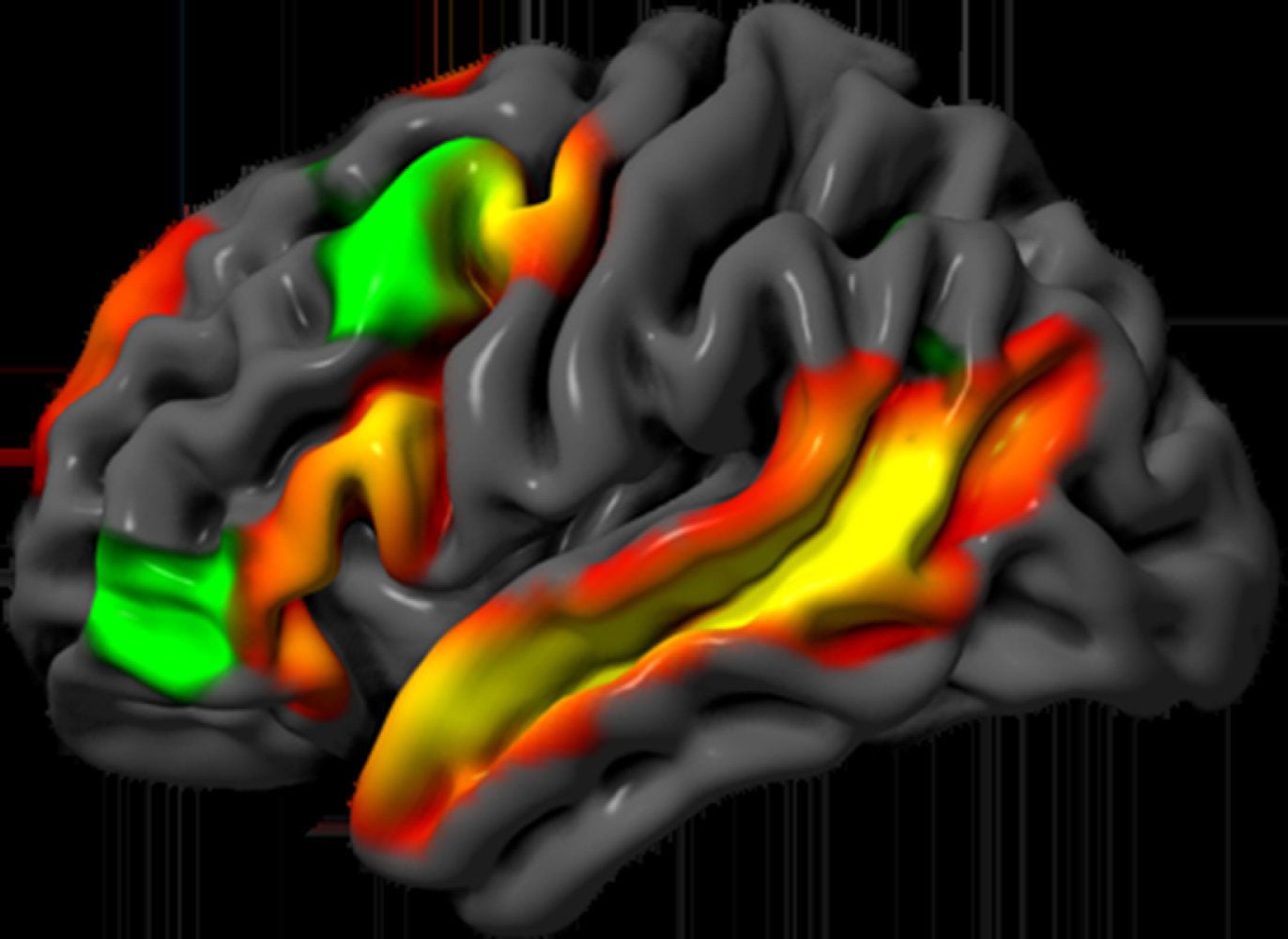
Participants completed several MRI sessions at MIT. Some tasks were designed to locate each person’s language-processing regions, while others mapped the so-called “multiple demand network” — a distributed brain system that supports complex problem-solving.
Inside the scanner, participants worked through logic games resembling those completed by the patients. They also answered syllogistic problems built around “if-then” statements, including examples such as “if the ball is red, then it is big. The ball is red. Is the ball big?”
The researchers changed the difficulty of the puzzles to identify brain areas that became more active as reasoning demands increased. They also compared two distinct forms of logic: inductive reasoning (when participants identified hidden rules) and deductive reasoning (when they assessed the validity of syllogistic conclusions).
The scans showed that neither type of reasoning activated the brain’s language system. The multiple demand network did respond during inductive reasoning, but unexpectedly, it did not appear to participate in deductive reasoning. Kean is continuing to investigate that difference.
Taken together, the behavioral and imaging evidence supports a separation between language and logic in the brain. The findings also extend earlier work from Fedorenko’s lab showing that object categorization and social reasoning can proceed without relying on the language system.
Language loss does not mean lost intelligence
This matters beyond theoretical debates because it affects how people interpret aphasia, an acquired impairment that disrupts the ability to understand or produce language. Clinicians have long recognized that losing language does not mean losing intelligence, yet communication difficulties are often mistaken for impaired thought.
People with aphasia may still manage finances, play chess, complete sudoku puzzles, and make complex decisions. Their difficulty lies in expressing or receiving language, not necessarily in understanding relationships, rules, or consequences.
“This research adds to a growing body of work establishing that even severely aphasic individuals can preserve their ability for abstract logical thought — a defining feature of our species,” Fedorenko says. “We should continue to educate the public that linguistic difficulties — in aphasia, but also in those with developmental language conditions, such as stuttering, or those who do not speak English natively — are not indicative of how smart or capable someone is.”
The results may also inform research on artificial intelligence. Large language models such as ChatGPT and Claude learn from text and generate text, yet they can imitate certain forms of human reasoning. Comparing those systems with the human brain, where language and abstract logic appear to operate separately, could help researchers understand what current models are actually doing and how future systems might be designed, Kean says.
For Kean, the broader goal is to map the still uncertain organization of human thought. She describes the effort to identify where and how the brain performs reasoning as a new frontier in the geography of thought, and one she intends to continue exploring.
Reference: “Evidence from formal logical reasoning reveals that the language of thought is not natural language” by Hope Kean, Alexander Fung, Paris Jaggers, Jason Chen, Joshua S. Rule, Yael Benn, Joshua B. Tenenbaum, Steven T. Piantadosi, Rosemary A. Varley and Evelina Fedorenko, 6 July 2026, Proceedings of the National Academy of Sciences.
DOI: 10.1073/pnas.2520095123
Never miss a breakthrough: Join the SciTechDaily newsletter.
Follow us on Google and Google News.