
Close Menu
    Facebook X (Twitter) Instagram
    SciTechDaily
    • Biology
    • Chemistry
    • Earth
    • Health
    • Physics
    • Science
    • Space
    • Technology
    Facebook X (Twitter) Pinterest YouTube RSS
    SciTechDaily
    Home»Earth»The Fish Farms of Hainan Island in the South China Sea
    Earth

    The Fish Farms of Hainan Island in the South China Sea

    By NASA Earth ObservatoryOctober 9, 2021No Comments2 Mins Read
    Facebook Twitter Pinterest Telegram LinkedIn WhatsApp Email Reddit
    Share
    Facebook Twitter LinkedIn Pinterest Telegram Email Reddit
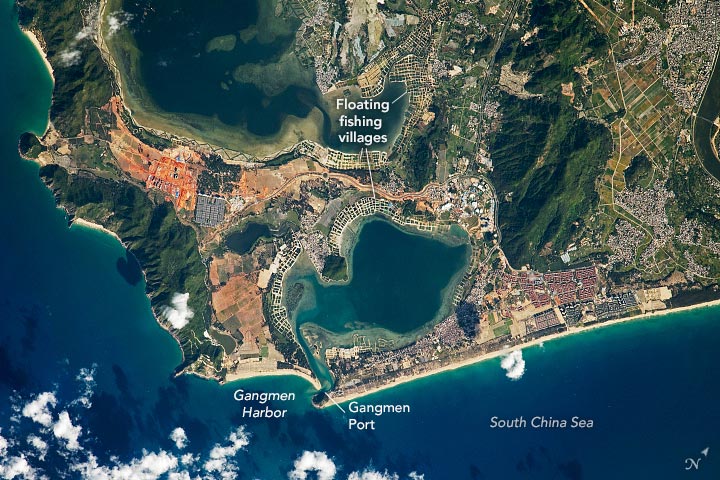
    Hainan Island Annotated
    May 9, 2021

    The southern coasts of this Chinese island are lined with tropical beaches, while the inner bays are lined with floating fishing villages.

    Situated in the South China Sea, the large island of Hainan is China’s southernmost province, spanning approximately 339,000 hectares (1,300 square miles). This photograph, taken by an astronaut onboard the International Space Station (ISS), focuses on the landscape around Gangmen Harbor and captures many typical characteristics of Hainan: forested mountain terrain juxtaposed with dense populations. Cleared lands show up with bright orange and red soils that owe their color to the oxidation of iron-rich sediments. The coasts are lined with tropical beaches, while the inner bays are lined with floating fishing villages often built in a grid-like patterns in shallow waters.

    Língshui Li Autonomous County, at the south end of Hainan, sustains a large nomadic sea community. China is already a world leader in wild catch fish production, and fish farming is rapidly expanding. China grows nearly 60 percent of the world’s farmed fish, particularly for carp and tilapia. These aquaculture sites are often paired with fishing ports (such as Gangmen) that provide efficient transport for fish, machinery, and construction materials needed to sustain aquacultural production.

    Astronaut photograph ISS065-E-31198 was acquired on May 9, 2021, with a Nikon D5 digital camera using a focal length of 1150 millimeters. It is provided by the ISS Crew Earth Observations Facility and the Earth Science and Remote Sensing Unit, Johnson Space Center. The image was taken by a member of the Expedition 65 crew. The image has been cropped and enhanced to improve contrast, and lens artifacts have been removed. The International Space Station Program supports the laboratory as part of the ISS National Lab to help astronauts take pictures of Earth that will be of the greatest value to scientists and the public, and to make those images freely available on the Internet. Caption by Amber Turner and Andrea Meado, Jacobs, JETS Contract at NASA-JSC.

    Never miss a breakthrough: Join the SciTechDaily newsletter.
    Follow us on Google and Google News.

    Fish Geography NASA NASA Earth Observatory
    Share. Facebook Twitter Pinterest LinkedIn Email Reddit

    Related Articles

    NASA Picturing Earth: Astronaut Photography In Focus [Video]

    Coloring the Great Salt Lake – Astronaut Takes Beautiful Photograph From Space Station

    Sea Ice in Denmark Strait – Drifted More Than 1,000 Km (600 Miles) From the Arctic Ocean

    NASA Scientists Map Beirut Blast Damage – Devastating Explosion Rocked Port Area

    NASA Advanced Rapid Imaging Satellite Maps Blast Damage: Beirut Explosion Aftermath

    NASA/NOAA Satellites Observe Surprisingly Rapid Increase in Scale and Intensity of Fires in Siberia

    Mars Terraforming: Cultivating Ideas for Mars on Earth

    Meandering Mississippi River: Photo Taken by Astronaut on Space Station Shows Divergence From State Boundaries

    Incredible Rare Peek at Patagonia in Winter

    Leave A Reply Cancel Reply

    • Facebook
    • Twitter
    • Pinterest
    • YouTube

    Don't Miss a Discovery

    Subscribe for the Latest in Science & Tech!

    Trending News

    Once-in-a-Century Impact: NASA Just Found a Massive New Crater on the Moon

    Anak Krakatau Just Blasted Ash 50,000 Feet Into the Sky

    NASA’s Chandra Reveals Galaxies Being Torn Apart, Blasted by Black Holes, and Reborn in Stars

    Ozempic’s Active Ingredient Shows Surprising Anti-Aging Effects

    Scientists Discover Canada’s First Dinosaur Tracks From a Rarely Documented Cretaceous Age

    Astronomers Just Caught a Giant Planet in the Act of Forming

    Two Dead Stars Are Racing Around Each Other Every 6.2 Minutes

    Natural Compound May Help Protect the Brain and Heart From Excess Salt

    Follow SciTechDaily
    • Facebook
    • Twitter
    • YouTube
    • Pinterest
    • Newsletter
    • RSS
    SciTech News
    • Biology News
    • Chemistry News
    • Earth News
    • Health News
    • Physics News
    • Science News
    • Space News
    • Technology News
    Recent Posts
    • Scientists Pinpoint a Possible “Sweet Spot” for Life’s Origins 4.33 Billion Years Ago
    • Scientists Reveal What Could Happen if Yellowstone Erupted Now
    • Brain Differences May Explain Why Some Children Struggle at Math
    • Scientists Test an Unexpected Sleep Aid Made From Tree Roots
    • Scientists Discover a Molecular “Memory” That Could Make Lost Weight Come Back
    Copyright © 1998 - 2026 SciTechDaily. All Rights Reserved.
    • Science News
    • About
    • Contact
    • Editorial Board
    • Privacy Policy
    • Terms of Use

    Type above and press Enter to search. Press Esc to cancel.