
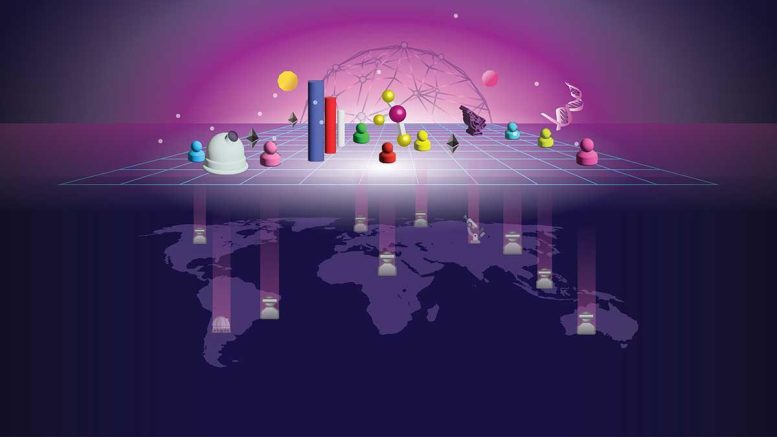
A researcher from Notre Dame advises that we should move past the excitement and examine how virtual reality could enhance the efficiency of scientists. However, in order to harness these advantages, researchers need to carefully strategize and sidestep possible drawbacks.
In 2021, Facebook brought the term “metaverse” to the forefront of internet discourse by renaming itself as Meta and announcing a plan to build “a set of interconnected digital spaces that lets you do things you can’t do in the physical world.” Since then, the metaverse has been called many different things. Some people see it as the “future of the internet” while others dismiss it as “an amorphous concept that no one really wants.”
For Diego Gómez-Zará, an assistant professor in the University of Notre Dame’s Department of Computer Science and Engineering, the metaverse is something else: a tool for better science.
In a paper recently published in Nature Human Behavior, Gómez-Zará argues that scientists should take advantage of the metaverse for research while also guarding against the potential hazards that come with working in virtual reality.
Virtual Environments, Real Benefits
Along with co-authors Peter Schiffer (Department of Applied Physics and Department of Physics, Yale University) and Dashun Wang (McCormick School of Engineering, Northwestern University), Gómez-Zará defines the metaverse as a virtual space where users can interact in a three-dimensional environment and take actions that affect the world outside.
The researchers say the metaverse stands to benefit science in four main ways.
First, it could remove barriers and make science more accessible. To understand these opportunities, Gómez-Zará says, we need not speculate about the distant future. Instead, we can point to ways researchers have already begun using virtual environments in their work.
At the University College London School of Pharmacy, for example, scientists have made a digital replica of their lab that can be visited in virtual reality. This digital replica allows scientists at various points around the world to meet, collaborate and make decisions together about how to move a research project forward.
Similarly, a virtual laboratory training developed by the Centers for Disease Control and Prevention teaches young scientists in many different locations to identify the parts of a lab and even conduct emergency procedures.
This example shows a second benefit: improving teaching and learning.
Gómez-Zará explains, “For someone training to become a surgeon, it is very hard to perform a procedure for the first time without any mistakes. And if you are working with a real patient, a mistake can be very harmful. Experiential learning in a virtual environment can help you try something and make mistakes along the way without harmful consequences, and the freedom from harmful consequences can improve research in other fields as well.”
Gómez-Zará is also working with a team at Notre Dame’s Virtual Reality Lab to understand a third potential benefit, one related to the social side of science. The research team studies the effects of online environments on a team’s work processes. They find that virtual environments can help teams collaborate more effectively than videoconferencing.
“Since the pandemic, we have all become comfortable videoconferencing,” says Gómez-Zará. “But that doesn’t mean getting on a video call is the most effective tool for every task. Especially for intense social activities like team building and innovation, virtual reality is a much closer replica of what we would have offline and could prove much more effective.”
Gómez-Zará says the metaverse could also be used to create wholly new experimental environments.
“If you can get data and images from somewhere, you can create a virtual replica of that place in virtual reality,” Gómez-Zará explains. For example, he says, we have images of Mars captured by satellites and robots. “These could be used to create a virtual reality version of the environment where scientists can experience what it is like there. Eventually, they could even interact with the environment from a distance.”
Potential Pitfalls
Gómez-Zará emphasizes that realizing the full benefits of the metaverse will also require us to avoid several pitfalls associated with it.
There are still barriers to using virtual reality. Virtual reality goggles and related equipment, while becoming more affordable, still require a significant investment.
This issue relates to a larger one: Who owns the metaverse? Currently, a few technology companies control the metaverse, but Gómez-Zará notes that there have been calls for agencies and others who support research to invest in building an open, public metaverse. In the meantime, he says, it is important for researchers to think through questions of ownership and privacy any time they work in the metaverse.
His overall message, though, is a hopeful one. “We still tend to associate the metaverse with entertainment and casual socialization. This makes it all too easy to dismiss,” he says. “But look at how quickly we have all adapted to technologies we used rarely before the pandemic. It could be the same way with the metaverse. We need the research community to explore it. That is the best way to plan for the risks while also recognizing all of the possibilities.”
Reference: “The promise and pitfalls of the metaverse for science” by Diego Gómez-Zará, Peter Schiffer and Dashun Wang, 18 May 2023, Nature Human Behaviour.
DOI: 10.1038/s41562-023-01599-5
Never miss a breakthrough: Join the SciTechDaily newsletter.
Follow us on Google and Google News.