
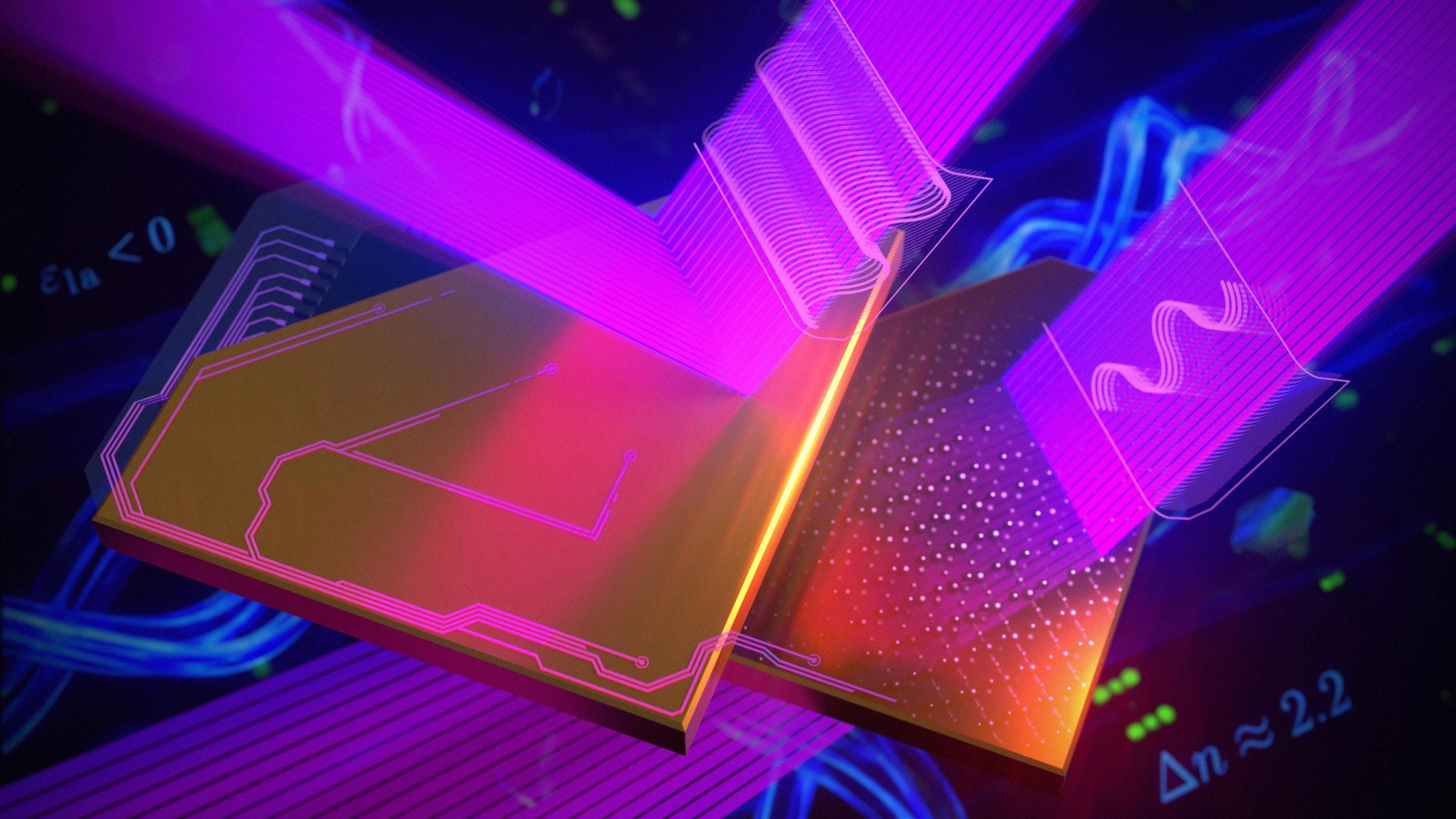
This record-breaking crystal can transform from mirror-like to glass-like, opening the door to tiny optical chips, AR displays, and smart contact lenses.
Creating truly “invisible” wearable technology such as smart contact lenses and ultrathin augmented reality glasses will require a radical rethink of how optical devices are built. Instead of relying on conventional bulky components, researchers are looking for materials that can manipulate light at the atomic scale.
A team from XPANCEO, working with scientists from the National University of Singapore and the University of Chemistry and Technology, Prague, has now identified remarkable properties in a layered crystal called molybdenum oxychloride (MoOCl2). Their findings, published in Nano Letters, could help pave the way for dramatically smaller optical technologies.
A Crystal That Behaves Like Both Metal and Glass
The researchers produced the first complete experimental map of MoOCl2‘s optical properties and found that it exhibits the strongest light-bending effect ever measured in a natural material.
What makes the crystal especially unusual is that its behavior changes depending on how it is oriented. In one direction, it reflects light like a metal. Rotate it by 90 degrees, and it becomes transparent like glass.
Scientists describe this behavior as extreme optical anisotropy. The crystal’s response to light varies dramatically depending on direction. With an in-plane birefringence value of about 2.2, MoOCl2 can split and redirect light with exceptional efficiency.
For developers working on wearable displays, this capability is particularly attractive. It suggests that optical functions currently performed by larger components could someday be achieved using materials thousands of times thinner than a human hair.
A Rare Ability to Slow Down Light
The team also discovered a rare epsilon-near-zero point at 512 nm (green light).
At this specific wavelength, part of the material’s optical response falls close to zero. As a result, light effectively slows down inside the crystal while the internal electric field becomes much stronger.
This effect can significantly boost interactions between light and matter, an advantage for integrated photonic chips that process information using light rather than electricity. Stronger interactions can enable faster data processing while consuming less power.
Why Physicists Are Interested in MoOCl2
Researchers have been studying MoOCl2 for several years because of its unusual electronic structure.
The material is classified as a “bad metal” and contains one-dimensional chains of molybdenum atoms. These chains allow electrons to move more easily in one direction than another. As a result, the crystal behaves like a metal along one axis and like a dielectric material along the perpendicular axis.
This unusual combination gives MoOCl2 its exceptionally strong anisotropy.
Previous studies published in Science and Nature Communications had already revealed that the crystal could support tightly confined light waves called hyperbolic plasmon polaritons. Those experiments showed that light could travel through the material in highly directional and unexpected ways.
However, one important piece of the puzzle was still missing. Scientists could observe these effects, but they had not directly measured the fundamental optical constants responsible for them. Without those measurements, designing practical devices remained difficult.
Visible-Light ENZ Behavior Opens New Possibilities
The new study fills that gap.
The measurements confirmed that near 512 nanometers in the green portion of the visible spectrum, one component of the material’s optical response approaches zero. This visible-light epsilon-near-zero, or ENZ, point allows electromagnetic energy to become highly concentrated inside the crystal, increasing light–matter interactions.
Many materials reach ENZ conditions only in the deep ultraviolet or mid-infrared regions. MoOCl2 is unusual because it does so in the visible spectrum, where many existing lasers, microscopes, cameras, and sensing technologies already operate.
“Observing a phenomenon is the first step, but engineering requires precise numbers,” said Dr. Valentyn Volkov, founder and CTO of XPANCEO and corresponding author of the study. “By rigorously measuring the complete dielectric tensor of MoOCl2, our work provides the experimental foundation needed to understand why this material behaves the way it does and to design around it with greater confidence. That makes it a valuable scientific result for the field, with possible relevance across compact polarization optics, nonlinear devices, and, in the longer term, highly miniaturized integrated systems including smart contact lenses.”
Shrinking Optical Hardware Onto Chips
The detailed optical map also highlights how MoOCl2 could help reduce the size of future optical systems.
Because of its extreme structural anisotropy, the crystal naturally functions as a hyperbolic medium. In practical terms, this allows light to travel through the material as highly directional nanoscale rays without diffracting (or scattering), an essential feature for building smaller optical circuits.
Its ability to operate in the visible range further increases its appeal for integrated photonic chips, where light must be guided, filtered, and concentrated within extremely small spaces.
The researchers point to several potential applications. These include ultrathin broadband polarizers that control the direction of light in compact optical devices, as well as sub-diffractional waveguides capable of directing light through spaces smaller than conventional optics allow.
The material could also advance nonlinear nanophotonics, a field that uses intense light–matter interactions to generate new colors of light and process optical signals more efficiently.
Taken together, the findings provide a new foundation for designing ultracompact optical technologies and bring futuristic devices such as smart contact lenses and next-generation AR displays a step closer to reality.
Reference: “Giant Optical Anisotropy and Visible-Frequency Epsilon-near-Zero in Hyperbolic van der Waals MoOCl2” by Georgy Ermolaev, Adilet Toksumakov, Aleksandr Slavich, Anton Minnekhanov, Gleb Tselikov, Arslan Mazitov, Ivan Kruglov, Gleb Tikhonowski, Mikhail Mironov, Ilya P. Radko, Dmitriy Grudinin, Ilia Fradkin, Andrey Vyshnevyy, Zdeněk Sofer, Aleksey Arsenin, Kostya S. Novoselov and Valentyn Volkov, 16 March 2026, Nano Letters.
DOI: 10.1021/acs.nanolett.5c06153
Never miss a breakthrough: Join the SciTechDaily newsletter.
Follow us on Google and Google News.