

Natural Products Collection Reveals Novel Enzymes With Surprising Properties
Slumbering among thousands of bacterial strains in a collection of natural specimens at The Herbert Wertheim UF Scripps Institute for Biomedical Innovation & Technology, several fragile vials held something unexpected, and possibly very useful.
Novel Enzymes Unveiled
Writing in the journal Nature Chemical Biology, a team led by chemist Ben Shen, Ph.D., described the discovery of two new enzymes, ones with uniquely useful properties that could help in the fight against human diseases including cancer. The discovery, published last week, offers potentially easier ways to study and manufacture complex natural chemicals, including those that could become medicines.
Impact on Drug Discovery
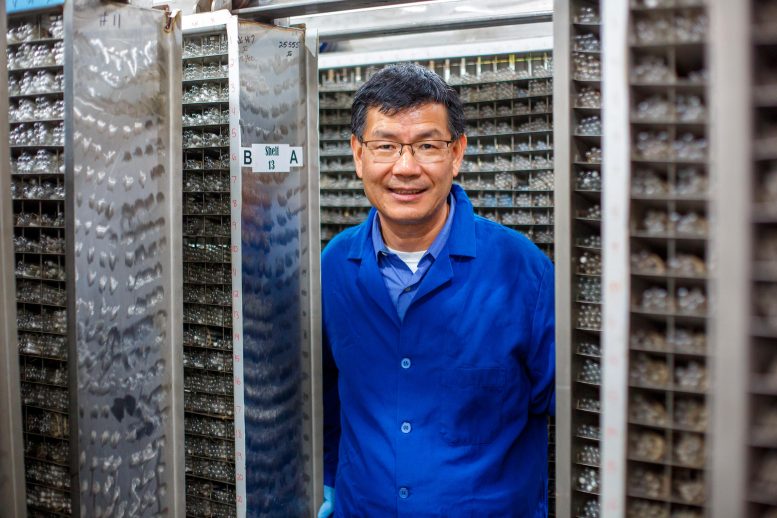
The contribution of bacterial chemicals to the history of drug discovery is remarkable, said Shen, who directs the Natural Products Discovery Center at the institute, one of the world’s largest microbial natural product collections.
“Few people realize that nearly half of the FDA-approved antibiotics and anticancer drugs on the market are natural products or are inspired by them,” Shen said. “Nature is the best chemist to make these complex natural products. We are applying modern genomic technologies and computational tools to understand their fascinating chemistry and enzymology, and this is leading to progress at unprecedented speed. These enzymes are the latest exciting example.”
Unique Properties of the Discovered Enzymes
The enzymes the team discovered have a descriptive, if unwieldy, name. They are called “cofactorless oxygenases.” This means the bacterial enzymes pull oxygen from the air and incorporate it into new compounds, without requiring the typical metals or other cofactors to initiate the necessary chemical reaction.
This new way of synthesizing defensive substances would confer a survival advantage, enabling the organism to fend off infections or invaders. And because enzymes are to chemists what drill bits or saw blades are to a carpenter, they offer scientists new ways to create useful things, said the paper’s first authors, postdoctoral researchers Chun Gui, Ph.D., and Edward Kalkreuter, Ph.D.
Solving a Lingering Mystery
Most immediately, the discovery of the enzymes, TnmJ and TnmK2, solves a lingering mystery of how a potential antibiotic and anticancer compound the Shen lab had first discovered in 2016, tiancimycin A, achieved such potency, Gui and Kalkreuter said.
The enzymes enable the bacteria to produce compounds for targeting and breaking up DNA, Gui said. This would be immensely useful in fighting off a virus or other germ — or killing cancer.
Tiancimycin A: A Potent Compound
Tiancimycin A is being developed as part of a cancer-targeting antibody therapy. These types of combined antibody-drug therapeutics represent a rapidly growing new approach to fighting cancer. But a critical step to using tiancimycin A as an antibody’s payload is making enough to study it at a larger scale. That proved challenging.
“Even after we identified genes responsible for encoding tiancimycin A, several of the steps required to synthesize it could not be predicted,” Gui said. “The two enzymes described in the current study are highly unusual.”
Tiancimycin A was first found in a soil-dwelling bacteria, a type of Streptomyces from the strain collection at the Natural Products Discovery Center. To make its powerful chemical weapon, the organism had to solve a problem. It somehow had to break three highly stable carbon-carbon bonds and replace them with more reactive carbon-oxygen bonds. For a long time, the scientists couldn’t understand how the bacteria managed that feat.
Unveiling the Collection’s Potential
Cracking the mystery involved finding other tiancimycin A-like natural product-producing bacteria among the institute’s Natural Products Discovery Center collection of 125,000 bacterial strains, and analyzing their genomes to search for the evolutionary hints.
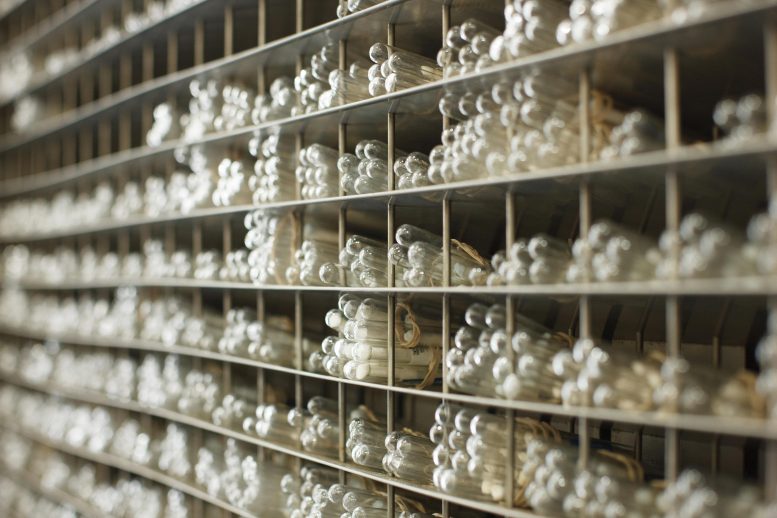
The historic collection had long been housed in a pharmaceutical company’s basement, collected over decades following the discovery of penicillin in the scientific community’s hopeful rush to find the next great antibiotic. The collection did generate several historically important drugs through the years, including the tuberculosis antibiotic streptomycin and the organ transplant drug sirolimus. But the majority of the collection’s freeze-dried bacterial strains had rested in their glass vials, unexplored.
In 2018, Shen won a competition for the collection, so that it could be fully investigated in an academic setting, where it would be open to science. His team is now developing ways to study the strains, read their genomes and deposit the information into a searchable database for the scientific community to access. Modern genome sequencing and bioinformatics techniques are proving that there may be as many as 30 interesting gene clusters in each strain of bacteria they study, and many of them code for natural products never before documented by scientists, said Shen, who is a member of the UF Health Cancer Center.
Future Prospects and Implications
The discovery of the new cofactorless enzymes is but the latest example of the chemical riches that lie within The Wertheim UF Scripps Institute’s collection, Shen said. Their discovery has sparked new excitement about further investigating the reasons the unique chemistry evolved, and the ways it may prove useful.
“This publication underscores how many surprises nature still has for us,” Shen said, “It can teach us much about fundamental chemistry and biology and provide us with the tools and inspiration we need to translate laboratory findings into medicines that impact society and address many problems faced by humanity.”
Reference: “Cofactorless oxygenases guide anthraquinone-fused enediyne biosynthesis” by Chun Gui, Edward Kalkreuter, Yu-Chen Liu, Gengnan Li, Andrew D. Steele, Dong Yang, Changsoo Chang and Ben Shen, 9 November 2023, Nature Chemical Biology.
DOI: 10.1038/s41589-023-01476-2
Never miss a breakthrough: Join the SciTechDaily newsletter.
Follow us on Google and Google News.