
Infrared Emission From Methane Suggests Atmospheric Heating by Auroral Processes
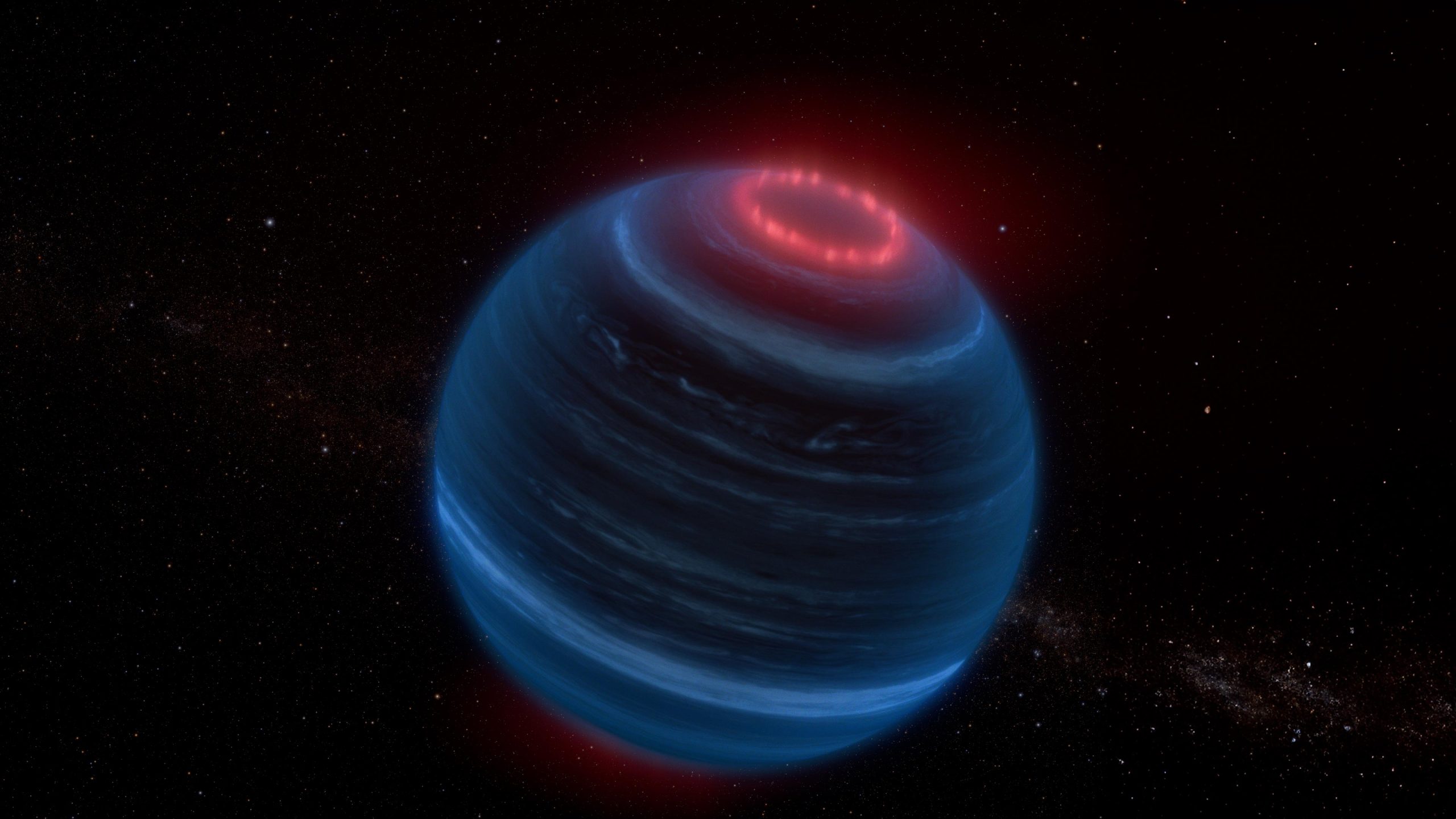
Astronomers using NASA’s James Webb Space Telescope have found a brown dwarf (an object more massive than Jupiter but smaller than a star) that may display possible aurorae, like the familiar Northern Lights on our world. This is an unexpected mystery because the brown dwarf, known as W1935, is an isolated object in space, with no nearby star to create an aurora.
Aurorae on Earth are made when energetic particles from the Sun are captured by our planet’s magnetic field. Those particles cascade down into our atmosphere near Earth’s poles, colliding with gas molecules and creating eerie, dancing curtains of light. Since W1935 has no star to generate a stellar wind, it’s possible that external interactions with either interstellar plasma or a nearby active moon (like Jupiter’s Io) may help account for the observed infrared emission.
Webb Space Telescope Finds Signs of Possible Aurorae on Isolated Brown Dwarf
Astronomers using NASA’s James Webb Space Telescope have found a brown dwarf (an object more massive than Jupiter but smaller than a star) with infrared emission from methane, likely due to energy in its upper atmosphere. This is an unexpected discovery because the brown dwarf, W1935, is cold and lacks a host star; therefore, there is no obvious source for the upper atmosphere energy. The team speculates that the methane emission may be due to processes generating aurorae.
These findings are being presented at the 243rd meeting of the American Astronomical Society in New Orleans.
To help explain the mystery of the infrared emission from methane, the team turned to our solar system. Methane in emission is a common feature in gas giants like Jupiter and Saturn. The upper-atmosphere heating that powers this emission is linked to aurorae.
Aurorae in Our Solar System
On Earth, aurorae are created when energetic particles blown into space from the Sun are captured by Earth’s magnetic field. They cascade down into our atmosphere along magnetic field lines near Earth’s poles, colliding with gas molecules and creating eerie, dancing curtains of light. Jupiter and Saturn have similar auroral processes that involve interacting with the solar wind, but they also get auroral contributions from nearby active moons like Io (for Jupiter) and Enceladus (for Saturn).
For isolated brown dwarfs like W1935, the absence of a stellar wind to contribute to the auroral process and explain the extra energy in the upper atmosphere required for the methane emission is a mystery. The team surmises that either unaccounted internal processes like the atmospheric phenomena of Jupiter and Saturn, or external interactions with either interstellar plasma or a nearby active moon may help account for the emission.
A Detective Story
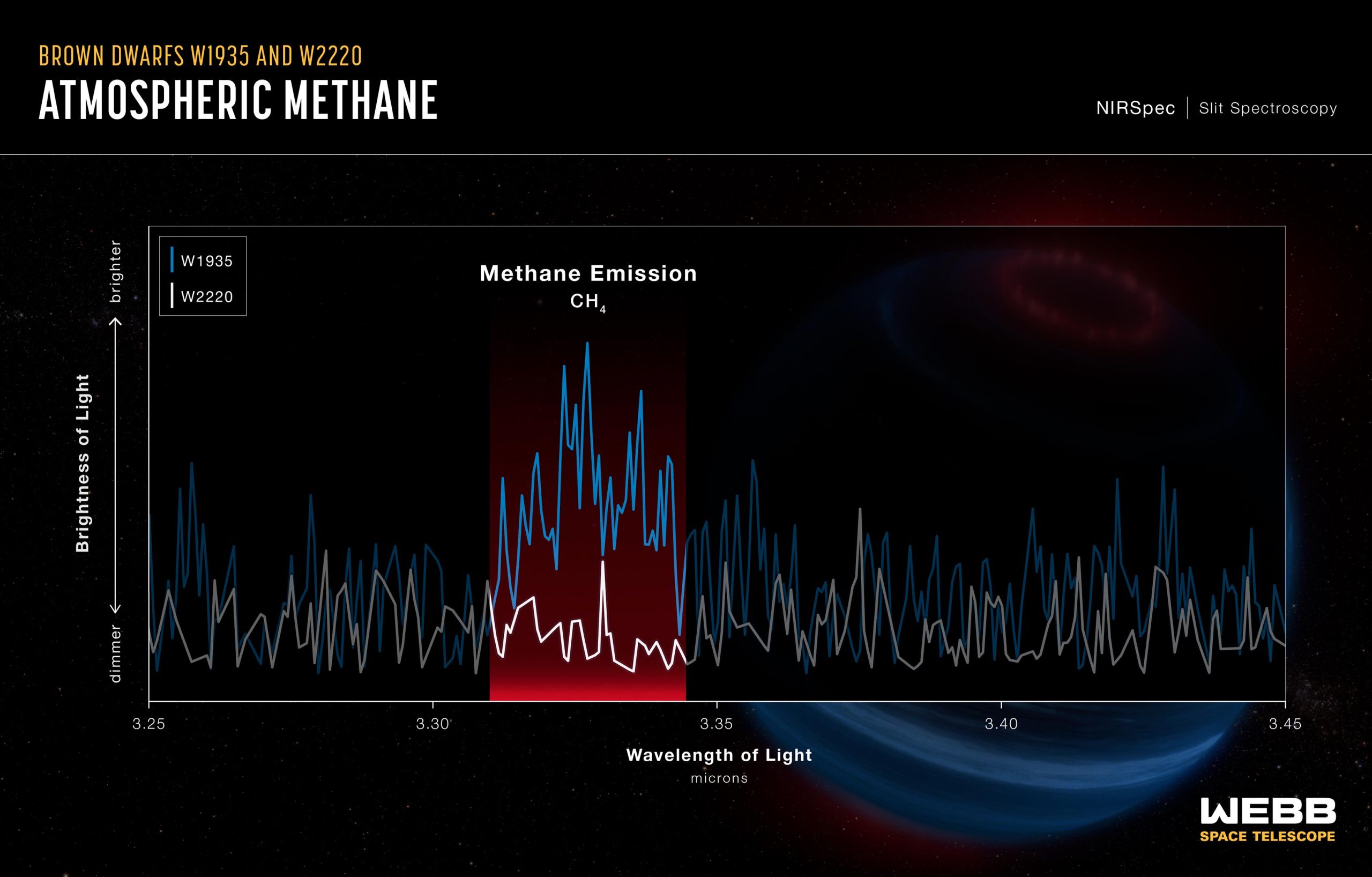
The aurorae’s discovery played out like a detective story. A team led by Jackie Faherty, an astronomer at the American Museum of Natural History in New York, was awarded time with the Webb telescope to investigate 12 cold brown dwarfs. Among those were W1935 – an object that was discovered by citizen scientist Dan Caselden, who worked with the Backyard Worlds Zooniverse project – and W2220, an object that was discovered using NASA’s Wide Field Infrared Survey Explorer. Webb revealed in exquisite detail that W1935 and W2220 appeared to be near clones of each other in composition. They also shared similar brightness, temperatures, and spectral features of water, ammonia, carbon monoxide and carbon dioxide. The striking exception was that W1935 showed emission from methane, as opposed to the anticipated absorption feature that was observed toward W2220. This was seen at a distinct infrared wavelength to which Webb is uniquely sensitive.
“We expected to see methane because methane is all over these brown dwarfs. But instead of absorbing light, we saw just the opposite: The methane was glowing. My first thought was, what the heck? Why is methane emission coming out of this object?” said Faherty.
The team used computer models to infer what might be behind the emission. The modeling work showed that W2220 had an expected distribution of energy throughout the atmosphere, getting cooler with increasing altitude. W1935, on the other hand, had a surprising result. The best model favored a temperature inversion, where the atmosphere got warmer with increasing altitude.
“This temperature inversion is really puzzling,” said Ben Burningham, a co-author from the University of Hertfordshire in England and lead modeler on the work. “We have seen this kind of phenomenon in planets with a nearby star that can heat the stratosphere, but seeing it in an object with no obvious external heat source is wild.”
Clues From Our Solar System
For clues, the team looked in our own backyard, to the planets of our solar system. The gas giant planets can serve as proxies for what is seen going on more than 40 light-years away in the atmosphere of W1935.
The team realized that temperature inversions are prominent in planets like Jupiter and Saturn. There is still ongoing work to understand the causes of their stratospheric heating, but leading theories for the solar system involve external heating by aurorae and internal energy transport from deeper in the atmosphere (with the former a leading explanation).
Brown Dwarf Aurora Candidates in Context
This is not the first time an aurora has been used to explain a brown dwarf observation. Astronomers have detected radio emission coming from several warmer brown dwarfs and invoked aurorae as the most likely explanation. Searches were conducted with ground-based telescopes like the Keck Observatory for infrared signatures from these radio-emitting brown dwarfs to further characterize the phenomenon but were inconclusive.
W1935 is the first auroral candidate outside the solar system with the signature of methane emission. It’s also the coldest auroral candidate outside our solar system, with an effective temperature of about 400 degrees Fahrenheit (200 degrees Celsius), about 600 degrees Fahrenheit warmer than Jupiter.
In our solar system, the solar wind is a primary contributor to auroral processes, with active moons like Io and Enceladus playing a role for planets like Jupiter and Saturn, respectively. W1935 lacks a companion star entirely, so a stellar wind cannot contribute to the phenomenon. It is yet to be seen whether an active moon might play a role in the methane emission on W1935.
“With W1935, we now have a spectacular extension of a solar system phenomenon without any stellar irradiation to help in the explanation,” Faherty noted. “With Webb, we can really ‘open the hood’ on the chemistry and unpack how similar or different the auroral process may be beyond our solar system,” she added.
The James Webb Space Telescope is the world’s premier space science observatory. Webb is solving mysteries in our solar system, looking beyond to distant worlds around other stars, and probing the mysterious structures and origins of our universe and our place in it. Webb is an international program led by NASA with its partners, ESA (European Space Agency) and the Canadian Space Agency.
Never miss a breakthrough: Join the SciTechDaily newsletter.
Follow us on Google and Google News.