
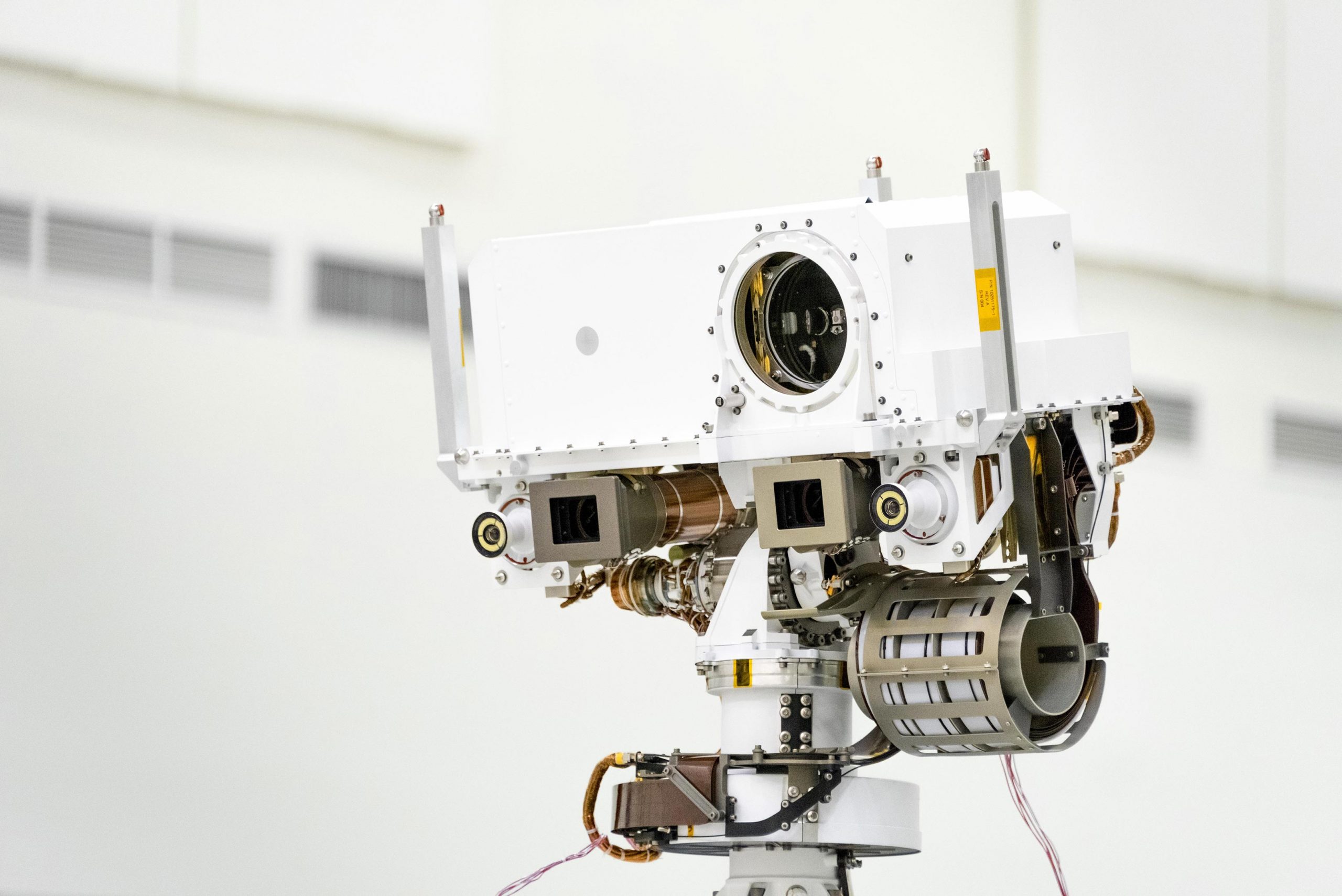
SuperCam is a rock-vaporizing instrument that will help scientists hunt for Mars fossils.
NASA is sending a new laser-toting robot to Mars. But unlike the lasers of science fiction, this one is used for studying mineralogy and chemistry from up to about 20 feet (7 meters) away. It might help scientists find signs of fossilized microbial life on the Red Planet, too.
One of seven instruments aboard the Mars 2020 rover that launches this summer, SuperCam was built by a team of hundreds and packs what would typically require several sizable pieces of equipment into something no bigger than a cereal box. It fires a pulsed laser beam out of the rover’s mast, or “head,” to vaporize small portions of rock from a distance, providing information that will be essential to the mission’s success.
Here’s a closer look at what makes the instrument so special:
A Far Reach
Using a laser beam will help researchers identify minerals that are beyond the reach of the rover’s robotic arm or in areas too steep for the rover to go. It will also enable them to analyze a target before deciding whether to guide the rover there for further analysis. Of particular interest: minerals that formed in the presence of liquid water, like clays, carbonates, and sulfates. Liquid water is essential to the existence of life as we know it, including microbes, which could have survived on Mars billions of years ago.
Scientists can also use the information from SuperCam to help decide whether to capture rock cores for the rover’s sample caching system. Mars 2020 will collect these core samples in metal tubes, eventually depositing them at a predetermined location for a future mission to retrieve and bring back to Earth.
Laser Focus
SuperCam is essentially a next-generation version of the Curiosity rover’s ChemCam. Like its predecessor, SuperCam can use an infrared laser beam to heat the material it impacts to around 18,000 degrees Fahrenheit (10,000 degrees Celsius) — a method called laser induced breakdown spectroscopy, or LIBS — and vaporizes it. A special camera can then determine the chemical makeup of these rocks from the plasma that is created.
The Mast Unit for Mars 2020’s SuperCam, shown being tested here, will use a laser to vaporize and study rock material on the Red Planet’s surface. Credit: LANL
Just like ChemCam, SuperCam will use artificial intelligence to seek out rock targets worth zapping during and after drives, when humans are out of the loop. In addition, this upgraded A.I. lets SuperCam point very precisely at small rock features.
Another new feature in SuperCam is a green laser that can determine the molecular composition of surface materials. This green beam excites the chemical bonds in a sample and produces a signal depending on which elements are bonded together — a technique called Raman spectroscopy. SuperCam also uses the green laser to cause some minerals and carbon-based chemicals to emit light, or fluoresce.
Minerals and organic chemicals fluoresce at different rates, so SuperCam’s light sensor features a shutter that can close as quickly as 100 nanoseconds at a time — so fast that very few photons of light will enter it. Altering the shutter speed (a technique called time-resolved luminescence spectroscopy) will enable scientists to better determine the compounds present.
Moreover, SuperCam can use visible and infrared (VISIR) light reflected from the Sun to study the mineral content of rocks and sediments. This VISIR technique complements the Raman spectroscopy; each technique is sensitive to different types of minerals.
Laser With a Mic Check
SuperCam includes a microphone so scientists can listen each time the laser hits a target. The popping sound created by the laser subtly changes depending on a rock’s material properties.
“The microphone serves a practical purpose by telling us something about our rock targets from a distance. But we can also use it to directly record the sound of the Martian landscape or the rover’s mast swiveling,” said Sylvestre Maurice of the Institute for Research in Astrophysics and Planetary Science in Toulouse, France.
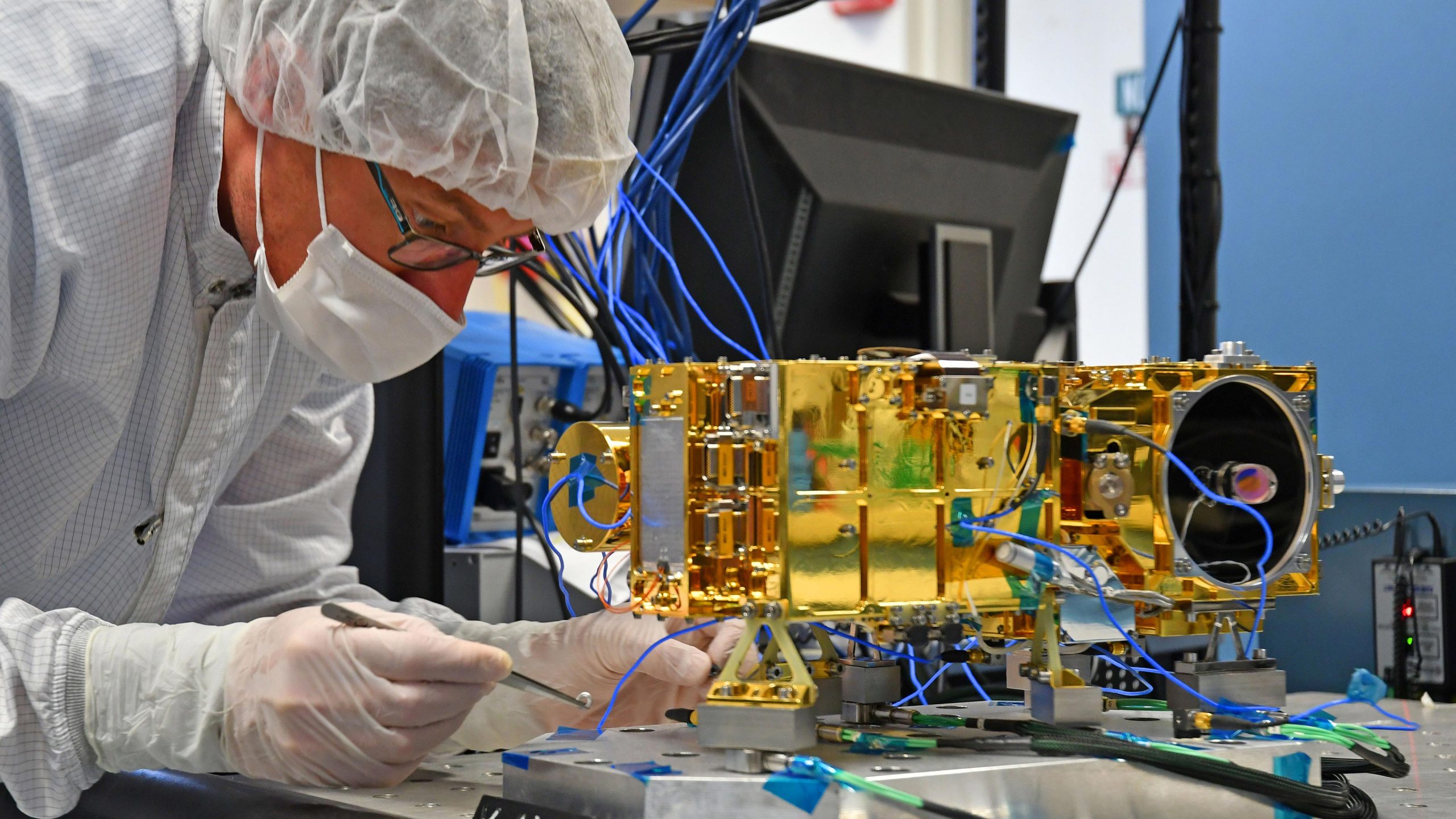
The Mast Unit for Mars 2020’s SuperCam, shown being tested here, will use a laser to vaporize and study rock material on the Red Planet’s surface. Credit: LANL
The Mars 2020 rover marks the third time this particular microphone design will go to the Red Planet, Maurice said. In the late 1990s, the same design rode aboard the Mars Polar Lander, which crashed on the surface. In 2008, the Phoenix mission experienced electronics issues that prevented the microphone from being used.
In the case of Mars 2020, SuperCam doesn’t have the only microphone aboard the rover: an entry, descent and landing microphone will capture all the sounds of the car-sized rover making its way to the surface. It will add audio to full-color video recorded by the rover’s cameras, capturing a Mars landing like never before.
Teamwork
SuperCam is led by Los Alamos National Laboratory in New Mexico, where the instrument’s Body Unit was developed. That part of the instrument includes several spectrometers, control electronics, and software.
The Mast Unit was developed and built by several laboratories of the CNRS (French research center) and French universities under the contracting authority of CNES (French space agency). Calibration targets on the rover deck are provided by Spain’s University of Valladolid.
JPL is building and will manage operations of the Mars 2020 rover for the NASA Science Mission Directorate at the agency’s headquarters in Washington.
Never miss a breakthrough: Join the SciTechDaily newsletter.
Follow us on Google and Google News.