
Close Menu
    Facebook X (Twitter) Instagram
    SciTechDaily
    • Biology
    • Chemistry
    • Earth
    • Health
    • Physics
    • Science
    • Space
    • Technology
    Facebook X (Twitter) Pinterest YouTube RSS
    SciTechDaily
    Home»Space»Astronomers Hypothesize that Milky Way Might Be Teeming with Planets
    Space

    Astronomers Hypothesize that Milky Way Might Be Teeming with Planets

    By SciTechDailyJanuary 12, 2012No Comments3 Mins Read
    Facebook Twitter Pinterest Telegram LinkedIn WhatsApp Email Reddit
    Share
    Facebook Twitter LinkedIn Pinterest Telegram Email Reddit
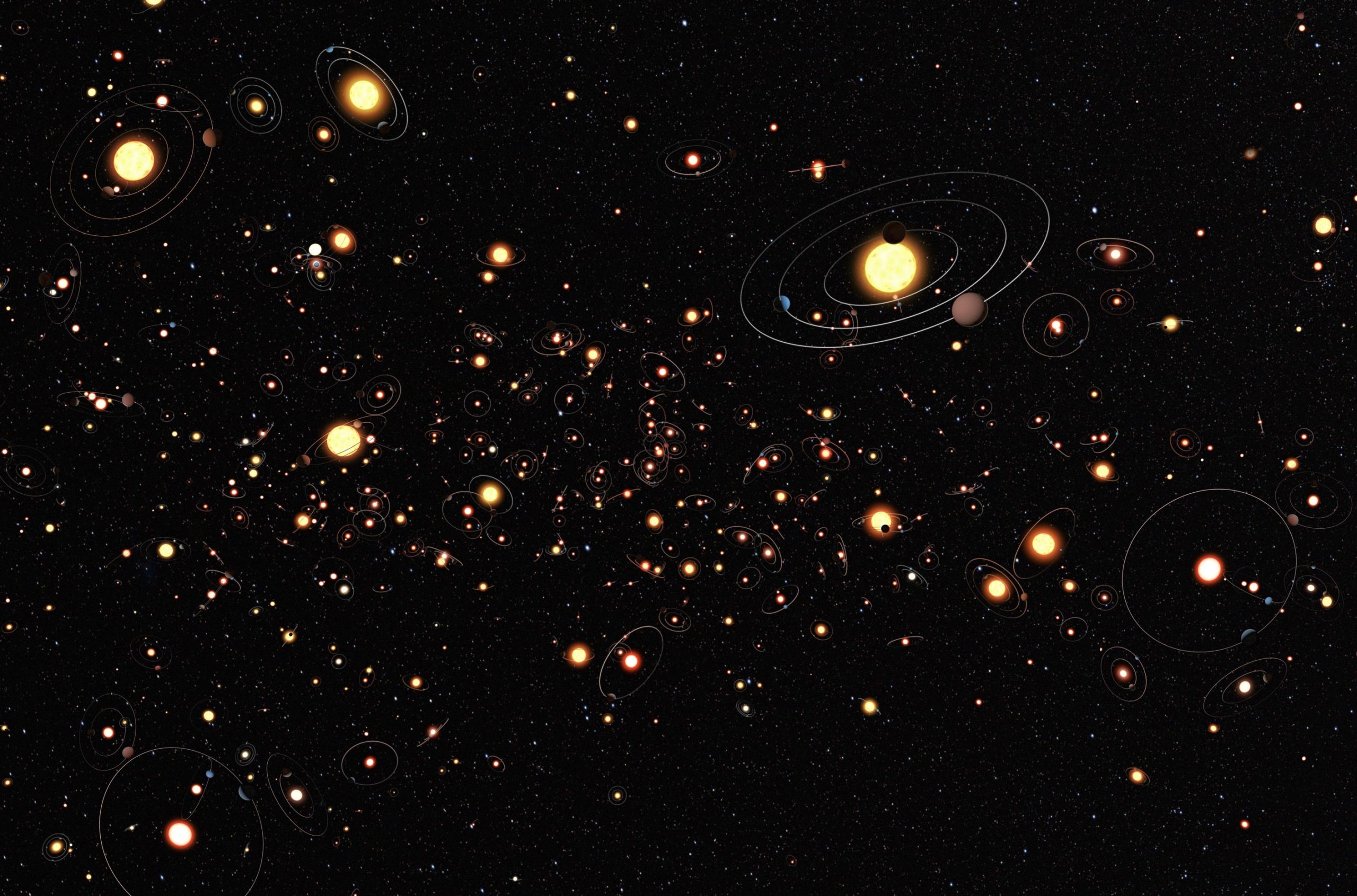
    Planets Common Around Stars in Milky Way Galaxy
    This artist’s illustration gives an impression of how common planets are around the stars in the Milky Way. The planets, their orbits, and their host stars are all vastly magnified compared to their real separations. Credit: NASA/ESA/ES

    In the past, astronomers had no evidence that there were planets orbiting other stars. Now, they estimate that the Milky Way might contain huge numbers of planets, with rocky, Earth-sized worlds outnumbering the rest.

    Astronomers have been using a technique based on Einstein’s Theory of Relativity, which implies that massive objects bend the fabric of spacetime. Kailash Sahu of the Space Telescope Science Institute in Baltimore, Maryland, states that on average, every star has a planet and since there are 100 billion stars in our galaxy, there might be as many as 100 billion planets. Sahu co-authored a new study, which appeared in Nature on January 11th.

    Kepler-35 System
    The Kepler-35 System: An artist’s rendition of the Kepler-35 planetary system, in which a Saturn-size planet orbits a pair of stars. Credit: Lynette Cook / extrasolar.spaceart.org

    An exoplanet will bend light as it passes in front of its parent star, causing a slight brightening of the star’s light. Microlensing has allowed astronomers to look at a lot more stars for exoplanets. Unlike other methods, microlensing can discover planets with different masses and distances from their star.

    Sahu’s team looked at 30 different microlensing events and found extrasolar planets that caused three of them. Microlensing observations have been known to miss a percentage of planets, the researchers used statistical analysis to get the number of exoplanets in the galaxy.

    Sahu says that about one-sixth of stars should have Jupiter-like planets, half likely have Neptune-sized planets, and two-thirds should have Earth-like planets.

    Reference: “One or more bound planets per Milky Way star from microlensing observations” by A. Cassan, D. Kubas, J.-P. Beaulieu, M. Dominik, K. Horne, J. Greenhill, J. Wambsganss, J. Menzies, A. Williams, U. G. Jørgensen, A. Udalski, D. P. Bennett, M. D. Albrow, V. Batista, S. Brillant, J. A. R. Caldwell, A. Cole, Ch. Coutures, K. H. Cook, S. Dieters, D. Dominis Prester, J. Donatowicz, P. Fouqué, K. Hill, N. Kains, S. Kane, J.-B. Marquette, R. Martin, K. R. Pollard, K. C. Sahu, C. Vinter, D. Warren, B. Watson, M. Zub, T. Sumi, M. K. Szymański, M. Kubiak, R. Poleski, I. Soszynski, K. Ulaczyk, G. Pietrzyński and Ł. Wyrzykowski, 11 January 2012, Nature.
    DOI: 10.1038/nature10684

    Never miss a breakthrough: Join the SciTechDaily newsletter.
    Follow us on Google and Google News.

    Exoplanet JPL Milky Way Nature
    Share. Facebook Twitter Pinterest LinkedIn Email Reddit

    Related Articles

    Spitzer Images Create 360-Degree View of the Milky Way

    NASA Study Reveals that Carbon Planets May be Waterless

    “Habitable Zone” Might Help Extreme Life Forms Survive on Exoplanets

    Smaller Than Earth, Exoplanet Candidate UCF-1.01 Is Just 33 Light-Years Away

    Searching for “Bubbles” in the Milky Way

    New Planck Mission Images Show Strange Haze and Cold Gas

    Extrasolar Planetary System Suggests Our Own Isn’t That Special

    Milky Way Galaxy Has Over 100 Billion Planets

    Milky Way Galaxy Mosaic of Images from WISE

    Leave A Reply Cancel Reply

    • Facebook
    • Twitter
    • Pinterest
    • YouTube

    Don't Miss a Discovery

    Subscribe for the Latest in Science & Tech!

    Trending News

    Scientists Finally Uncover How a “Forever Chemical” Causes Birth Defects

    Scientists Uncover the Earliest Brain Changes That May Predict Alzheimer’s Decades Before Symptoms

    Surprising New Study Challenges a Century-Old Theory of Habit Formation

    Scientists Turn Seawater Into Drinking Water Without Toxic Brine

    Vitamin D Drug Shows Surprising Promise Against One of the Deadliest Cancers

    NASA’s X-59 Sonic Boom Killer Is Ready for Its Biggest Test Yet

    The Best Exercise Combination for Longevity, According to a 30-Year Study

    Popular Weight-Loss Drug Found To Slow Biological Aging in Landmark Human Trial

    Follow SciTechDaily
    • Facebook
    • Twitter
    • YouTube
    • Pinterest
    • Newsletter
    • RSS
    SciTech News
    • Biology News
    • Chemistry News
    • Earth News
    • Health News
    • Physics News
    • Science News
    • Space News
    • Technology News
    Recent Posts
    • The Probiotic Breakthrough for Natural Anxiety Relief and Better Mental Health
    • Animal vs. Plant Protein: Scientists Found a Surprising Nutritional Difference
    • Tiny Genetic Change Turns Female Mice Into Males, Scientists Discover
    • Scientists Discover Strange New Spider Species That Disguises Itself as a Fungus
    • This Simple Drink Could Help Calm the Inflammation Behind Many Diseases
    Copyright © 1998 - 2026 SciTechDaily. All Rights Reserved.
    • Science News
    • About
    • Contact
    • Editorial Board
    • Privacy Policy
    • Terms of Use

    Type above and press Enter to search. Press Esc to cancel.