
Close Menu
    Facebook X (Twitter) Instagram
    SciTechDaily
    • Biology
    • Chemistry
    • Earth
    • Health
    • Physics
    • Science
    • Space
    • Technology
    Facebook X (Twitter) Pinterest YouTube RSS
    SciTechDaily
    Home»Space»Extrasolar Planetary System Suggests Our Own Isn’t That Special
    Space

    Extrasolar Planetary System Suggests Our Own Isn’t That Special

    By SciTechDailyJanuary 12, 2012No Comments3 Mins Read
    Facebook Twitter Pinterest Telegram LinkedIn WhatsApp Email Reddit
    Share
    Facebook Twitter LinkedIn Pinterest Telegram Email Reddit
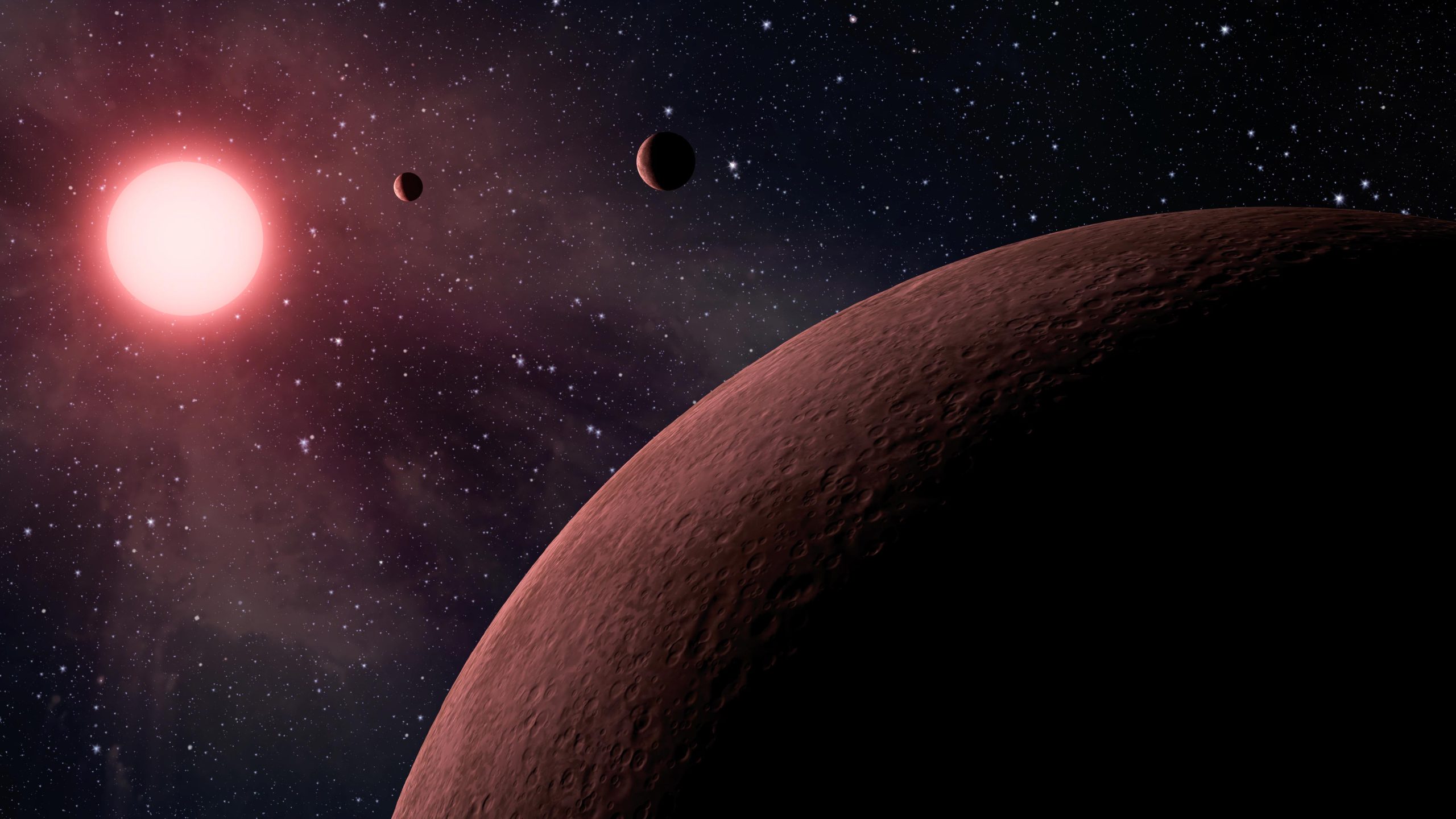
    KOI-961 Mini Planetary System
    Mini Planetary System: This artist’s conception illustrates KOI-961. Credit: NASA/JPL-Caltech

    NASA’s Kepler spacecraft has discovered the three smallest exoplanets ever detected. All of them are smaller than Earth, and the smallest is no larger than Mars. These newly discovered exoplanets actually form a miniature planetary system, which orbits a cool, dim red dwarf star called KOI-961.

    The three planets orbit their star too closely for them to support carbon-based life, but unlike other exoplanets, most of which are Jupiter-scale gas giants, all three are rocky worlds like Earth and other worlds of the inner Solar System. Red dwarf stars are the most common type of stars in the Milky Way, which could imply that the galaxy might be teeming with rocky exoplanets. Some of these might reside in the habitable region around their stars, where temperatures could be right for water to remain liquid, thus supporting life as we know it.
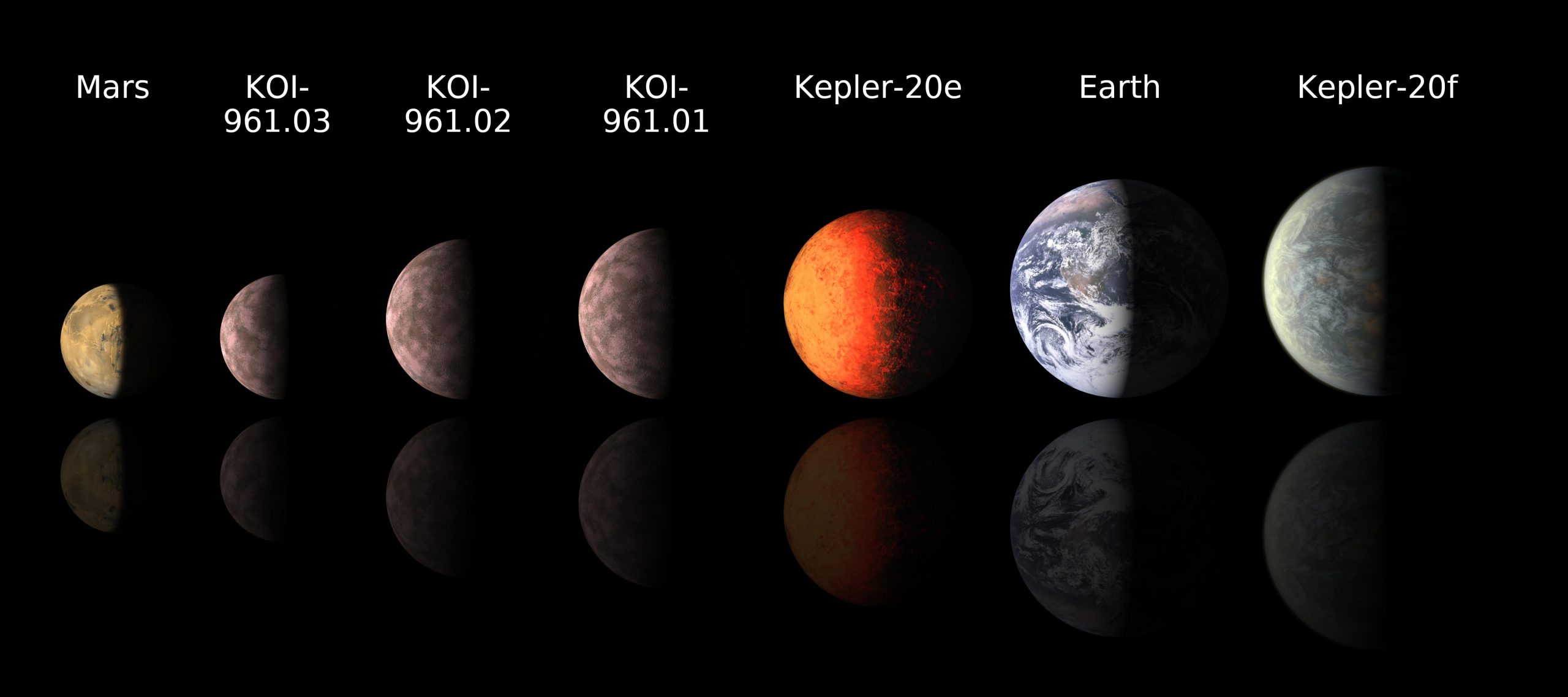
    KOI-961 Sizing Up Exoplanets
    Sizing Up Exoplanets: This chart compares artists’ concepts of the smallest known exoplanets, or planets orbiting outside the solar system, to our own planets Mars and Earth. Credit: NASA/JPL-Caltech

    Astronomer Sara Seager states that they need to find a census of how many rocky exoplanets are out there to understand how Earth was formed and how common life may be in the Milky Way. The suggestion is that these rocky planets are common and diverse, although they have yet to find proof of this.

    The Kepler findings were presented on the 11th of January, at the semi-annual meeting of the American Astronomical Society in Austin Texas, by John Johnson and Philip Muirhead of the California Institute of Technology in Pasadena. Their paper has been accepted by the Astrophysical Journal.
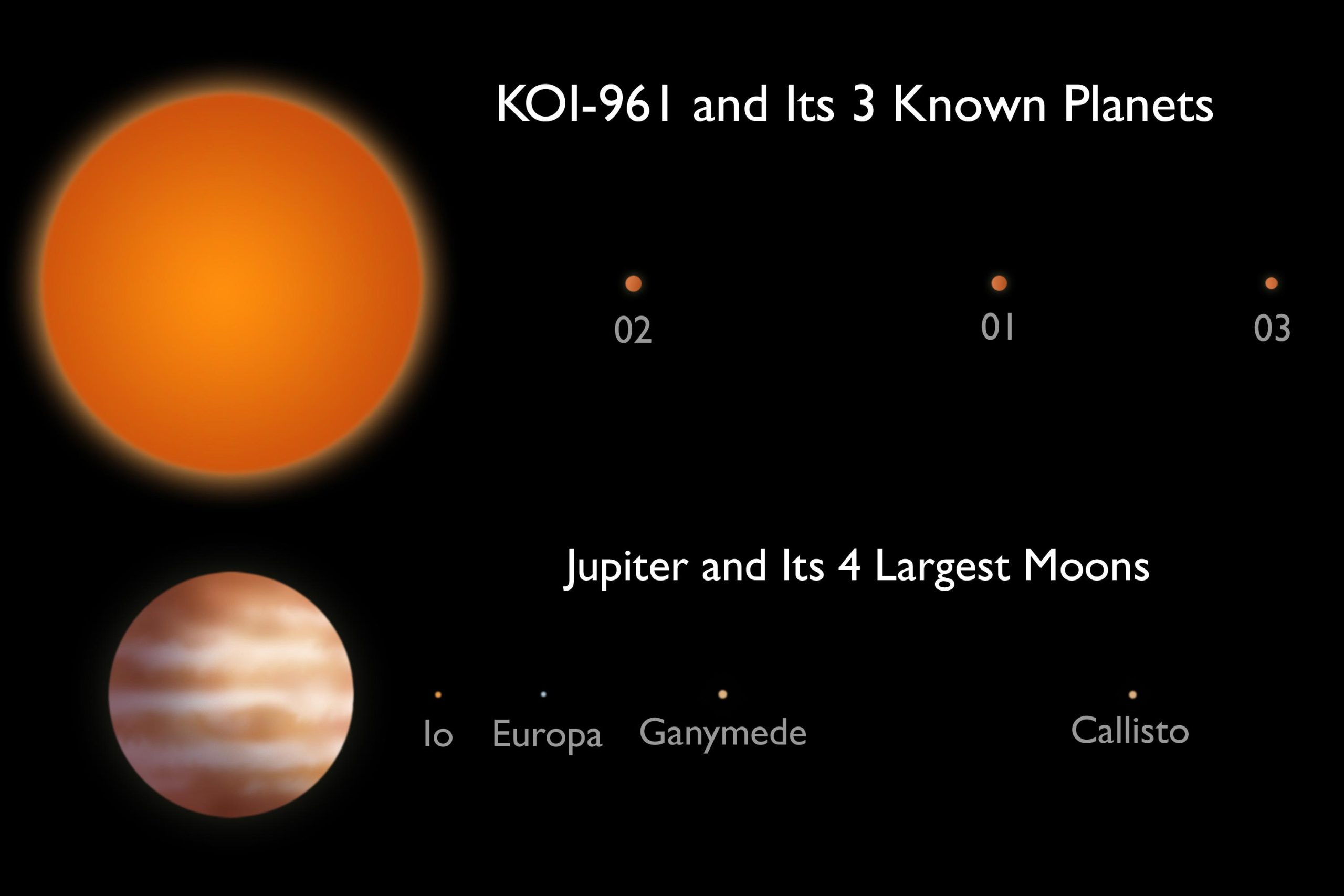
    KOI-961 Compared to Jupiter
    ‘Honey I Shrunk the Planetary System’: This artist’s concept compares the KOI-961 planetary system to Jupiter and the largest four of its many moons. Credit: NASA/JPL-Caltech

    A paper describing the discovery has been accepted by the Astrophysical Journal. Named KOI-961, for Keppler Object of Interest, the red dwarf in question has come under close scrutiny by astronomers. It’s one-sixth the size of Sol. Last December, Johnson received an email from Kevin Apps, an amateur astronomer from Horley, England, and co-author of the paper. He spends his spare time studying data on extrasolar planets and nearby stars and alerted the team that KOI-961 bore an uncanny resemblance in color and temperature to Barnard’s Star. The team followed up with ground-based telescopes and confirmed that the stars were almost virtual twins.

    Since Barnard’s Star is only 6 light years from Earth, Johnson’s team was able to gauge the diameter of KOI-961 and find its transiting planets. All three planets whip around the star in less than two days.

    Never miss a breakthrough: Join the SciTechDaily newsletter.
    Follow us on Google and Google News.

    California Institute of Technology Exoplanet JPL NASA
    Share. Facebook Twitter Pinterest LinkedIn Email Reddit

    Related Articles

    Hot Jupiters Orbit 20 Times Closer to Their Host Stars Than Earth Does to the Sun

    Flower-Shaped Starshade Spacecraft to Acquire Images of Earth-Like Planets

    JPL Image of the Day – The Orion Nebula

    NASA Study Reveals that Carbon Planets May be Waterless

    Astronomers Discover Earliest Starburst Galaxy Ever Observed

    “Habitable Zone” Might Help Extreme Life Forms Survive on Exoplanets

    Smaller Than Earth, Exoplanet Candidate UCF-1.01 Is Just 33 Light-Years Away

    New Herschel Space Observatory Image Shows Magellanic Cloud Galaxy

    NASA Plans Trajectory Maneuver for Mars Science Laboratory Spacecraft

    Leave A Reply Cancel Reply

    • Facebook
    • Twitter
    • Pinterest
    • YouTube

    Don't Miss a Discovery

    Subscribe for the Latest in Science & Tech!

    Trending News

    Artificial Sweeteners May Harm Future Generations, Study Suggests

    Splashdown! NASA Artemis II Returns From Record-Breaking Moon Mission

    What If Consciousness Exists Beyond Your Brain

    Scientists Finally Crack the 100-Million-Year Evolutionary Mystery of Squid and Cuttlefish

    Beyond “Safe Levels”: Study Challenges What We Know About Pesticides and Cancer

    Researchers Have Found a Dietary Compound That Increases Longevity

    Scientists Baffled by Bizarre “Living Fossil” From 275 Million Years Ago

    Your IQ at 23 Could Predict Your Wealth at 27, Study Finds

    Follow SciTechDaily
    • Facebook
    • Twitter
    • YouTube
    • Pinterest
    • Newsletter
    • RSS
    SciTech News
    • Biology News
    • Chemistry News
    • Earth News
    • Health News
    • Physics News
    • Science News
    • Space News
    • Technology News
    Recent Posts
    • What if Dark Matter Has Two Forms? Bold New Hypothesis Could Explain a Cosmic Mystery
    • Researchers Expose Hidden Chemistry of “Ore-Forming” Elements in Biology
    • Geologists Reveal the Americas Collided Earlier Than We Thought
    • 20x Difference: Study Reveals True Source of Airborne Microplastics
    • Scientists Uncover Hidden Force Powering Yellowstone’s Supervolcano
    Copyright © 1998 - 2026 SciTechDaily. All Rights Reserved.
    • Science News
    • About
    • Contact
    • Editorial Board
    • Privacy Policy
    • Terms of Use

    Type above and press Enter to search. Press Esc to cancel.