
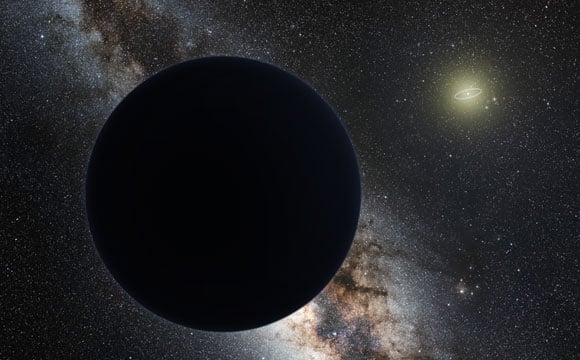
New research details how Planet 9 may have once been an exoplanet “captured” by our sun billions of years ago.
Through a computer-simulated study, astronomers at Lund University in Sweden show that it is highly likely that the so-called Planet 9 is an exoplanet. This would make it the first exoplanet to be discovered inside our own solar system. The theory is that our sun, in its youth some 4.5 billion years ago, stole Planet 9 from its original star.
An extrasolar planet, or exoplanet, is by definition a planet located outside our solar system. Now it appears that this definition is no longer viable. According to astronomers in Lund, there is a lot to indicate that Planet 9 was captured by the young sun and has been a part of our solar system completely undetected ever since.
“It is almost ironic that while astronomers often find exoplanets hundreds of light years away in other solar systems, there’s probably one hiding in our own backyard,” says Alexander Mustill, astronomer at Lund University.
Stars are born in clusters and often pass by one another. It is during these encounters that a star can “steal” one or more planets in orbit around another star. This is probably what happened when our own sun captured Planet 9.
In a computer-simulated model, Alexander together with astronomers in Lund and Bordeaux has shown that Planet 9 was probably captured by the sun when coming in close contact while orbiting another star.
“Planet 9 may very well have been ‘shoved’ by other planets, and when it ended up in an orbit that was too wide around its own star, our sun may have taken the opportunity to steal and capture Planet 9 from its original star. When the sun later departed from the stellar cluster in which it was born, Planet 9 was stuck in an orbit around the sun,” says Alexander Mustill.
“There is still no image of Planet 9, not even a point of light. We don’t know if it is made up of rock, ice, or gas. All we know is that its mass is probably around ten times the mass of Earth.”
It requires a lot more research before it can be ascertained that Planet 9 is the first exoplanet in our solar system. If the theory is correct, Alexander Mustill believes that the study of space and the understanding of the sun and the Earth will take a giant leap forward.
“This is the only exoplanet that we, realistically, would be able to reach using a space probe,” he says.
The article is published in Monthly Notices of the Royal Astronomical Society Letters, (MNRAS Letters).
Reference: “Is there an exoplanet in the Solar system?” by Alexander J. Mustill, Sean N. Raymond and Melvyn B. Davies, 26 April 2016, MNRAS Letters.
DOI: /10.1093/mnrasl/slw075
arXiv:1603.07247
Never miss a breakthrough: Join the SciTechDaily newsletter.
Follow us on Google and Google News.
2 Comments
This proposal comes as no surprise to me, because I do not believe in the core accretion theory of planetary formation and consider that the whole solar system – a motley crew, if ever there was one – consists of captured free planets.
The strange orbit proposed for planet 9 indicates to me that it was indeed captured in the manner described, but at a very much later date than the others, which had already been constrained by their mutual gravitational forces and the influence of the Sun’s gravitational and magnetic fields into the single ecliptic plane of rotation.
Eehm, accretion disks have been observed around multiple stars so it strikes me as a bit odd that you’d dismiss the whole accretion theory. If mercury, venus, earth, mars, jupiter, saturn, neptune and uranus all would have been captured, like you said, then they had to come in a very specific order otherwize some of the planets would have been flung out into space again (what goes down, must go up:P). Ecpecially mars with its big ass neighbour nearby.
I do agree that planet 9 is to far away for the accretion method and therefore must be capured, but i doubt the “stole directly from another sun” story. I reackon it was a rogue planet that was captured and slowed down bij the other planets so i could stay in orbit. But hey, what do i know.