
Scientists from the Wellcome Trust Sanger Institute have identified the majority of the mutational signatures that explain the genetic development and history of cancers in patients, uncovering more than 20 signatures of processes that mutate DNA.
Researchers have provided the first comprehensive compendium of mutational processes that drive tumor development. Together, these mutational processes explain most mutations found in 30 of the most common cancer types. This new understanding of cancer development could help to treat and prevent a wide range of cancers.
Each mutational process leaves a particular pattern of mutations, an imprint or signature, in the genomes of cancers it has caused. By studying 7,042 genomes of people with the most common forms of cancer, the team uncovered more than 20 signatures of processes that mutate DNA. For many of the signatures, they also identified the underlying biological process responsible.
All cancers are caused by mutations in DNA occurring in cells of the body during a person’s lifetime. Although we know that chemicals in tobacco smoke cause mutations in lung cells that lead to lung cancers and ultraviolet light causes mutations in skin cells that lead to skin cancers, we have remarkably little understanding of the biological processes that cause the mutations which are responsible for the development of most cancers.
“We have identified the majority of the mutational signatures that explain the genetic development and history of cancers in patients,” says Ludmil Alexandrov first author from the Wellcome Trust Sanger Institute. “We are now beginning to understand the complicated biological processes that occur over time and leave these residual mutational signatures on cancer genomes.”
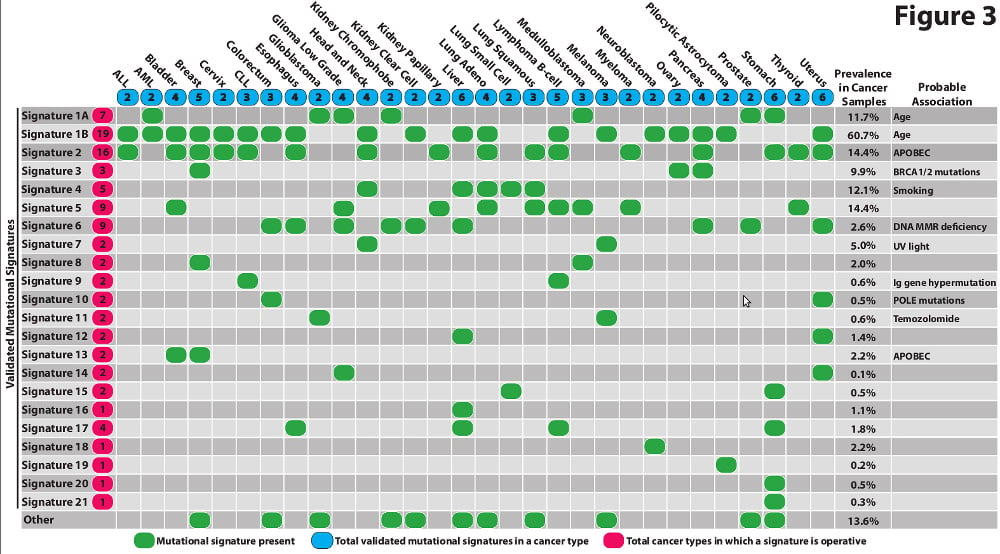
All of the cancers contained two or more signatures, reflecting the variety of processes that work together during the development of cancer. However, different cancers have different numbers of mutational processes. For example, two mutational processes underlie the development of ovarian cancer, while six mutational processes underlie the development of liver cancer.
Some of the mutational signatures are found in multiple cancer types, while others are confined to a single cancer type. Out of the 30 cancer types, 25 had signatures arising from age-related mutational processes. Another signature, caused by defects in repairing DNA due to mutations in the breast cancer susceptibility genes BRCA1 and 2, was found in breast, ovarian, and pancreatic cancers.
“Through detailed analysis, we can start to use the overwhelming amounts of information buried deep in the DNA of cancers to our advantage in terms of understanding how and why cancers arise,” says Dr Serena Nik-Zainal, author from the Wellcome Trust Sanger Institute. “Our map of the events that cause the majority of cancers in humans is an important step to discovering the processes that drive cancer formation.”
The team found that a family of enzymes, which is known to ‘edit’ (ie mutate) DNA, was linked to more than half of the cancer types. These enzymes, known as APOBECs, can be activated in response to viral infections. It may be that the resulting signatures are collateral damage on the human genome caused by the enzymes’ actions to protect cells from viruses.
Recently, the research team described a remarkable pattern of mutation in breast cancer whereby small regions of the genome are deluged with mutations. They now show that this process, known as kataegis, is present in most cancers. Researchers speculate that the onset of kataegis may also be linked to the activation of APOBEC enzymes.
“We have uncovered the archaeological traces within cancer genomes of the diverse mutational processes that lead to the development of most cancers,” says Professor Sir Mike Stratton, lead author and Director of the Wellcome Trust Sanger Institute. “This compendium of mutational signatures and the consequent insights into the mutational processes underlying them has profound implications for the understanding of cancer development with potential applications in disease prevention and treatment.”
Reference: “Signatures of mutational processes in human cancer” by Ludmil B. Alexandrov, Serena Nik-Zainal, David C. Wedge, Samuel A. J. R. Aparicio, Sam Behjati, Andrew V. Biankin, Graham R. Bignell, Niccolò Bolli, Ake Borg, Anne-Lise Børresen-Dale, Sandrine Boyault, Birgit Burkhardt, Adam P. Butler, Carlos Caldas, Helen R. Davies, Christine Desmedt, Roland Eils, Jórunn Erla Eyfjörd, John A. Foekens, Mel Greaves, Fumie Hosoda, Barbara Hutter, Tomislav Ilicic, Sandrine Imbeaud, Marcin Imielinski, Natalie Jäger, David T. W. Jones, David Jones, Stian Knappskog, Marcel Kool, Sunil R. Lakhani, Carlos López-Otín, Sancha Martin, Nikhil C. Munshi, Hiromi Nakamura, Paul A. Northcott, Marina Pajic, Elli Papaemmanuil, Angelo Paradiso, John V. Pearson, Xose S. Puente, Keiran Raine, Manasa Ramakrishna, Andrea L. Richardson, Julia Richter, Philip Rosenstiel, Matthias Schlesner, Ton N. Schumacher, Paul N. Span, Jon W. Teague, Yasushi Totoki, Andrew N. J. Tutt, Rafael Valdés-Mas, Marit M. van Buuren, Laura van ’t Veer, Anne Vincent-Salomon, Nicola Waddell, Lucy R. Yates, Australian Pancreatic Cancer Genome Initiative, ICGC Breast Cancer Consortium, ICGC MMML-Seq Consortium, ICGC PedBrain, Jessica Zucman-Rossi, P. Andrew Futreal, Ultan McDermott, Peter Lichter, Matthew Meyerson, Sean M. Grimmond, Reiner Siebert, Elías Campo, Tatsuhiro Shibata, Stefan M. Pfister, Peter J. Campbell and Michael R. Stratton, 14 August 2013, Nature.
DOI: 10.1038/nature12477
Never miss a breakthrough: Join the SciTechDaily newsletter.
Follow us on Google and Google News.
1 Comment
Some years back, I have studied a thesis,in an International Andrological Science Journal from China, authored by my relative friend, Sujatha of Pondicherry University for her research Degree, regarding such mutations in testis which are carried on to the generations. A set of laboratory mices were used to feed on vegetables grown with the pesticide Endosulfan’ and the next F1 generations were kept feeding on pure nature grown vegetables without any contamination of Endosulfan. But when the testis of F1 generations were studied, surprisingly they were having signatures of Endosulfan in their testis. Thus DNA mutations of harmful nature are carried on to generations. This is possible only if the mutations are undergoing multiple times at the end of which only they pronounce cancer. The mutations in half the way though not harmful is a precursor to the future of the cancer in the organs concerned.Thank You.