
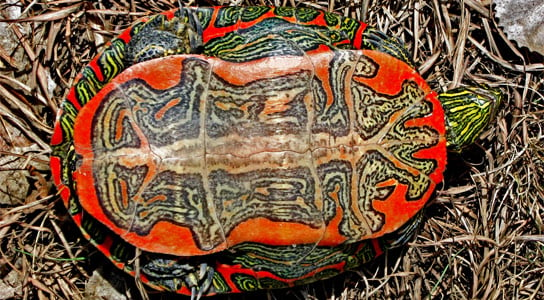
In a newly published study, a large team of biologists describe the genome of the western painted turtle, discovering clues how the painted turtle may offer important insights into the management of a number of human health disorders.
Humans could learn a thing or two from turtles, and scientists who have just sequenced the first turtle genome uncovered clues about how people can benefit from the shelled creatures’ remarkable longevity and ability to survive for months without breathing.
Understanding the natural mechanisms turtles use to protect their heart and brain from oxygen deprivation may one day improve treatments for heart attack and stroke, the researchers said.
Conservation biologist and lead author Brad Shaffer from the University of California, Los Angeles (UCLA) collaborated with the Genome Institute at Washington University in St. Louis and 58 co-authors on the multi-year research project. Their paper, which appears in the journal Genome Biology, describes the genome of the western painted turtle, one of the most widespread and well-studied turtles in the world.
Researchers were somewhat surprised to find that the painted turtle’s extraordinary adaptations were not the result of previously unknown genes but of gene networks that are common in vertebrates — including humans, said Shaffer, a professor at UCLA’s Institute of the Environment and Sustainability (IoES) and UCLA’s Department of Ecology and Evolutionary Biology.
“They’re the same genes we have, and the turtles are just using them in different ways and really cranking up their activity in most cases,” said Shaffer, who also directs the La Kretz Center for California Conservation Science at the IoES.
“Given how extreme their adaptations are, I imagined we would see weird new genes, so I was surprised,” he added. “But the fact that they’re common means they may have direct relevance to human health conditions, especially those related to oxygen deprivation, hypothermia and possibly longevity.”
Inside the turtle genome, the researchers found 19 genes in the brain and 23 in the heart that became more active in low-oxygen conditions, including one that became 130 times more active. These genes, all of which are present in humans, may be important candidates for exploring oxygen-deprivation treatment in humans, the researchers noted.
Many of the extreme adaptations the researchers studied, such as the ability to survive months of anoxia — total oxygen depletion — are primarily seen in painted turtles, and the western painted turtle is the most anoxia-tolerant terrestrial vertebrate known. At low temperatures, such as in the ice-covered ponds where they hibernate, painted turtles can survive for four months underwater without coming up for air. Turtles are also famous for their extreme longevity, with some species even continuing to reproduce into their second century of life.
But when the research team examined genes that may be responsible for turtles’ longevity, instead of finding super-active genes like the ones protecting them from oxygen deprivation, the scientists found indications that turtles’ long life spans may come from silencing “life-shortening” genes.
“We looked at two genes that are either absent or severely down-regulated in other animals that live a long time,” Shaffer said. “We found turtles have only non-functioning vestiges of these genes, if they have them at all. Both of these genes are present and active in humans, so they’re an appealing candidate to learn about human longevity.”
Analysis of the turtle genome confirmed that the shelled creatures are more closely related to birds and crocodilians than any other vertebrates. The researchers also discovered that turtles have an extraordinarily slow rate of genomic evolution and that the turtle genome evolves at about a third the rate of the human genome.
One aspect of turtle evolution that is progressing rapidly, however, is the threat of extinction. More than half of the 330 turtle species worldwide are considered threatened, making them the most endangered major group of vertebrates. Their demise is largely due to humans, partly the result of human-caused habitat loss and modification. But it is their popularity on restaurant menus and dinner tables, particularly in Asia, that is the biggest reason for the global decline, Shaffer said.
“The challenge is to preserve the rich diversity of living turtles that still exist as we continue to unravel their secrets for success,” Shaffer said. “Turtles have a tremendous amount to tell us about evolution and human health, but their time is running out unless we act to protect them.”
Reference: “The western painted turtle genome, a model for the evolution of extreme physiological adaptations in a slowly evolving lineage” by H Bradley Shaffer, Patrick Minx, Daniel E Warren, Andrew M Shedlock, Robert C Thomson, Nicole Valenzuela, John Abramyan, Chris T Amemiya, Daleen Badenhorst, Kyle K Biggar, Glen M Borchert, Christopher W Botka, Rachel M Bowden, Edward L Braun, Anne M Bronikowski, Benoit G Bruneau, Leslie T Buck, Blanche Capel, Todd A Castoe, Mike Czerwinski, Kim D Delehaunty, Scott V Edwards, Catrina C Fronick, Matthew K Fujita, Lucinda Fulton, Tina A Graves, Richard E Green, Wilfried Haerty, Ramkumar Hariharan, Omar Hernandez, LaDeana W Hillier, Alisha K Holloway, Daniel Janes, Fredric J Janzen, Cyriac Kandoth, Lesheng Kong, AP Jason de Koning, Yang Li, Robert Literman, Suzanne E McGaugh, Lindsey Mork, Michelle O’Laughlin, Ryan T Paitz, David D Pollock, Chris P Ponting, Srihari Radhakrishnan, Brian J Raney, Joy M Richman, John St John, Tonia Schwartz, Arun Sethuraman, Phillip Q Spinks, Kenneth B Storey, Nay Thane, Tomas Vinar, Laura M Zimmerman, Wesley C Warren, Elaine R Mardis & Richard K Wilson, 28 March 2013, Genome Biology.
DOI: 10.1186/gb-2013-14-3-r28
The research was funded by the National Human Genome Research Institute at the National Institutes of Health, a National Science Foundation grant to Shaffer and other funding. The paper, “The western painted turtle genome, a model for the evolution of extreme physiological adaptations in a slowly evolving lineage,” was published in Genome Biology on March 28.
Never miss a breakthrough: Join the SciTechDaily newsletter.
Follow us on Google and Google News.