
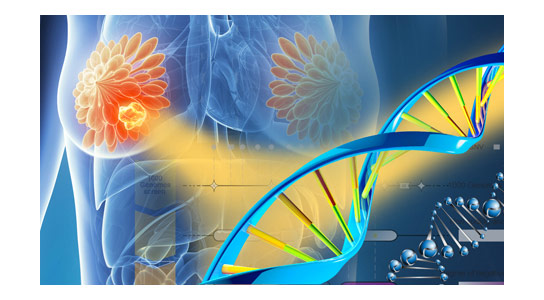
A new analysis of little-explored regions of the human genome has revealed dozens of cancer triggers.
A massive data analysis of natural genetic variants in humans and variants in cancer tumors has implicated dozens of mutations in the development of breast and prostate cancer, a Yale-led team has found.
The newly discovered mutations are in regions of DNA that do not code for proteins but instead influence the activity of other genes. These areas represent an unexplored world that will allow researchers and doctors to gain new insight into the causes and treatment of cancer, said the scientists.
“This allows us to take a systematic approach to cancer genomics,” said Mark Gerstein, the Albert L. Williams Professor of Biomedical Informatics and co-senior author of the paper, which appears in the October 4 issue of Science. “Now we do not need to limit ourselves to the roughly 1% of the genome that codes for proteins but can explore the rest of our DNA.”
The analysis — led by Yale researchers and including scientists from the Wellcome Trust Sanger Institute, Cornell University, and other institutions — is a statistical marriage of separate mammoth research projects, each providing groundbreaking insights in our genome, the genetic blueprint of life.
The 1000 Genomes project is compiling the personal genomes of many individuals. The data help pinpoint regions of DNA that vary little within the population and thus are of crucial importance to human health. The Encyclopedia of DNA Elements (ENCODE) project is working toward cataloging the function of each location in the human genome.
The team took non-coding DNA elements from the ENCODE project and looked for those that are highly conserved in the 1000 Genomes data. They then contrasted the data with mutations in tumor samples from about 90 patients with breast or prostate cancer. They found dozens in areas of DNA that vary little and therefore are likely to drive tumor progression. They also looked for additional features of the cancer mutations such as their proximity to regulatory-network hubs, which also indicate they may be particularly damaging.
While the research focused on variants of single base pairs, many of the conclusions also apply to other, larger forms of genetic variation, the authors say.
The great diversity of variants found proves that massive data projects have direct relevance to cancer in individuals, the authors said.
“Our approach can be directly used in the context of precision medicine,” says Ekta Khurana, an associate research scientist in Gerstein’s lab and the first author of the study.
The research was funded by the National Institutes of Health and the Williams Professorship Funds.
Other Yale authors are Yao Fu, Xinmeng Jasmine Mu, Lucas Lochovsky, Jieming Chen, Arif Harmanci, Alexej Abyzov, Suganthi Balasubramanian, Declan Clarke, Yong Kong, Cristina Sisu, and Michael Wilson.
Reference: “Integrative Annotation of Variants from 1092 Humans: Application to Cancer Genomics” by Ekta Khurana, Yao Fu, Vincenza Colonna, Xinmeng Jasmine Mu, Hyun Min Kang, Tuuli Lappalainen, Andrea Sboner, Lucas Lochovsky, Jieming Chen, Arif Harmanci, Jishnu Das, Alexej Abyzov, Suganthi Balasubramanian, Kathryn Beal, Dimple Chakravarty, Daniel Challis, Yuan Chen, Declan Clarke, Laura Clarke, Fiona Cunningham, Uday S. Evani, Paul Flicek, Robert Fragoza, Erik Garrison, Richard Gibbs, Zeynep H. Gümüş, Javier Herrero, Naoki Kitabayashi, Yong Kong, Kasper Lage, Vaja Liluashvili, Steven M. Lipkin, Daniel G. MacArthur, Gabor Marth, Donna Muzny, Tune H. Pers, Graham R. S. Ritchie, Jeffrey A. Rosenfeld, Cristina Sisu, Xiaomu Wei, Michael Wilson, Yali Xue, Fuli Yu, 1000 Genomes Project Consortium, Emmanouil T. Dermitzakis, Haiyuan Yu, Mark A. Rubin, Chris Tyler-Smith and Mark Gerstein, 4 October 2013, Science.
DOI: 10.1126/science.1235587
Never miss a breakthrough: Join the SciTechDaily newsletter.
Follow us on Google and Google News.
1 Comment
Let us label three genomes as 1,2 and 3 of which let us assume that Genome 1 and Genome 3 are exons executable protein- forming genes but Genome 2 being a dummy non-executable junk gene. Again let us assume that there are three mutations required in executable gene to form cancer. We know that BRCA1 and
BRCA2 are two notorious genes causing breast cancer of which at least three mutations are required to precipitate cancer. We know that just one mutation
in these genes may not cause cancer but it will be a carrier in their siblings. This shows that mutations are not single gene specific but they will be broadly affecting the DNA in both executable and non-executable genes.Hence it is no surprise that in cancer affected person non-executable genes also present mutations invariably. If the spectrum of mutational genes are completely affecting the executable genes, then other extension of this shadow of mutations will affect the junk genes adjoining them. If gene 1 and gene 3 are executable and if very broad spectrum of mutations encompass all the three genes together then shadow of mutations will be found in the intervening non-executable dummy gene2 also. Probably junk genes to the extent of 90% of human genomes are interleaved to help humans to avoid undesired mutations more frequently in the workable 10% genes, by the environmental factors such as radiation and chemicals.Thank You.