
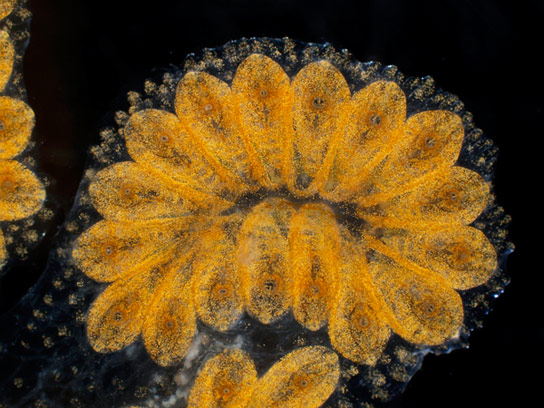
Stanford researchers have sequenced the genome of mankind’s closest invertebrate relative, Botryllus schlosseri – a small sea creature that can regenerate its entire body from its blood vessels alone.
At first glance, Botryllus schlosseri has very little in common with humans. The small sea creature fuses together with others to form colonies that look like psychedelic blobs, encrusting rocks and seaweeds. It can reproduce asexually, and an entire individual can be regenerated from its blood vessels alone.
And yet, Botryllus is humans’ closest living invertebrate relative. (Invertebrates lack a spinal column.) Now, a group led by Stanford scientists has sequenced its genome, making it possible to find the genetic basis for some of the animal’s amazing regenerative abilities and immunity features, which potentially could be applied to human medicine.
In total, the group sequenced the animal’s 580 million base pairs of DNA. (The human genome, by comparison, consists of more than 3 billion base pairs.) Though the researchers haven’t studied the entire genome, they found evidence that Botryllus makes a useful invertebrate model for studying human genetics, in particular for highlighting the evolution of immunity and stem cell-mediated regeneration.
The researchers compared the Botryllus genome with several vertebrate and invertebrate genomes. Focusing on genes involved in various human diseases – affecting things such as heart and eye development, pregnancy, and cancer – they found homologous genes for each in Botryllus, far more matches than in any of a dozen other invertebrates commonly used in research.
An additional investigation of blood-related genes revealed that Botryllus was probably the first invertebrate to have vasculature in the same context of the human circulatory system, with blood cells traveling through blood vessels.
For example, in looking at a set of 20 genes that encode for humans’ hematopoietic stem cells – cells that can self-renew and differentiate into other types of blood cells – they found 14 that are also expressed in cells isolated from the Botryllus stem cell niche. The scientists are now investigating how these genes function in Botryllus.
“The whole body can regenerate from the vasculature alone: the heart, digestive system, sophisticated tissues,” said Ayelet Voskoboynik, a scientist at Stanford’s Stem Cell Institute and Hopkins Marine Station, and the lead author on the study. “And it can do this relatively fast, probably using stem cells. Now that we have the genome, we can try to understand the mechanism behind it.”
The study of Botryllus’ genome could also lead to advances in transplant medicine. When two genetically distinct Botryllus colonies come into contact with each other, they either fuse their blood vessels to create a single organism, or reject one another and maintain individuality. When the blood vessels between the two colonies fuse into one interconnected network, the stem cells from each partner colony begin to circulate throughout the other.
The stem cells compete and in many cases one partner’s stem cells “win” – and any new or replacement tissue grown through the fused colony does so based on the “winner’s” genetic code.
A similar process occurs in humans who undergo an allogeneic transplant – when a patient receives tissue or cells from a non-identical donor. For instance, if a patient receives bone marrow or a ligament graft from a donor, over time, the recipient’s cells replace the donor tissue.
In some instances, particularly concerning transplants of bone marrow or hematopoietic stem cells, the recipient’s body rejects the donor cells. Voskoboynik suspects that studying the genetic basis for this interaction in Botryllus could lead to improvements in human therapies.
“If we can learn what makes a highly competitive stem cell a winner, and why others are rejected, we could hope to apply that knowledge to improve the success rate of allogeneic transplantations in humans,” Voskoboynik said.
An important byproduct of the research, Voskoboynik said, was that Botryllus’ complicated genome required the team to develop a new sequencing technique. The method, which has been patented, yielded exceptionally long, accurate sequences of DNA.
Additionally, rather than creating an average of the genetic information encoded on each paired chromosome, as standard techniques do, the new method yielded individual results from each chromosome. That advance, Voskoboynik said, could play a critical role in studying human diseases that occur as the result of different versions of genes existing on paired chromosomes.
Reference: “The genome sequence of the colonial chordate, Botryllus schlosseri” by Ayelet Voskoboynik, Norma F Neff, Debashis Sahoo, Aaron M Newman, Dmitry Pushkarev, Winston Koh, Benedetto Passarelli, H Christina Fan, Gary L Mantalas, Karla J Palmeri, Katherine J Ishizuka, Carmela Gissi, Francesca Griggio, Rachel Ben-Shlomo, Daniel M Corey, Lolita Penland, Richard A White III, Irving L Weissman and Stephen R Quake, 2 July 2013, eLife.
DOI: 10.7554/eLife.00569
Never miss a breakthrough: Join the SciTechDaily newsletter.
Follow us on Google and Google News.