
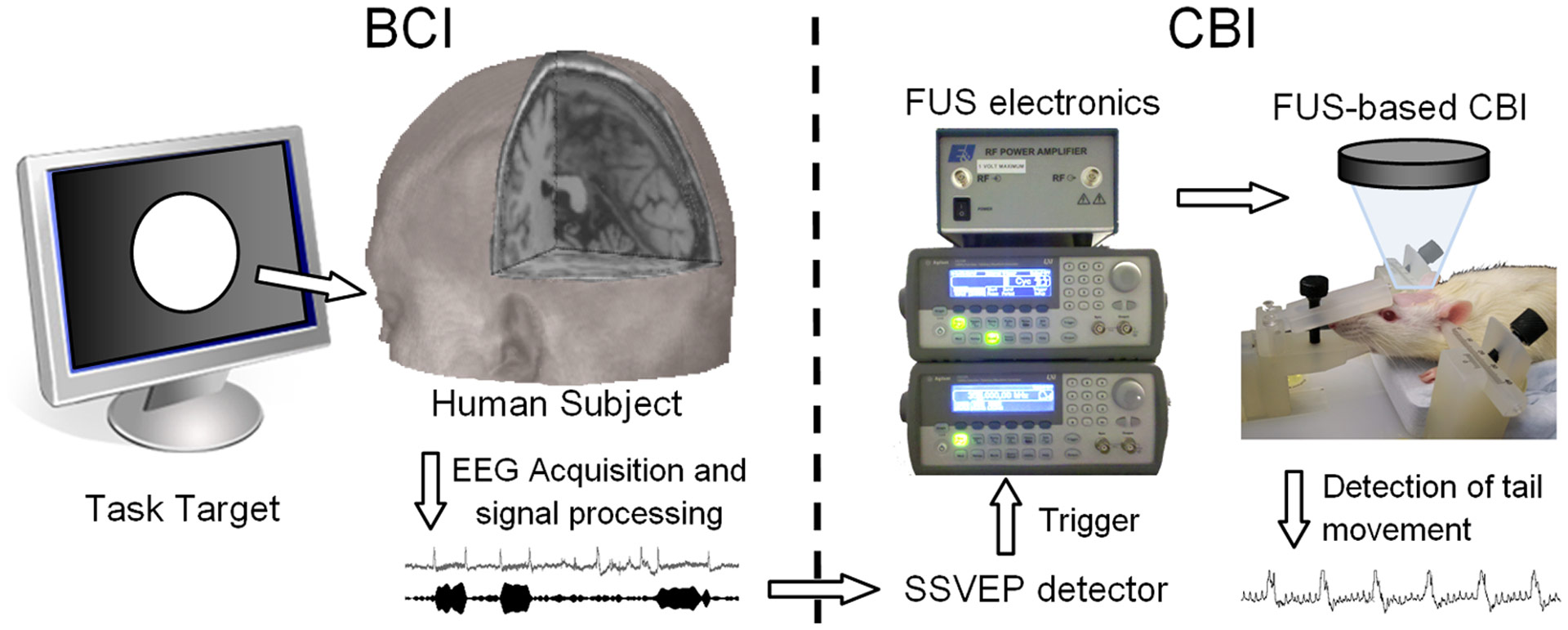
The implementation consists of steady-state visual evoked potential (SSVEP)-based brain-to-computer interface (BCI: on the left column) and focused ultrasound (FUS)-based computer-to-brain interface (CBI) segments (on the right column). doi:10.1371/journal.pone.0060410.g001
In a newly published open-access study, scientists at Harvard Medical School describe how they implemented a non-invasive brain-to-brain interface between a human and a Sprague-Dawley rat, establishing functional links between the two brains.
The video recordings of BBI procedure. A volunteer (upper left panel) signaled the intention (stimulate the motor area of a rat brain) with a thumb movement (a green dot appearing on the screen). The increased amplitude of SSVEP triggered the operation of FUS neuromodulation of a rat under the anesthesia (upper left panel), which was subsequently created the animal’s tail movement. The lower panel shows the real-time recordings of volunteer’s attention, raw SSVEP signal, SSVEP signal filtered at 15 Hz, and the tail motion (from the top to the bottom row). doi:10.1371/journal.pone.0060410.s001
Abstract
Transcranial focused ultrasound (FUS) is capable of modulating the neural activity of specific brain regions, with a potential role as a non-invasive computer-to-brain interface (CBI). In conjunction with the use of brain-to-computer interface (BCI) techniques that translate brain function to generate computer commands, we investigated the feasibility of using the FUS-based CBI to non-invasively establish a functional link between the brains of different species (i.e. human and Sprague-Dawley rat), thus creating a brain-to-brain interface (BBI). The implementation was aimed to non-invasively translate the human volunteer’s intention to stimulate a rat’s brain motor area that is responsible for the tail movement. The volunteer initiated the intention by looking at a strobe light flicker on a computer display, and the degree of synchronization in the electroencephalographic steady-state-visual-evoked-potentials (SSVEP) with respect to the strobe frequency was analyzed using a computer. Increased signal amplitude in the SSVEP, indicating the volunteer’s intention, triggered the delivery of a burst-mode FUS (350 kHz ultrasound frequency, tone burst duration of 0.5 ms, pulse repetition frequency of 1 kHz, given for 300 msec duration) to excite the motor area of an anesthetized rat transcranially. The successful excitation subsequently elicited the tail movement, which was detected by a motion sensor. The interface was achieved at 94.0±3.0% accuracy, with a time delay of 1.59±1.07 sec from the thought-initiation to the creation of the tail movement. Our results demonstrate the feasibility of a computer-mediated BBI that links central neural functions between two biological entities, which may confer unexplored opportunities in the study of neuroscience with potential implications for therapeutic applications.
Publication: Yoo S-S, Kim H, Filandrianos E, Taghados SJ, Park S (2013) Non-Invasive Brain-to-Brain Interface (BBI): Establishing Functional Links between Two Brains. PLoS ONE 8(4): e60410. doi:10.1371/journal.pone.0060410
Editor: Julie A. Chowen, Hosptial Infantil Universitario Niño Jesús, CIBEROBN, Spain
Received: October 10, 2012; Accepted: February 26, 2013; Published: April 3, 2013
Funding: This work was supported by National Institutes of Health (R21 NS074124 to SSY), KIST Institutional Program (2E23031 to SSY and HMK), UNIST grant (to SSY), and National Research Foundation of Korea (Korean Ministry of Education, Science and Technology, 2010-0027294 to SSP). The funders had no role in study design, data collection and analysis, decision to publish, or preparation of the manuscript.
Image & Video: Yoo S-S, et al., doi:10.1371/journal.pone.0060410.g001
Never miss a breakthrough: Join the SciTechDaily newsletter.
Follow us on Google and Google News.