
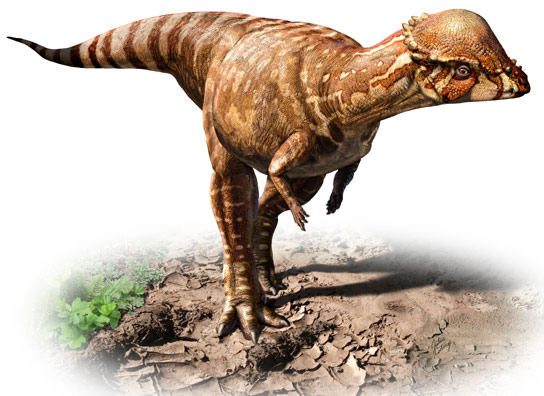
New research describes the newly discovered species of bone-headed dinosaur, named Acrotholus audeti, which lived about 85 million years ago.
Scientists have named a new species of bone-headed dinosaur (pachycephalosaur) from Alberta, Canada. Acrotholus audeti (Ack-RHO-tho-LUS) was identified from both recently discovered and historically collected fossils. Approximately six feet long and weighing about 40 kgs in life, the newly identified plant-eating dinosaur represents the oldest bone-headed dinosaur in North America, and possibly the world. Dr. Michael Ryan, curator of vertebrate paleontology at The Cleveland Museum of Natural History, co-authored research describing the new species, which was published on May 7, 2013, in the journal Nature Communications.
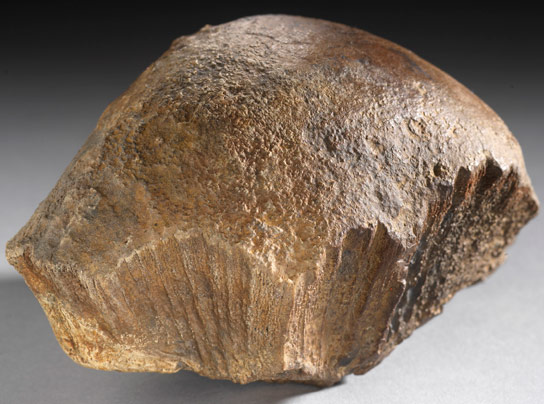
Acrotholus means “high dome,” referring to its dome-shaped skull, which is composed of solid bone over 10 centimeters (two inches) thick. The name Acrotholus audeti also honors Alberta rancher Roy Audet, on whose land the best specimen was discovered in 2008. Acrotholus walked on two legs and had a greatly thickened, domed skull above its eyes, which was used for display to other members of its species, and may have also been used in head-butting contests. Acrotholus lived about 85 million years ago.
The new dinosaur discovery is based on two skull ‘caps’ from the Milk River Formation of southern Alberta. One of these was collected by the Royal Ontario Museum (ROM) more than 50 years ago. However, a better specimen was found in 2008 by University of Toronto graduate student Caleb Brown during a field expedition organized by Dr. David Evans of the Royal Ontario Museum and University of Toronto, and Ryan.
“Acrotholus provides a wealth of new information on the evolution of bone-headed dinosaurs. Although it is one of the earliest known members this group, its thickened skull dome is surprisingly well-developed for its geological age,” said lead author Evans, ROM curator, vertebrate paleontology. “More importantly, the unique fossil record of these animals suggests that we are only beginning to understand the diversity of small-bodied plant-eating dinosaurs.”
Small mammals and reptiles can be very diverse and abundant in modern ecosystems, but small dinosaurs (less than 100 kg or 220 lb) are considerably less common than large ones in the fossil record. Whether this pattern is a true reflection of dinosaur communities, or is related to the greater potential for small bones to be destroyed by carnivores and natural decay, has been debated. The massively constructed skull domes of pachycephalosaurs are resistant to destruction, and are much more common than their relatively delicate skeletons—which resemble those of other small plant-eating dinosaurs. Therefore, the researchers suggest that the pachycephalosaur fossil record can provide valuable insights into the diversity of small, plant-eating dinosaurs as a whole.
“We can predict that many new small dinosaur species like Acrotholus are waiting to be discovered by researchers willing to sort through the many small bones that they pick up in the field,” said co-author Ryan of The Cleveland Museum of Natural History. “This fully domed and mature individual suggests that there is an undiscovered, hidden diversity of small-bodied dinosaurs. So when we look back, we need to reimagine the paleoenvironment. There is an evolutionary history that we just don’t know because the fossil record is incomplete. This discovery also highlights the importance of landowners, like Roy Audet, who grant access to their land and allow scientifically important finds to be made.”
This dinosaur is the latest in a series of new finds being made by Evans and Ryan as part of their Southern Alberta Dinosaur Project, which aims to fill in gaps in the record of Late Cretaceous dinosaurs and study their evolution. This project focuses on the paleontology of some of the oldest dinosaur-bearing rocks in Alberta, which have been studied less intensely than those of the famous badlands of Dinosaur Provincial Park and Drumheller.
Acrotholus was identified by a team comprising of paleontologists Evans, of the Royal Ontario Museum; and Ryan, of The Cleveland Museum of Natural History; as well as Ryan Schott, Caleb Brown, and Derek Larson, all graduate students at the University of Toronto who studied under Evans.
The fossils of Acrotholus will be put on public display at the Royal Ontario Museum starting May 7, 2013.
Reference: “The oldest North American pachycephalosaurid and the hidden diversity of small-bodied ornithischian dinosaurs” by David C. Evans, Ryan K. Schott, Derek W. Larson, Caleb M. Brown and Michael J. Ryan, 7 May 2013, Nature Communications.
DOI:10.1038/ncomms2749
Never miss a breakthrough: Join the SciTechDaily newsletter.
Follow us on Google and Google News.
3 Comments
Approximately six feet long and 40 kg in weight is comparable to modern day’s ostrich, emu or cassovari birds of australia. It is already surmised that dinosaurs are fore fathers of modern birds. Hence the discovery of small dinosaurs are indeed strengthening this theory. Thank You.
Acrotholus means “high dome,” referring to its dome-shaped skull, which is composed of solid bone over 10 centimeters (two inches) thick.
10cm =/= 2 inches
Are the serations around the skull cap teeth marks from a predator/scavenger? They appear rather too regular for typical skull sutures.