
Researchers at the Department of Energy’s Oak Ridge National Laboratory are refining their design of a 3D-printed nuclear reactor core, scaling up the additive manufacturing process necessary to build it, and developing methods to confirm the consistency and reliability of its printed components.
The Transformational Challenge Reactor Demonstration Program’s unprecedented approach to nuclear energy leverages advances from ORNL in manufacturing, materials, nuclear science, nuclear engineering, high-performance computing, data analytics and related fields.
The lab aims to turn on the first-of-its-kind reactor by 2023. The program has maintained its aggressive timeline during the COVID-19 pandemic, using remote work to continue design and analysis efforts.
The Transformational Challenge Reactor will demonstrate a revolutionary approach to deploying new nuclear power systems. By building and operating an additively manufactured microreactor, the Oak Ridge National Laboratory program will explore solutions to the high costs and lengthy deployment timelines that threaten the future of nuclear energy—the country’s largest source of carbon-free energy.
“The nuclear industry is still constrained in thinking about the way we design, build and deploy nuclear energy technology,” ORNL Director Thomas Zacharia said. “DOE launched this program to seek a new approach to rapidly and economically develop transformational energy solutions that deliver reliable, clean energy.”
Reactor development and deployment have traditionally relied on materials, fuels and technology pioneered in the 1950s and ’60s, and high costs and decades-long construction times have limited the United States to building only one new nuclear power plant in the last 20 years.
TCR will introduce new, advanced materials and use integrated sensors and controls, providing a highly optimized, efficient system that reduces cost, relying on scientific advances with potential to shape a new path in reactor design, manufacturing, licensing, and operation.
The TCR program has completed several foundational experiments including selection of a core design, and a three-month “sprint” that demonstrated the agility of the additive manufacturing technology to quickly produce a prototype reactor core.
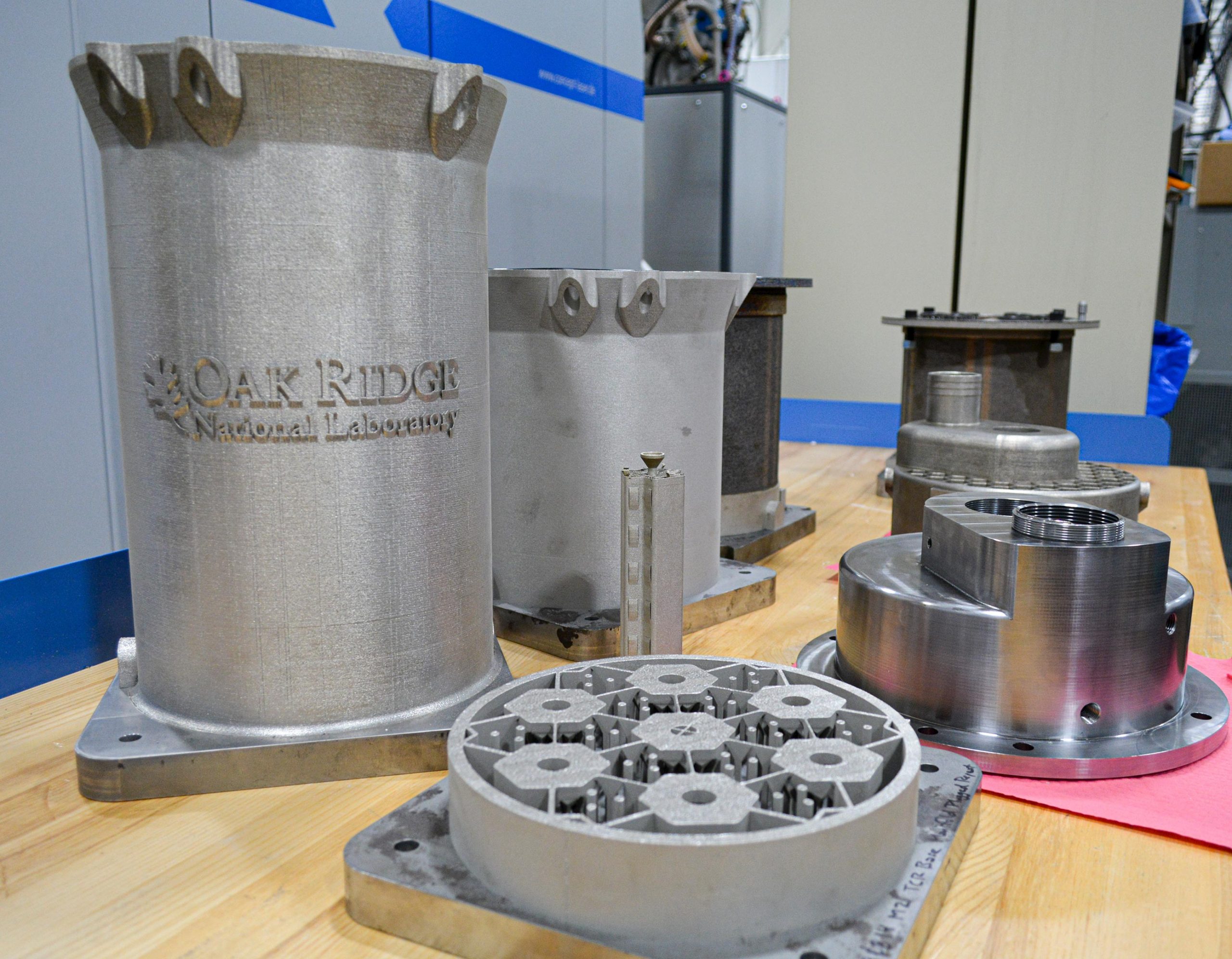
Researchers will now focus on refining the selected design and the processes that will ensure an optimal and reliable energy system. Monitoring technologies continually assess the manufacturing process, providing live data streams that enable real-time qualification of the printed material and performance analysis through artificial intelligence. The team also conducts extensive post-build testing to assess component performance and establish links between the behavior of each unique part and its live manufacturing data.
“We have been aggressively developing the capability to make this program a reality over the last several months, and our effort has proven that this technology is ready to demonstrate a 3D-printed nuclear reactor core,” said Kurt Terrani, the TCR technical director. “The current situation for nuclear is dire. This is a foundational effort that can open the floodgates to rapid innovation for the nuclear community.”
As part of deploying a 3D-printed nuclear reactor, the program will also create a digital platform that will help in handing off the technology to industry for rapid adoption of additively manufactured nuclear energy technology.
“The entire TCR concept is made possible because of the significant advances in additive manufacturing process technology,” Terrani said. “By using 3D printing, we can use technology and materials that the nuclear community has been unable to capitalize on in the last several decades. This includes sensors for near autonomous control and a library of data and a new and accelerated approach to qualification that will benefit the entire nuclear community.”
Through the TCR program, ORNL is seeking a solution to a troubling trend. Although nuclear power plants provide nearly 20 percent of U.S. electricity, more than half of U.S. reactors will be retired within 20 years, based on current license expiration dates.
“The TCR program will provide a new model for accelerated deployment of advanced nuclear energy systems,” Zacharia said. “If cost and construction times are not addressed in the very near future, the United States will eventually lose its single largest source of emissions-free power.”
ORNL is partnering with Argonne and Idaho national laboratories and engaging with industry to enable rapid adoption for commercial use.
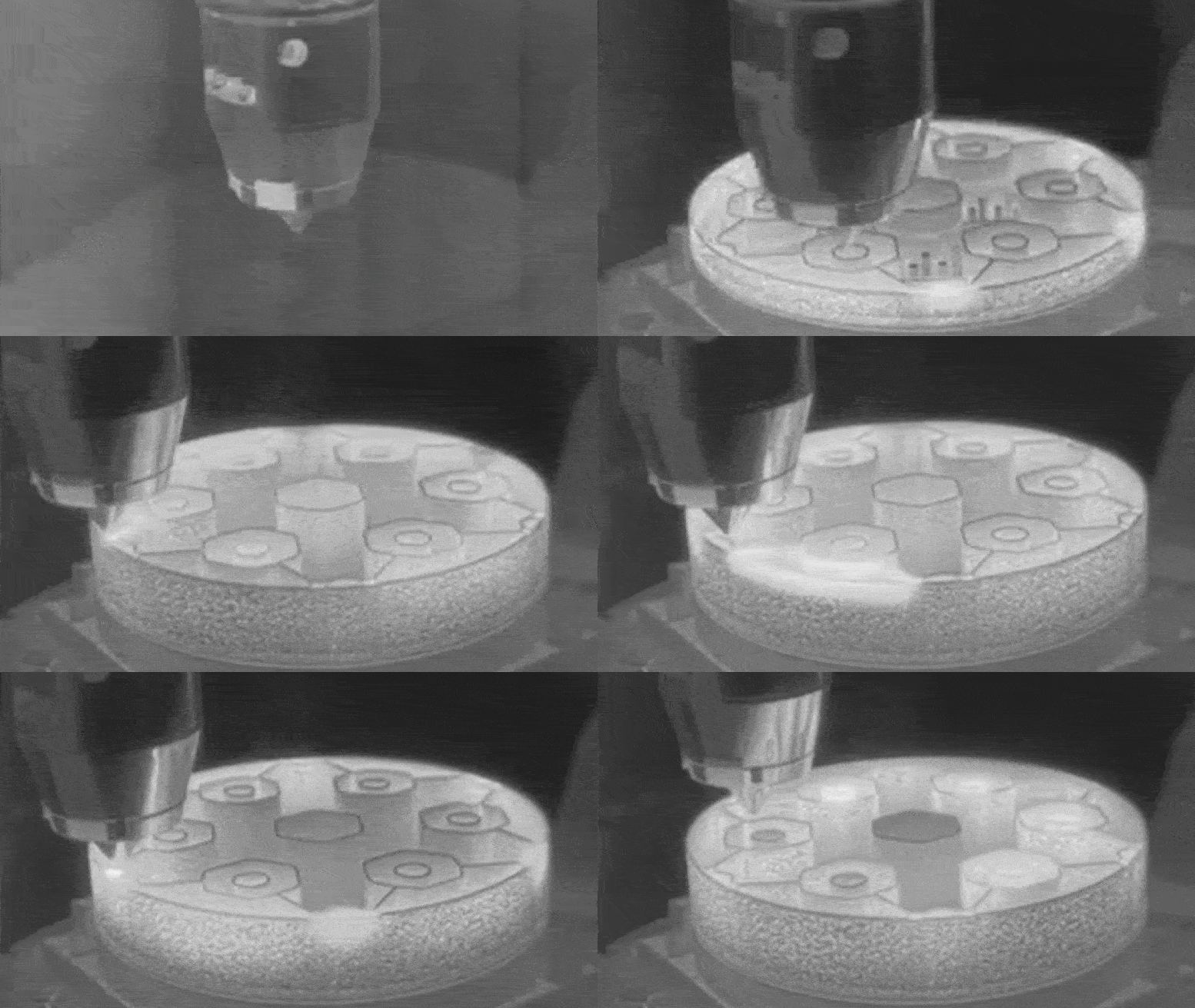
The hexagonal structure took close to 40 hours to build, with temperatures reaching over 1,400 degrees Celsius around the melt pool where a laser heats and melts while adding a new layer. Credit: Oak Ridge National Laboratory, U.S. Dept. of Energy
The Transformational Challenge Reactor builds on ORNL’s 77-year history of international leadership in nuclear science and technology development. The lab began as home to the world’s first continuously operating reactor, and its scientists and engineers pioneered technology and expertise in the first decades of the Atomic Age.
Today, the lab operates the High Flux Isotope Reactor, a DOE Office of Science user facility that provides a world-leading source of neutrons for a variety of research and produces isotopes for medicine, industry, and space exploration. TCR will be the 14th reactor built and operated by ORNL.
“Since its inception as the home of the X-10 Graphite Reactor, ORNL has been at the forefront of nuclear science and engineering,” Zacharia said. “Today, our expertise and unparalleled scientific tools create an opportunity to chart a new course in the nuclear field.”
TCR is supported by DOE’s Office of Nuclear Energy.
UT-Battelle manages ORNL for DOE’s Office of Science, the single largest supporter of basic research in the physical sciences in the United States. The Office of Science is working to address some of the most pressing challenges of our time.
Never miss a breakthrough: Join the SciTechDaily newsletter.
Follow us on Google and Google News.