
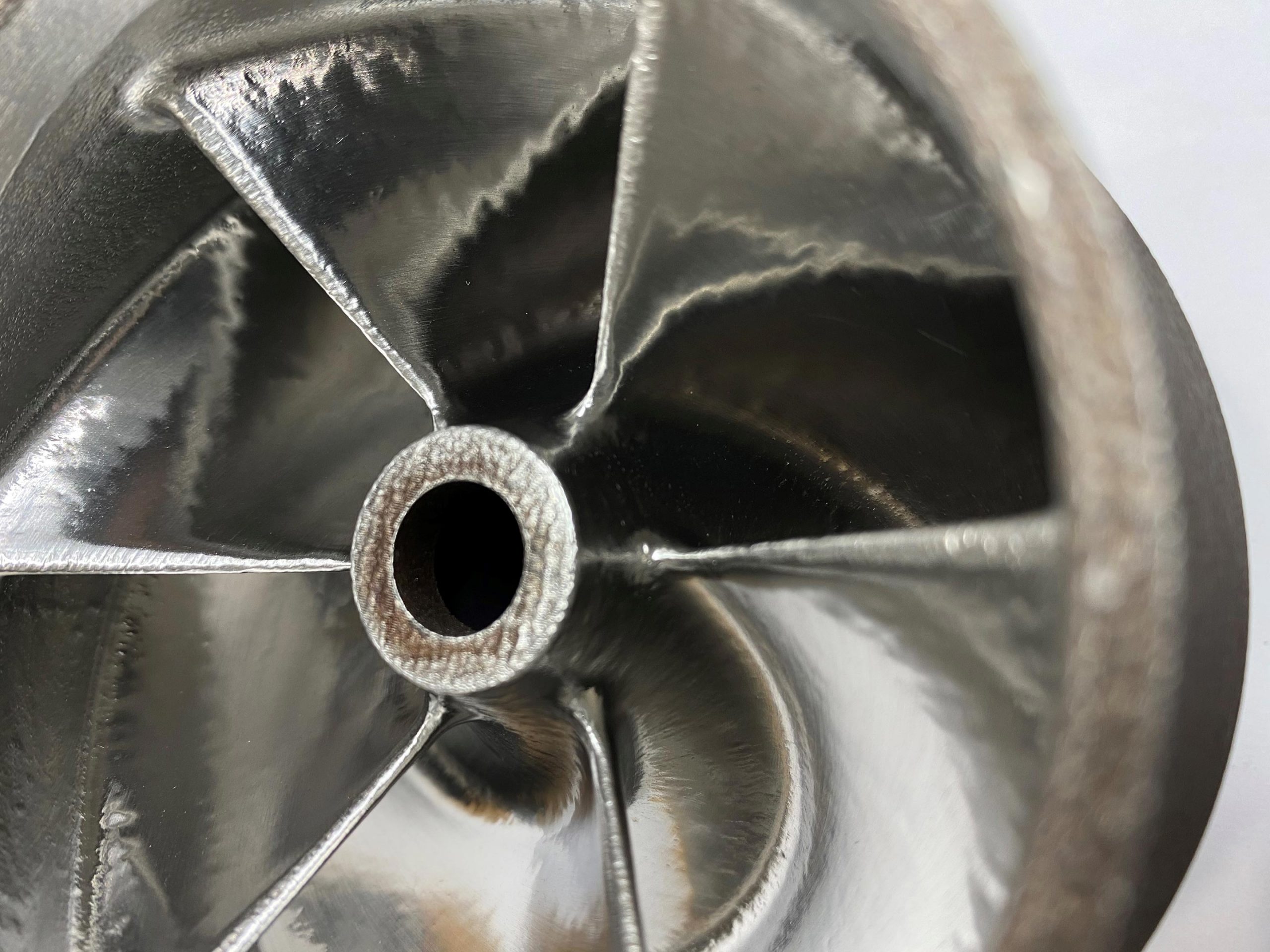
At the Department of Energy Manufacturing Demonstration Facility at ORNL, this part for a scaled-down prototype of a reactor was produced for industry partner Kairos Power. Credit: Kairos Power
Scientists at the Department of Energy Manufacturing Demonstration Facility at Oak Ridge National Laboratory have their eyes on the prize: the Transformational Challenge Reactor, or TCR, a microreactor built using 3D printing and other new approaches that will be up and running by 2023.
But their end goal is bigger than a single reactor: It’s to revolutionize manufacturing in the nuclear industry — and in other industries, too.
That means outside companies are already benefitting from what ORNL is learning from the TCR program.
“As we’re developing this framework for TCR, we are also engaging companies that can benefit from additive manufacturing and data analytics technologies for producing components,” said ORNL’s Ryan Dehoff, group leader for Deposition Science and Technology. “We’ve shown them the benefits 3D printing can provide — especially in the nuclear industry — and now we’re working with them to start to realize some of those advantages.”
One example is Kairos Power.
A part for a pump
California-based Kairos is also looking to develop innovative nuclear technology on a tight timeline, which led the company to partner with ORNL to produce a specific part for its own reactor prototype.
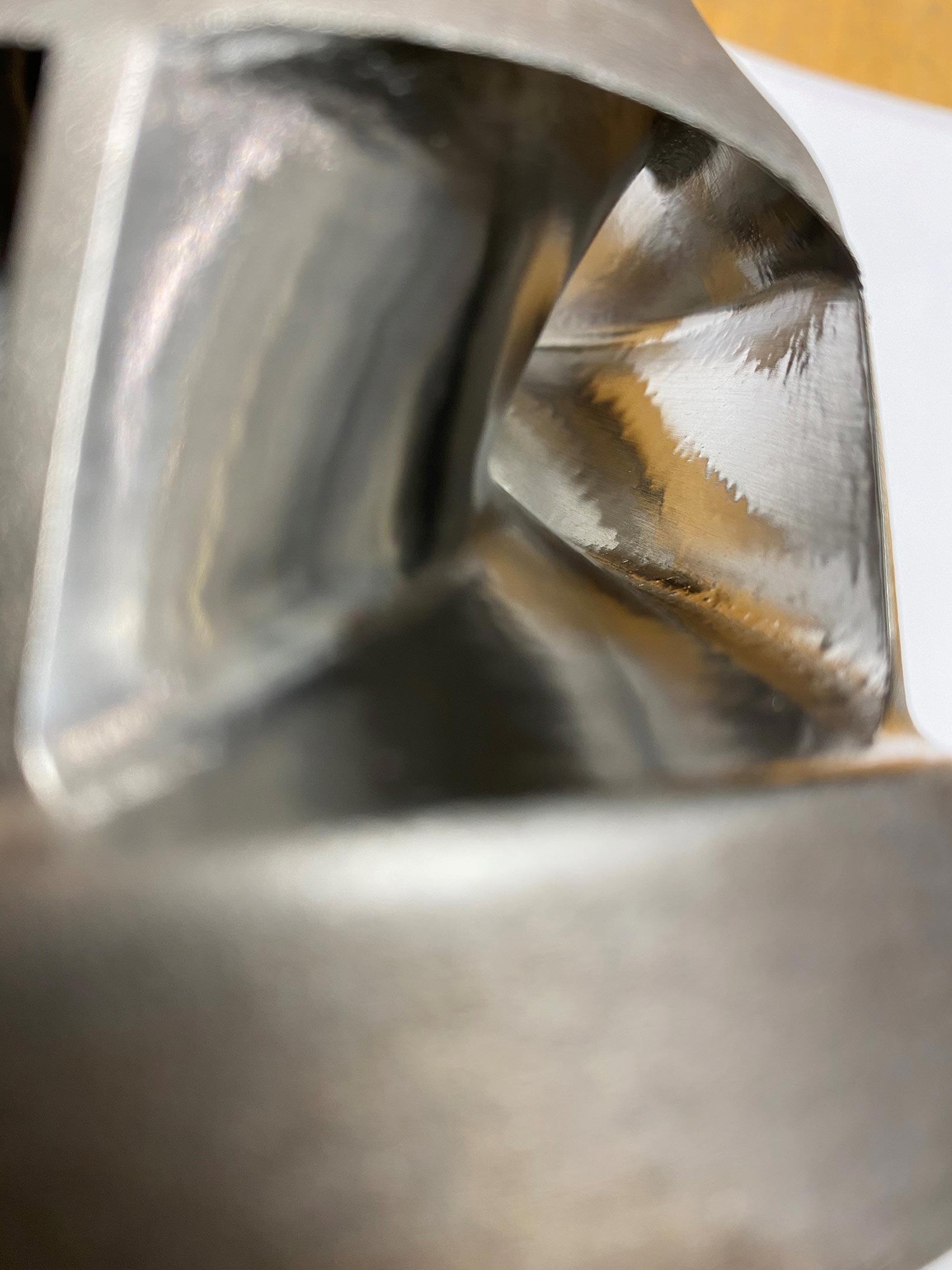
The part is a closed pump impeller, part of a heat exchanger loop designed to move molten salt through a heat source. It needs to withstand temperatures up to 600 degrees Celsius (1,100 degrees Fahrenheit), and it needs to perfectly fit with the rest of the prototype so that there’s no variance in the way that it works.
It needs to have exactly the right shape, exactly the right dimensions, and exactly the right surfaces.
That’s where advanced manufacturing excels. Without it, Kairos would have to make a mold, then cast, finish, and machine the prototype before ever testing it — a process that costs more and can take a month or longer. Most companies would max out at two or three iterations before ending testing. With next-day turnaround in manufacturing, the ORNL team worked with Kairos engineers to adjust their design for additive manufacturing without compromising the component’s performance.
“What TCR is doing is really important for changing the paradigm for nuclear energy,” said Per Peterson, chief nuclear officer of Kairos and elected member of the National Academy of Engineering. “But I think TCR is also changing the paradigm for our national labs to return them back to what were their most important competencies — a bar they were already hitting 50 years ago.”
With additive manufacturing technologies, ORNL can take a computer-aided design, or CAD, file, 3D-print a scaled-down prototype, and give it to a company for testing in their environments relevant for their specific application. If modifications are required, no matter how slight, the CAD file can be adjusted, printed again, and then tested, modified, and printed again and again, in agile fashion, until optimal specifications are met.
“Instead of getting to try two designs, we might get to try 20,” Dehoff said. “It makes for a very rapid design iteration, to final design and then full-scale production.”
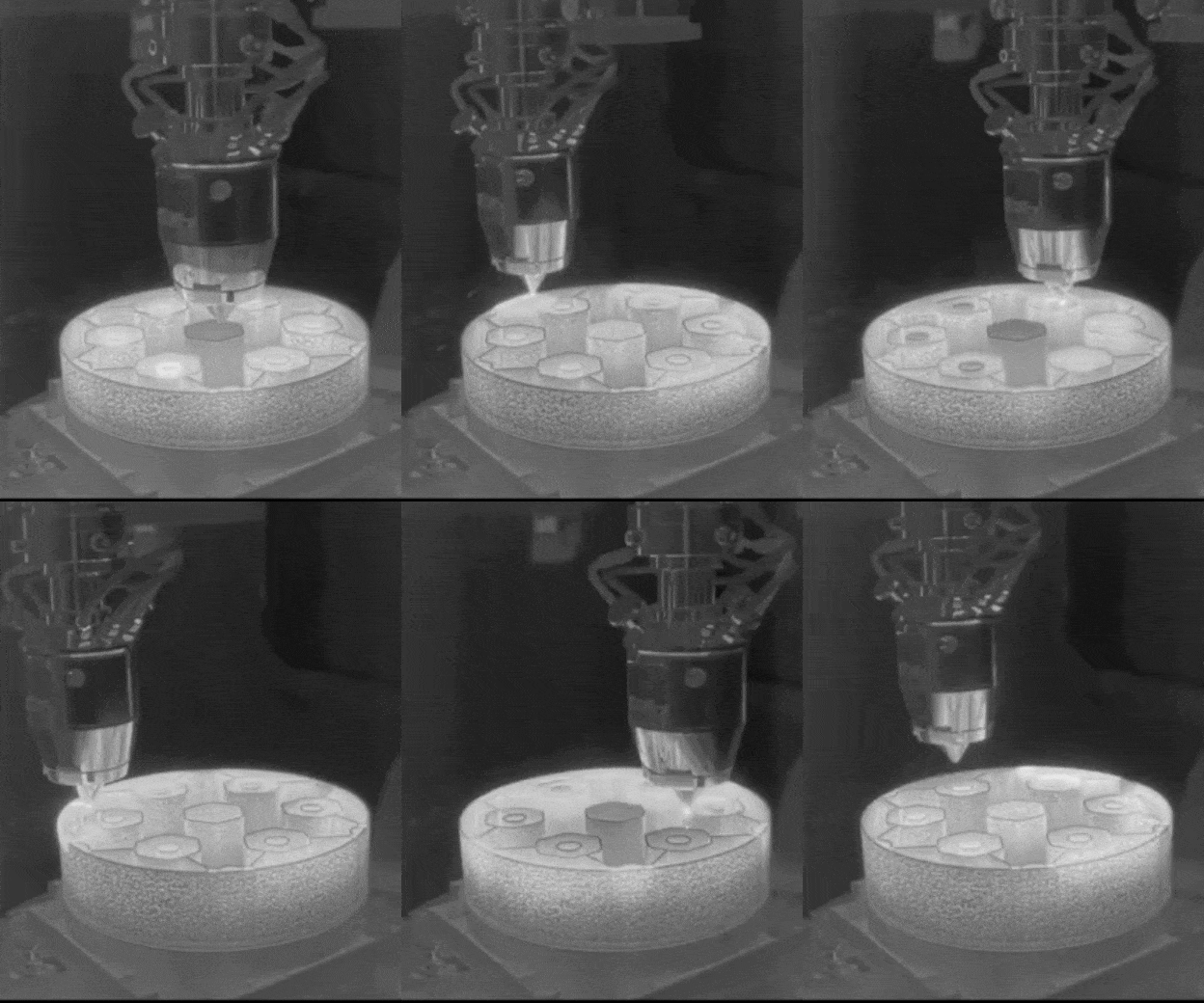
TCR is the first to develop and demonstrate an expansive digital platform that combines continuous monitoring of the print and data analytics to certify the quality of the additively manufactured components that demanding nuclear applications require. Companies receive not only the part, but also digital data associated with every aspect of the part. As test results come in, engineers can correlate performance with manufacturing data from embedded monitoring.
“Having a relationship with ORNL strengthens our technology development program for Kairos Power’s advanced reactor, specifically in advanced manufacturing,” said Dr. Edward Blandford, Kairos’ co-founder, and chief technology officer. “This partnership creates flexibility and competency, allowing us to build smarter and faster through our iterative development approach.”
Solving supply-chain issues
What if a company needs five of an item instead of 500?
Good luck finding a casting company willing to make a mold and manufacture such a small number – and even if one is willing, the cost is likely to be prohibitive.
“Where additive manufacturing excels is in low-quantity production with high quality, rigorous requirements where there’s difficulty in the supply chain,” such as having to wait for a large enough order to justify producing a batch, said ORNL researcher Fred List of Deposition Science and Technology. “The turnaround is days, rather than weeks to months.”
Best of all, because of its ability to consider literally a thousand different variables and then make sense of them, advanced manufacturing can produce items that are already “qualified” — that is, it’s possible to already know exactly how they will perform.
For the tightly regulated nuclear industry, where such details are crucial, Dehoff said that this new way of producing components can be a game changer.
“For TCR, we’re using this digital platform to certify components inside a nuclear reactor, so this rapid design iteration is very important,” Dehoff said. “We could never do that with a traditional project.”
ORNL is the perfect place for such a goal, he said, because of the availability of a multidisciplinary team of experts, including nuclear engineers, materials scientists, data scientists, robotics engineers, system engineers — and, ultimately, industry partners.
“We want to make sure that TCR isn’t done in a bottle,” Dehoff said. “There has to be broad societal impact and broad applicability to the nuclear community. The things that are being developed inside of TCR will be used by the nuclear industry to drive development and reduce costs.”
Henry Korellis, lead for engineering testing for Kairos, said it was a “truly satisfying experience” to collaborate with ORNL to build advanced reactor prototype components – and find that, on the very first build, optimized impeller flow paths and materials exactly matched the system requirements.
“The efficiency demonstrated by this three-way partnership between Kairos Power, high-performance fluid system partner Barber-Nichols, and Oak Ridge are accelerating us toward a cleaner future, something I am proud to be a part of,” Korellis said.
TCR is supported by DOE’s Office of Nuclear Energy.
UT-Battelle manages ORNL for the Department of Energy’s Office of Science, the single largest supporter of basic research in the physical sciences in the United States. The Office of Science is working to address some of the most pressing challenges of our time.
Never miss a breakthrough: Join the SciTechDaily newsletter.
Follow us on Google and Google News.