

Close Menu
    Facebook X (Twitter) Instagram
    SciTechDaily
    • Biology
    • Chemistry
    • Earth
    • Health
    • Physics
    • Science
    • Space
    • Technology
    Facebook X (Twitter) Pinterest YouTube RSS
    SciTechDaily
    Home»Health»How Many People Actually Have COVID-19? Significant Global Differences in Undetected Cases
    Health

    How Many People Actually Have COVID-19? Significant Global Differences in Undetected Cases

    By Max Planck SocietyJune 7, 2020No Comments4 Mins Read
    Facebook Twitter Pinterest Telegram LinkedIn WhatsApp Email Reddit
    Share
    Facebook Twitter LinkedIn Pinterest Telegram Email Reddit

    Coronavirus Blood Test

    According to a study, the number of undetected cases of infected persons differs significantly in different countries.

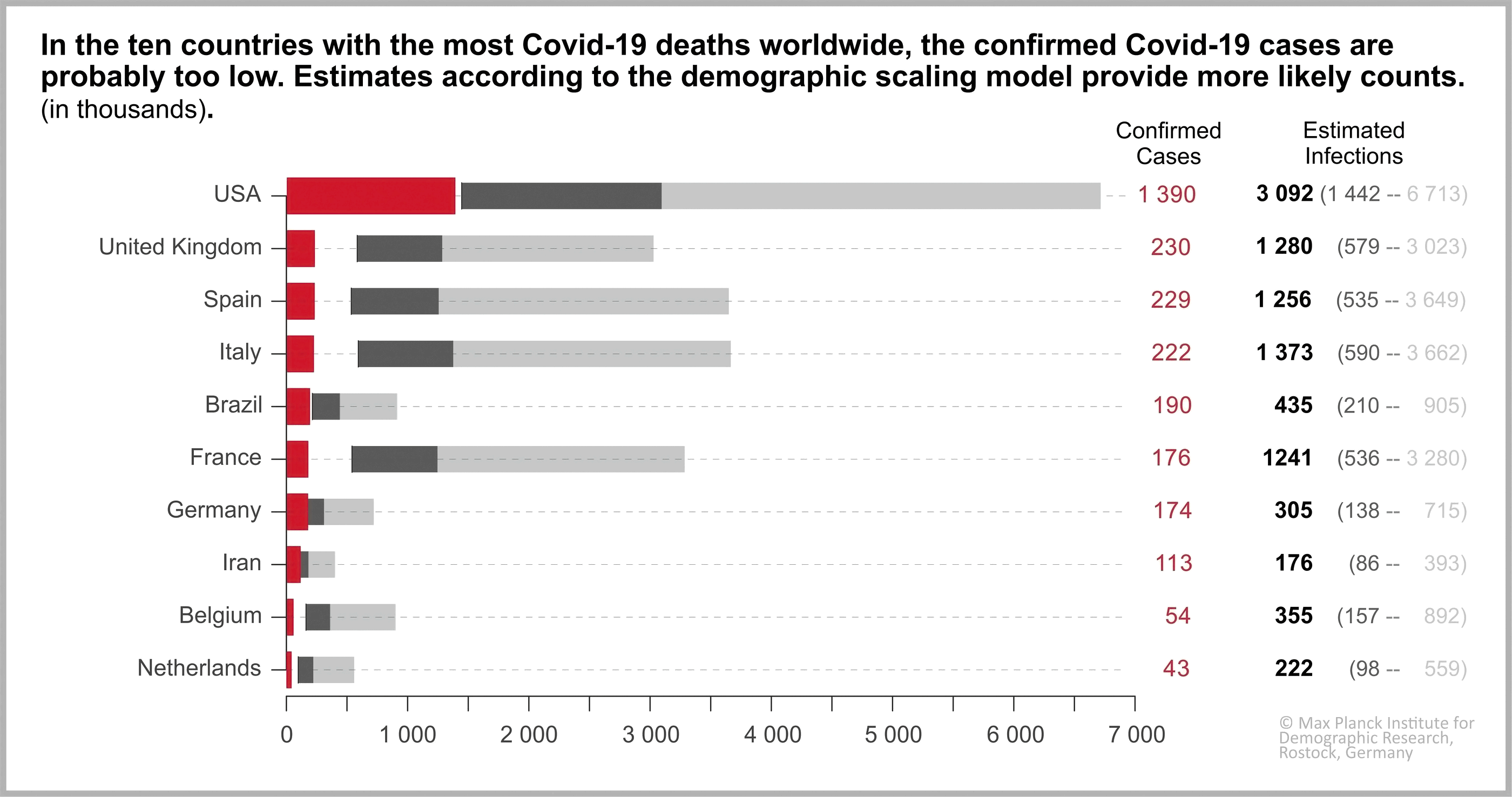
    The demographic scaling model developed by researchers at the Max Planck Institute for Demographic Research in Rostock and University of Helsinki makes it possible to estimate the actual number of COVID-19-infections in different countries with just a minimum of data. According to this model, the number of cases in Germany is only 1.8 times higher than the number of confirmed cases. For Italy, however, the researchers estimate that the number of infected is 6 times higher than the number of confirmed cases reported by the health authorities.

    “For the ten countries most affected by the COVID-19 pandemic, we used our demographic scaling model to estimate the number of unreported cases of infected people,” says Mikko Myrskylä, Director at the Max Planck Institute for demographic Research in Rostock, Germany. According to data from May 13, 2020, there are on average four times as many infected people as there are confirmed cases.

    For Italy, the model estimates about 1.4 million infected people which is six times higher than confirmed cases reported by the health authorities. The researchers estimate for the U.S. that there have been 3.1 million people infected with COVID-19, which is more than twice as many cases as officially reported. In Germany, on the other hand, where a large number of people are tested for COVID-19, the model estimates the number of unreported cases to be only 1.8 times as high.
    COVID 19 Likely Infected
    In all ten countries with the highest number of COVID-19 deaths (as of May 13), the number of infected persons is most likely higher than the number of confirmed cases. If the distance between the red bar (number of confirmed cases) and the dark grey bar (probable estimate) is large, the number of confirmed cases is far from the probable number of infected people. Credit: © Max Planck Institute for demographic Research

    “However, the uncertainty of our model estimates is large,” adds Christina Bohk-Ewald, co-author of the paper and currently working at the University of Helsinki. With a probability of 95%, the estimated total number of cases is between twice and eleven times as high as the number of confirmed cases. The differences between the individual countries are also large. The researchers present their model in a paper which is available online as a pre-print version on medRxiv but has not been peer-reviewed.

    For their model calculations the researchers mainly used data on COVID-19 deaths, infection fatality rates, and life tables. However, since COVID-19 infection fatality rates are not yet known for most countries, the researchers transferred it from one reference country to other countries using the so-called remaining life expectancy. This demographic parameter allows to control for cross-country differences in the age structure, previous illnesses in the population, and the health care systems of the different countries.

    The demographic scaling model is based on two main assumptions: firstly, it assumes that the number of people who have died of COVID-19 is fairly accurately recorded. Secondly, it assumes that the infection fatality rates from a reference country (in this case Hubei, China) are transferable to other countries after demographic adjustment. The three Max Planck researchers are aware that these two assumptions are only approximations and do not apply perfectly everywhere.

    Nevertheless, the researchers are convinced that they have developed a widely applicable model which provides useful estimates of the actual number of individuals who are infected with COVID-19, using only minimal input data. “Our model can also be used to check the plausibility of estimated infection numbers from other studies which measure, for example, the prevalence of antibodies in the population,” says Christian Dudel. According to Dudel, the antibody tests, which are only carried out regionally, are often not representative for the entire population of a country.

    Never miss a breakthrough: Join the SciTechDaily newsletter.
    Follow us on Google and Google News.

    COVID-19 Immunology Infectious Diseases Max Planck Institute Public Health
    Share. Facebook Twitter Pinterest LinkedIn Email Reddit

    Related Articles

    Highly Potent COVID Treatment: New Nanobodies Stop SARS-CoV-2 and Its Dangerous Variants

    Small Neutralizing Antibody Identified That May Prevent COVID-19 Infection

    Herd Immunity to COVID-19 Fails to Materialize in Sweden

    Research Shows Exposure to Common Cold Coronaviruses Can Teach the Immune System to Recognize SARS-CoV-2

    Yale to Lead Trial of Drug for Treating COVID-19 – Found Most Effective in Combatting SARS-CoV-2 Out of 13,000 Existing Drugs

    Common Molecular Feature of Antibodies That Neutralize SARS-CoV-2 Discovered, Boosting COVID-19 Vaccine Prospects

    Study Is First to Identify Potential Therapeutic Targets for Covid-19 Using Blood Samples From Critically Ill Patients

    FDA Approved Drug May Help Calm Cytokine Storm in COVID-19

    New Study Outlines a Roadmap for Effective Treatment of COVID-19

    Leave A Reply Cancel Reply

    • Facebook
    • Twitter
    • Pinterest
    • YouTube

    Don't Miss a Discovery

    Subscribe for the Latest in Science & Tech!

    Trending News

    Scientists Say This Natural Hormone Reverses Obesity by Targeting the Brain

    35-Million-Year-Old Mystery: Strange Arachnid Discovered Preserved in Amber

    Is AI Really Just a Tool? It Could Be Altering How You See Reality

    JWST Reveals a “Forbidden” Planet With a Baffling Composition

    The Protein “Sabotaging” Aging Muscle Recovery Could Be Key to Surviving Aging

    This Diet–Gut Interaction Could Transform Fat Into a Calorie-Burning Machine

    Scientists Discover Hidden Virus Linked to Colorectal Cancer

    Scientists Discover 132-Million-Year-Old Dinosaur Tracks on South Africa’s Coast

    Follow SciTechDaily
    • Facebook
    • Twitter
    • YouTube
    • Pinterest
    • Newsletter
    • RSS
    SciTech News
    • Biology News
    • Chemistry News
    • Earth News
    • Health News
    • Physics News
    • Science News
    • Space News
    • Technology News
    Recent Posts
    • Scientists Create “Optical Tornadoes” That Twist Light Into a Swirling Vortex
    • Scientists Uncover Hidden Superconductivity in Material Once Thought Only Magnetic
    • Scientists Baffled by Bizarre “Living Fossil” From 275 Million Years Ago
    • 500 Million Years Ago, Life Changed Forever: Scientists Reveal the DNA Changes That Helped Animals Move Onto Land
    • Surprise RNA Discovery Challenges Long-Held Beliefs About How Genes Work
    Copyright © 1998 - 2026 SciTechDaily. All Rights Reserved.
    • Science News
    • About
    • Contact
    • Editorial Board
    • Privacy Policy
    • Terms of Use

    Type above and press Enter to search. Press Esc to cancel.