
Note: There is now a newer Novel Coronavirus (COVID-19) Situation Report 73.
WHO Novel Coronavirus (COVID-19) Situation Report 72
- Three new countries/territories/areas reported cases of COVID-19 in the past 24 hours: Botswana, Burundi, and Sierra Leone.
- WHO has released a scientific brief on the off-label use of medicines for COVID-19. A number of medicines have been suggested as potential investigational therapies, many of which are now being or will soon be studied in clinical trials, including the SOLIDARITY trial co-sponsored by WHO and participating countries.
- WHO recognizes the importance of addressing the needs of refugees and migrants when preparing for or responding to the COVID-19 pandemic. WHO European Region has released a guidance document to assist healthcare working with refugees and migrants.
- At a press briefing, yesterday, PAHO Director Dr. Carissa Etienne stressed that countries of the Americas must act now to slow the spread of COVID-19.WHO encourages countries to prepare hospitals and health facilities, protect their health personnel, and decide what social distancing measures need to be implemented and for how long, among other actions.
- Public health and social measures to slow or stop the spread of COVID-19 must be implemented with the full engagement of all members of society. WHO has described four levels of COVID-19 transmission with varying public health and social measures depending on the local evolution of the COVID-19 pandemic. For more details, please see ‘Subject in Focus’ below.
Risk Assessment
Global Level: Very High
Coronavirus Situation in Numbers
Globally
- 823,626 confirmed cases (72,736 new)
- 40,598 deaths (4,193 new)
Western Pacific Region
- 106,422 confirmed cases (1,554 new)
- 3,701 deaths (30 new)
European Region
- 464,212 confirmed cases (40,266 new)
- 30,089 deaths (3,395 new)
South-East Asia
- 5,175 confirmed cases (960 new)
- 195 deaths (29 new)
Eastern Mediterranean Region
- 54,281 confirmed cases (3,932 new)
- 3,115 deaths (161 new)
Regions of the Americas
- 188,751 confirmed cases (25,737 new)
- 3,400 deaths (564 new)
African Region
- 4,073 confirmed cases (287 new)
- 91 deaths (14 new)
Subject in Focus: Public Health and Social Measures for the COVID-19 Pandemic
The purpose of this note is to outline public health and social measures useful for slowing or stopping the spread of COVID-19 at national or community level. Guidance for case finding and management, personal and environmental measures, travel measures, and mass gatherings is available on the WHO website available here.
Public health and social measures are measures or actions by individuals, institutions, communities, local and national governments and international bodies to slow or stop the spread of COVID-19. These measures to reduce transmission of COVID-19 include individual and environmental measures, detecting and isolating cases, contact-tracing and quarantine, social and physical distancing measures including for mass gatherings, international travel measures, and vaccines and treatments. While vaccines and specific medications are not yet available for COVID-19, other public health and social measures play an essential role in reducing the number of infections and saving lives.
Social and physical distancing measures aim to slow the spread of disease by stopping chains of transmission of COVID-19 and preventing new ones from appearing. These measures secure physical distance between people (of at least one meter), and reduce contact with contaminated surfaces, while encouraging and sustaining virtual social connection within families and communities. Measures for the general public include introducing flexible work arrangements such as teleworking, distance learning, reducing and avoiding crowding, closure of non-essential facilities and services, shielding and protection for vulnerable groups, local or national movement restrictions and staying-at home measures, and coordinated reorganization of health care and social services networks to protect hospitals. The measures are used in conjunction with individual protective measures against COVID-19 such as frequent hand washing and cough etiquette.
All public health measures to stop disease spread can be balanced with adaptive strategies to encourage community resilience and social connection, protect incomes and secure the food supply. Countries should balance the possible benefits and negative consequences of each intervention and deploy strategies to encourage community engagement, gain trust and limit social or economic harm. There are many strategies that can support community resilience and mental health, protect access to essential goods and services, and limit the economic impact of stay-at-home measures where these are deemed necessary. For example, organizing work-sites to ensure physical distance between persons, such as staggering shifts over time, or converting on-site service to home delivery may help to keep more businesses open. Tele-working and tele-schooling strategies in different contexts demonstrate innovation and the role of technology in supporting business continuity and sustaining social connection within families and communities. In general, implementation of distancing measures should also aim to sustain personal and professional community connections by virtual means and technology, including widely accessible means such as radio and mobile phones.
Alongside all these measures remains there is the critical to test all suspected cases of COVID-19 wherever possible, promptly isolate cases, trace contacts to the widest extent possible, and ensure quarantine of contacts for the duration of the incubation period. This goes for any context or level of spread of the pandemic in a country, in order to deepen the benefits of social measures. Social measures should make the task of contact tracing much easier as the number of contacts rapidly dwindles and eventually the number of cases declines as well. As social measures are lifted, it is essential to continue to strengthen case-finding, isolation for COVID-19 cases and quarantine of contacts, in order to respond to resurgent or imported cases. Coordinated reorganization of health and social services is essential to assess and test persons rapidly, treat patients effectively, and protect hospitals and health personnel.
WHO has described four levels of COVID-19 transmission. These are countries or local areas with:
- No cases reported.
- Sporadic cases.
- Clusters of cases (grouped in place and time), or
- Community transmission.
Countries are putting in place a range of public health and social measures in different combinations and at varying times in the local evolution of the COVID-19 pandemic. The alignment of public health measures to levels of transmission in a community is not fixed in stone. Countries may wish to specify which measures are to be taken at each level and review the situation regularly. A package of measures may be applied at local, regional or national level and adjusted as needed, considering aspects such as culture, living environments, terrain, and access to needed resources. Essential services should remain operational and governments should put in place social and economic policies to limit the longer term economic impact, support community resilience, and enable rapid recovery. Most importantly, the ultimate aim is to ‘walk back’ community transmission to clusters, sporadic cases, and down to no cases at all, and to begin gradually lifting social measures as soon as it is safe to do so. Guidance for lifting measures is being developed.
To be effective, public health measures must be implemented with the full engagement of all members of society, including communities and professional groups. All measures should be accompanied with clear, accessible, and regular risk communication to explain the response strategy and enable people to make informed decisions to protect themselves and help achieve the public health goal of ending the outbreak.
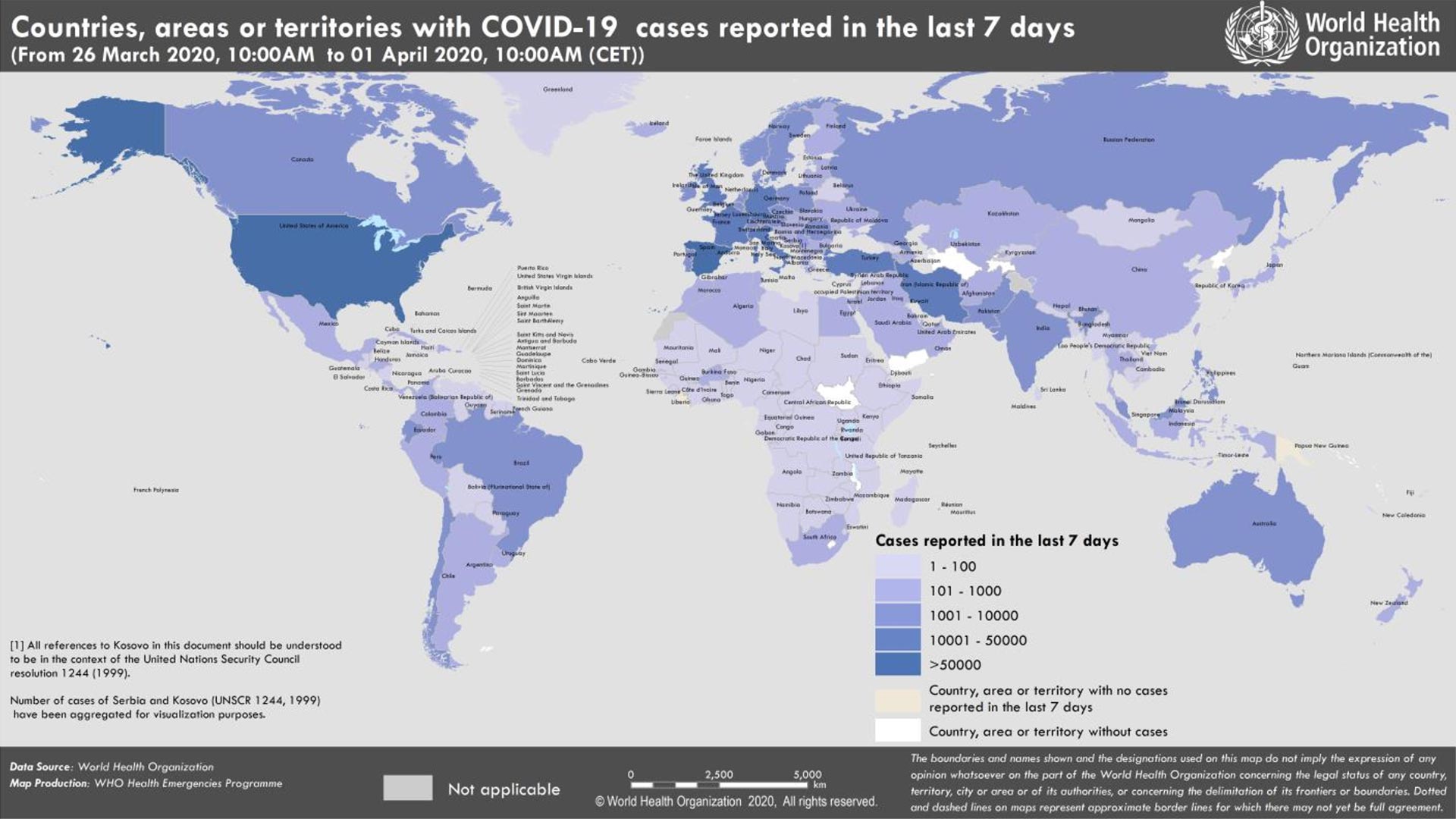
Countries, territories or areas with reported laboratory-confirmed COVID-19 cases and deaths, April 1, 2020
| Country/Territory/Area | Confirmed Cases |
|---|---|
| United States of America | 163199 |
| Italy | 105792 |
| Spain | 94417 |
| China | 82631 |
| Germany | 67366 |
| France | 51477 |
| Iran | 44606 |
| United Kingdom | 25154 |
| Switzerland | 16108 |
| Turkey | 13531 |
| Belgium | 12775 |
| Netherlands | 12595 |
| Austria | 10182 |
| Republic of Korea | 9887 |
| Canada | 7695 |
| Portugal | 7443 |
| Israel | 5129 |
| Australia | 4707 |
| Brazil | 4579 |
| Norway | 4447 |
| Sweden | 4435 |
| Czechia | 3308 |
| Ireland | 3235 |
| Denmark | 2860 |
| Malaysia | 2766 |
| Chile | 2738 |
| Russian Federation | 2337 |
| Poland | 2311 |
| Romania | 2245 |
| Ecuador | 2240 |
| Japan | 2178 |
| Luxembourg | 2178 |
| Philippines | 2084 |
| Pakistan | 2039 |
| Thailand | 1771 |
| India | 1636 |
| Saudi Arabia | 1563 |
| Indonesia | 1528 |
| Finland | 1384 |
| South Africa | 1353 |
| Greece | 1314 |
| Iceland | 1135 |
| Dominican Republic | 1109 |
| Mexico | 1094 |
| Peru | 1065 |
| Panama | 989 |
| Argentina | 966 |
| Singapore | 926 |
| Serbia | 900 |
| Croatia | 867 |
| Slovenia | 814 |
| Colombia | 798 |
| Qatar | 781 |
| Estonia | 745 |
| International (Diamond Princess Cruise Ship) | 712 |
| Egypt | 710 |
| Iraq | 694 |
| Ukraine | 669 |
| United Arab Emirates | 664 |
| New Zealand | 647 |
| Morocco | 638 |
| Algeria | 584 |
| Bahrain | 567 |
| Lithuania | 533 |
| Armenia | 532 |
| Hungary | 492 |
| Lebanon | 463 |
| Bosnia and Herzegovina | 413 |
| Bulgaria | 399 |
| Latvia | 398 |
| Tunisia | 394 |
| Andorra | 376 |
| Slovakia | 363 |
| Republic of Moldova | 353 |
| Kazakhstan | 348 |
| North Macedonia | 329 |
| Uruguay | 320 |
| Costa Rica | 314 |
| Azerbaijan | 298 |
| Kuwait | 289 |
| Jordan | 274 |
| Cyprus | 262 |
| Burkina Faso | 261 |
| Réunion | 247 |
| Albania | 243 |
| Puerto Rico | 239 |
| San Marino | 236 |
| Oman | 210 |
| Vietnam | 207 |
| Afghanistan | 192 |
| Cuba | 186 |
| Senegal | 175 |
| Uzbekistan | 173 |
| Côte d’Ivoire | 169 |
| Faroe Islands | 169 |
| Malta | 167 |
| Ghana | 152 |
| Mauritius | 143 |
| Sri Lanka | 143 |
| Cameroon | 139 |
| Honduras | 139 |
| Palestinian Territory | 134 |
| Brunei Darussalam | 129 |
| Venezuela | 129 |
| Martinique | 119 |
| Georgia | 115 |
| Guadeloupe | 114 |
| Kosovo | 112 |
| Kyrgyzstan | 111 |
| Nigeria | 111 |
| Cambodia | 109 |
| Democratic Republic of the Congo | 109 |
| Bolivia | 107 |
| Montenegro | 105 |
| Mayotte | 101 |
| Belarus | 94 |
| Trinidad and Tobago | 85 |
| Rwanda | 75 |
| Gibraltar | 69 |
| Guam | 69 |
| Liechtenstein | 68 |
| Paraguay | 65 |
| Jersey | 63 |
| Guernsey | 60 |
| Aruba | 55 |
| Bangladesh | 54 |
| Madagascar | 53 |
| Isle of Man | 52 |
| Monaco | 52 |
| Kenya | 50 |
| French Guiana | 46 |
| French Polynesia | 37 |
| Guatemala | 36 |
| Jamaica | 36 |
| Zambia | 35 |
| Togo | 34 |
| Barbados | 33 |
| Uganda | 33 |
| Djibouti | 31 |
| El Salvador | 30 |
| United States Virgin Islands | 30 |
| Bermuda | 27 |
| Ethiopia | 26 |
| Niger | 20 |
| Congo | 19 |
| United Republic of Tanzania | 19 |
| Maldives | 18 |
| Mali | 18 |
| Saint Martin | 18 |
| Guinea | 16 |
| New Caledonia | 16 |
| Haiti | 15 |
| Myanmar | 15 |
| Bahamas | 14 |
| Equatorial Guinea | 14 |
| Cayman Islands | 12 |
| Guyana | 12 |
| Mongolia | 12 |
| Curaçao | 11 |
| Dominica | 11 |
| Namibia | 11 |
| Greenland | 10 |
| Libya | 10 |
| Syrian Arab Republic | 10 |
| Benin | 9 |
| Eswatini | 9 |
| Grenada | 9 |
| Guinea-Bissau | 9 |
| Lao People’s Democratic Republic | 9 |
| Saint Lucia | 9 |
| Mozambique | 8 |
| Saint Kitts and Nevis | 8 |
| Seychelles | 8 |
| Suriname | 8 |
| Zimbabwe | 8 |
| Angola | 7 |
| Antigua and Barbuda | 7 |
| Chad | 7 |
| Gabon | 7 |
| Sudan | 7 |
| Central African Republic | 6 |
| Eritrea | 6 |
| Holy See | 6 |
| Saint Barthelemy | 6 |
| Sint Maarten | 6 |
| Cabo Verde | 5 |
| Fiji | 5 |
| Mauritania | 5 |
| Montserrat | 5 |
| Nepal | 5 |
| Somalia | 5 |
| Turks and Caicos | 5 |
| Bhutan | 4 |
| Nicaragua | 4 |
| Belize | 3 |
| Botswana | 3 |
| British Virgin Islands | 3 |
| Gambia | 3 |
| Liberia | 3 |
| Anguilla | 2 |
| Burundi | 2 |
| Northern Mariana Islands | 2 |
| Papua New Guinea | 1 |
| Saint Vincent and the Grenadines | 1 |
| Sierra Leone | 1 |
| Timor-Leste | 1 |
| Total | 823626 |
359
Recommendations and Advice for the Public
If you are not in an area where COVID-19 is spreading or have not traveled from an area where COVID-19 is spreading or have not been in contact with an infected patient, your risk of infection is low. It is understandable that you may feel anxious about the outbreak. Get the facts from reliable sources to help you accurately determine your risks so that you can take reasonable precautions (see Frequently Asked Questions). Seek guidance from WHO, your healthcare provider, your national public health authority or your employer for accurate information on COVID-19 and whether COVID-19 is circulating where you live. It is important to be informed of the situation and take appropriate measures to protect yourself and your family (see Protection measures for everyone).
If you are in an area where there are cases of COVID-19 you need to take the risk of infection seriously. Follow the advice of WHO and guidance issued by national and local health authorities. For most people, COVID-19 infection will cause mild illness however, it can make some people very ill and, in some people, it can be fatal. Older people, and those with pre-existing medical conditions (such as cardiovascular disease, chronic respiratory disease or diabetes) are at risk for severe disease (See Protection measures for persons who are in or have recently visited (past 14 days) areas where COVID-19 is spreading).
Never miss a breakthrough: Join the SciTechDaily newsletter.
Follow us on Google and Google News.