
Close Menu
    Facebook X (Twitter) Instagram
    SciTechDaily
    • Biology
    • Chemistry
    • Earth
    • Health
    • Physics
    • Science
    • Space
    • Technology
    Facebook X (Twitter) Pinterest YouTube RSS
    SciTechDaily
    Home»Space»Meteorites Show That Our Solar System Formed in Less Than 200,000 Years
    Space

    Meteorites Show That Our Solar System Formed in Less Than 200,000 Years

    By Lawrence Livermore National LaboratoryNovember 24, 20202 Comments3 Mins Read
    Facebook Twitter Pinterest Telegram LinkedIn WhatsApp Email Reddit
    Share
    Facebook Twitter LinkedIn Pinterest Telegram Email Reddit
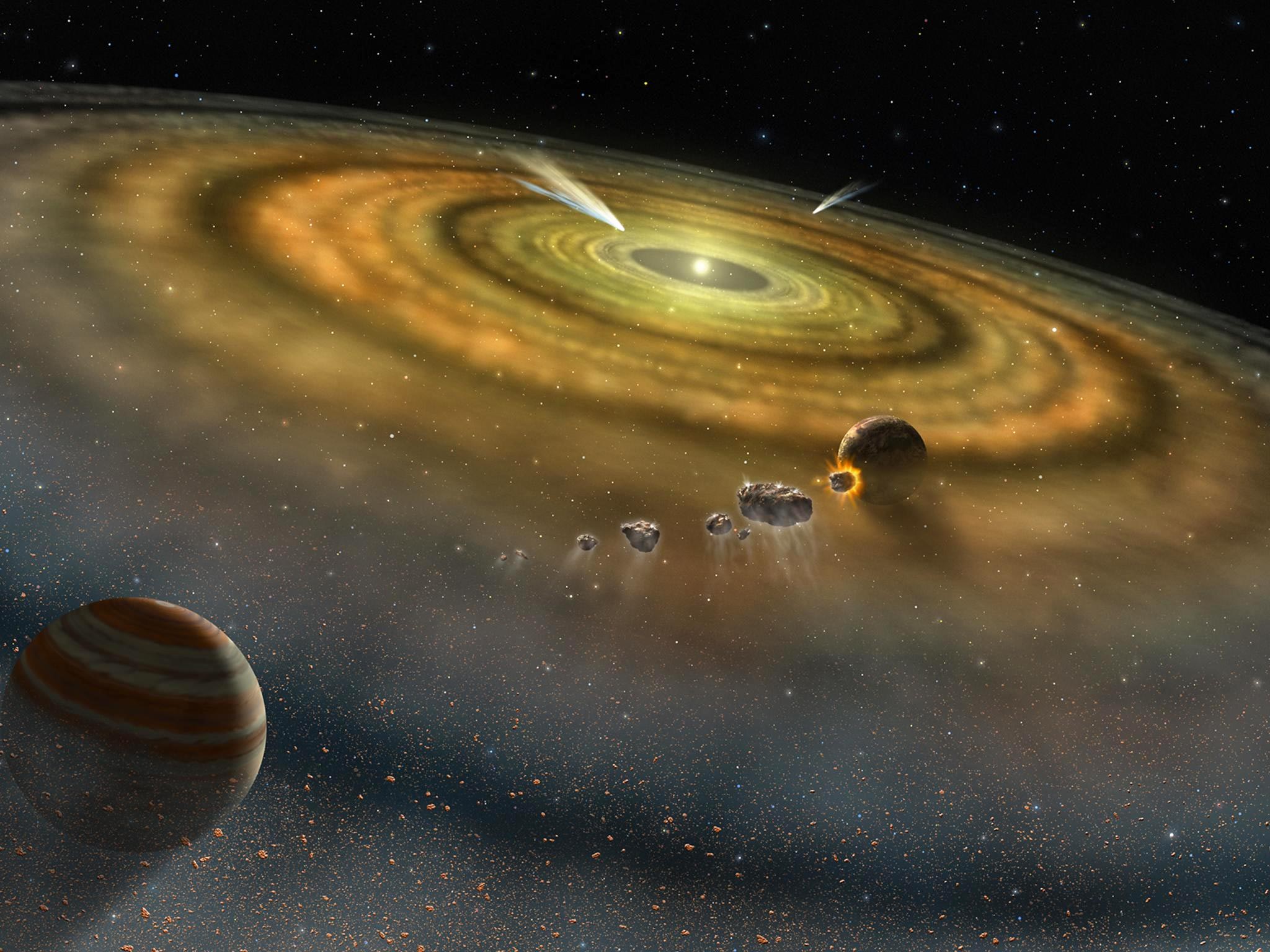
    Artist's Conception Solar System Formation
    Artist’s conception of the dust and gas surrounding a new planetary system. Credit: NASA

    A long time ago — roughly 4.5 billion years — our sun and solar system formed over the short time span of 200,000 years. That is the conclusion of a group of Lawrence Livermore National Laboratory (LLNL) scientists after looking at isotopes of the element molybdenum found on meteorites.

    The material that makes up the sun and the rest of the solar system came from the collapse of a large cloud of gas and dust about 4.5 billion years ago. By observing other stellar systems that formed similarly to ours, astronomers estimate that it probably takes about 1-2 million years for the collapse of a cloud and ignition of a star, but this is the first study that can provide numbers on our own solar system.

    “Previously, the timeframe of formation was not really known for our solar system,” said LLNL cosmochemist Greg Brennecka, lead author of a paper appearing in Science. “This work shows that this collapse, which led to the formation of the solar system, happened very quickly, in less than 200,000 years. If we scale this all to a human lifespan, formation of the solar system would compare to pregnancy lasting about 12 hours instead of nine months. This was a rapid process.”

    The oldest dated solids in the solar system are calcium-aluminum-rich inclusions (CAIs), and these samples provide a direct record of solar system formation. These micrometer- to centimeter-sized inclusions in meteorites formed in a high-temperature environment (more than 1,300 Kelvin), probably near the young sun. They were then transported outward to the region where carbonaceous chondrite meteorites (and their parent bodies) formed, where they are found today. The majority of CAIs formed 4.567 billion years ago, over a period of about 40,000 to 200,000 years.

    This is where the LLNL team comes in. The international team measured the molybdenum (Mo) isotopic and trace element compositions of a variety of CAIs taken from carbonaceous chondrite meteorites, including Allende, the largest carbonaceous chondrite found on Earth. Because they found that the distinct Mo isotopic compositions of CAIs cover the entire range of material that formed in the protoplanetary disk instead of just a small slice, these inclusions must have formed within the time span of cloud collapse.

    Since the observed time span of stellar accretion (1-2 million years) is much longer than CAIs took to form, the team was able to pinpoint which astronomical phase in the solar system’s formation was recorded by the formation of CAIs, and ultimately, how quickly the material that makes up the solar system accreted.

    Reference: “Astronomical context of Solar System formation from molybdenum isotopes in meteorite inclusions” by Gregory A. Brennecka, Christoph Burkhardt, Gerrit Budde, Thomas S. Kruijer, Francis Nimmo and Thorsten Kleine, 13 November 2020, Science.
    DOI: 10.1126/science.aaz8482

    Former LLNL scientist Thomas Kruijer (now at the Museum für Naturkunde in Berlin) also contributed to this study, as well as researchers from University of Münster, California Institute of Technology and the University of California, Santa Cruz.

    The work is funded by LLNL’s Laboratory Directed Research and Development program and NASA.

    Never miss a breakthrough: Join the SciTechDaily newsletter.
    Follow us on Google and Google News.

    Astrophysics Lawrence Livermore National Laboratory Meteorites Popular Solar System
    Share. Facebook Twitter Pinterest LinkedIn Email Reddit

    Related Articles

    Lost in Space: Earth and Mars Were Formed From Missing Solar System Material

    Analyzing Meteorites To Track Down the Forces That Shaped Our Solar System’s Evolution

    Sculpted by Starlight: An Unusual Meteorite Witness to the Solar System’s Birth

    Scientists Experimentally Recreate Conditions That Exist Deep Inside Giant Planets

    Astronomers Identify the Orbit and Size of Exoplanet Beta Pictoris b

    IBEX Reveals First View of the Solar System’s Tail, The Heliotail

    Study Challenges the Idea That a Supernova Prompted the Formation of the Solar System

    Scientists Detected Exoplanetary System With Regularly Aligned Orbits Similar to Our Solar System

    Possible Death of Solar System Seen in White Dwarf Stars

    2 Comments

    1. James Krause on November 24, 2020 10:33 pm

      It took 6 days and on the 7th day He rested.

      Reply
      • Torbjörn Larsson on November 25, 2020 12:06 pm

        Irrelevant – erroneous superstition.

        Read the article instead!

        Reply
    Leave A Reply Cancel Reply

    • Facebook
    • Twitter
    • Pinterest
    • YouTube

    Don't Miss a Discovery

    Subscribe for the Latest in Science & Tech!

    Trending News

    This Experimental Drug Repaired the Gut and Reversed Severe Fatty Liver Disease

    Physicists Just Turned a Black Hole Energy Theory Into Reality

    Stanford Scientists Solve a 252-Million-Year-Old Mass Extinction Mystery

    The Ancient Survival Mechanism Making Weight Loss So Difficult

    Just 3,000 Steps a Day May Help Protect the Brain From Alzheimer’s

    “Weird Clams” Reveal a New Invasion Along the U.S. Northeast Coast

    Archaeologists Decapitated Tutankhamun and Glued His Body Back Together

    New Black Hole Theory Solves a 50-Year-Old Problem

    Follow SciTechDaily
    • Facebook
    • Twitter
    • YouTube
    • Pinterest
    • Newsletter
    • RSS
    SciTech News
    • Biology News
    • Chemistry News
    • Earth News
    • Health News
    • Physics News
    • Science News
    • Space News
    • Technology News
    Recent Posts
    • The Hidden Cancer Risk of Ketogenic Diets
    • Quantum Computer Stores Data in Vibrations Like Notes on a Guitar
    • Astronomers Discover Two Super Puff Planets Lighter Than Cotton Candy
    • One Asteroid Collision May Have Rocked Earth, Mars, and the Moon
    • Scientists Restore the Sense of Touch With Electrical Brain Stimulation
    Copyright © 1998 - 2026 SciTechDaily. All Rights Reserved.
    • Science News
    • About
    • Contact
    • Editorial Board
    • Privacy Policy
    • Terms of Use

    Type above and press Enter to search. Press Esc to cancel.