
Close Menu
    Facebook X (Twitter) Instagram
    SciTechDaily
    • Biology
    • Chemistry
    • Earth
    • Health
    • Physics
    • Science
    • Space
    • Technology
    Facebook X (Twitter) Pinterest YouTube RSS
    SciTechDaily
    Home»Space»Scientists Experimentally Recreate Conditions That Exist Deep Inside Giant Planets
    Space

    Scientists Experimentally Recreate Conditions That Exist Deep Inside Giant Planets

    By Anne M Stark, Lawrence Livermore National LaboratoryJuly 18, 2014No Comments3 Mins Read
    Facebook Twitter Pinterest Telegram LinkedIn WhatsApp Email Reddit
    Share
    Facebook Twitter LinkedIn Pinterest Telegram Email Reddit
    Scientists Experimentally Recreate the Conditions That Exist Deep Inside Giant Planets
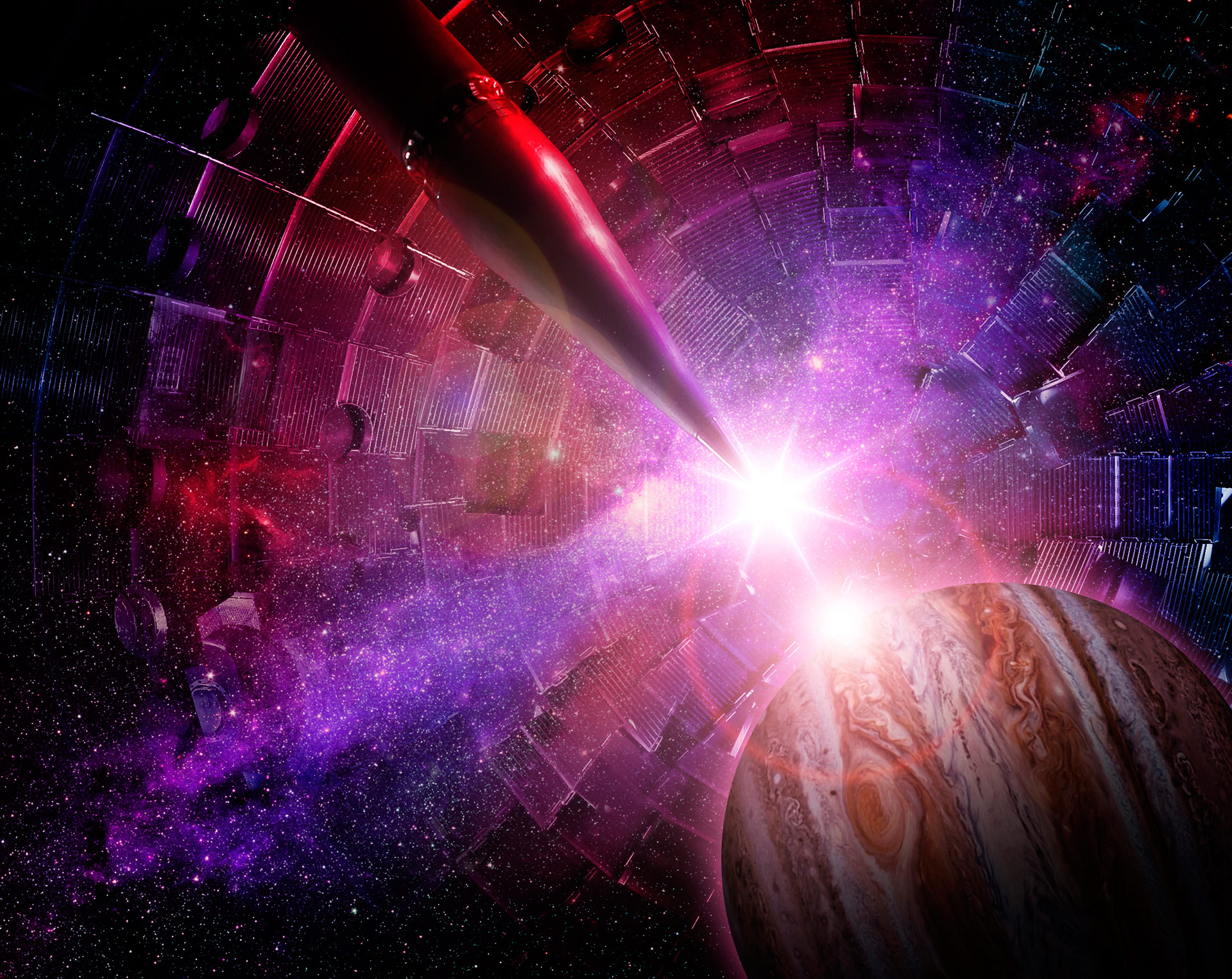
    The interior of the target chamber at the National Ignition Facility at Lawrence Livermore National Laboratory. The object entering from the left is the target positioner, on which a millimeter-scale target is mounted. Researchers recently used NIF to study the interior state of giant planets. Credit: Damien Jemison/LLNL

    Using the largest laser in the world, scientists were able to experimentally recreate the conditions that exist deep inside giant planets for the first time.

    Lawrence Livermore scientists for the first time have experimentally re-created the conditions that exist deep inside giant planets, such as Jupiter, Uranus and many of the planets recently discovered outside our solar system.

    Researchers can now recreate and accurately measure material properties that control how these planets evolve over time, information essential for understanding how these massive objects form. This study focused on carbon, the fourth most abundant element in the cosmos (after hydrogen, helium, and oxygen), which has an important role in many types of planets within and outside our solar system. The research appears in the July 17 edition of the journal, Nature.

    Using the largest laser in the world, the National Ignition Facility at Lawrence Livermore National Laboratory, teams from the Laboratory, University of California, Berkeley, and Princeton University squeezed samples to 50 million times Earth’s atmospheric pressure, which is comparable to the pressures at the center of Jupiter and Saturn. Of the 192 lasers at NIF, the team used 176 with exquisitely shaped energy versus time to produce a pressure wave that compressed the material for a short period of time. The sample — diamond — is vaporized in less than 10 billionths of a second.

    Though diamond is the least compressible material known, the researchers were able to compress it to an unprecedented density greater than lead at ambient conditions.

    “The experimental techniques developed here provide a new capability to experimentally reproduce pressure-temperature conditions deep in planetary interiors,” said Ray Smith, LLNL physicist and lead author of the paper.

    Such pressures have been reached before, but only with shock waves that also create high temperatures — hundreds of thousands of degrees or more — that are not realistic for planetary interiors. The technical challenge was keeping temperatures low enough to be relevant to planets. The problem is similar to moving a plow slowly enough to push sand forward without building it up in height. This was accomplished by carefully tuning the rate at which the laser intensity changes with time.

    “This new ability to explore matter at atomic scale pressures, where extrapolations of earlier shock and static data become unreliable, provides new constraints for dense matter theories and planet evolution models,” said Rip Collins, another Lawrence Livermore physicist on the team.

    The data described in this work are among the first tests for predictions made in the early days of quantum mechanics, more than 80 years ago, which are routinely used to describe matter at the center of planets and stars. While agreement between these new data and theory is good, there are important differences discovered, suggesting potential hidden treasures in the properties of diamond compressed to such extremes. Future experiments on NIF are focused on further unlocking these mysteries.

    Reference: “Ramp compression of diamond to five terapascals” by R. F. Smith, J. H. Eggert, R. Jeanloz, T. S. Duffy, D. G. Braun, J. R. Patterson, R. E. Rudd, J. Biener, A. E. Lazicki, A. V. Hamza, J. Wang, T. Braun, L. X. Benedict, P. M. Celliers and G. W. Collins, 16 July 2014, Nature.
    DOI: 10.1038/nature13526


    Never miss a breakthrough: Join the SciTechDaily newsletter.
    Follow us on Google and Google News.

    Astronomy Astrophysics Lawrence Livermore National Laboratory Popular
    Share. Facebook Twitter Pinterest LinkedIn Email Reddit

    Related Articles

    Ironing Out the Interiors of Super-Earth Exoplanets

    Lost in Space: Earth and Mars Were Formed From Missing Solar System Material

    Astronomers Identify the Orbit and Size of Exoplanet Beta Pictoris b

    Lonestar Supercomputer Helps Explore Dark Matter

    Astronomers Obtain Precise Measurements of the Two Kepler-16 Stars

    Possible Death of Solar System Seen in White Dwarf Stars

    Ancient Galactic Collision Created Stellar Swirls of NGC 5907

    The Bolshoi Simulation: Boxing the Universe

    Scientists Convene to Take a Picture of the Supermassive Black Hole at the Center of the Milky Way

    Leave A Reply Cancel Reply

    • Facebook
    • Twitter
    • Pinterest
    • YouTube

    Don't Miss a Discovery

    Subscribe for the Latest in Science & Tech!

    Trending News

    Breakthrough Bowel Cancer Trial Leaves Patients Cancer-Free for Nearly 3 Years

    Natural Compound Shows Powerful Potential Against Rheumatoid Arthritis

    100,000-Year-Old Neanderthal Fossils in Poland Reveal Unexpected Genetic Connections

    Simple “Gut Reset” May Prevent Weight Gain After Ozempic or Wegovy

    2.8 Days to Disaster: Scientists Warn Low Earth Orbit Could Suddenly Collapse

    Common Food Compound Shows Surprising Power Against Superbugs

    5 Simple Ways To Remember More and Forget Less

    The Atomic Gap That Could Cost the Semiconductor Industry Billions

    Follow SciTechDaily
    • Facebook
    • Twitter
    • YouTube
    • Pinterest
    • Newsletter
    • RSS
    SciTech News
    • Biology News
    • Chemistry News
    • Earth News
    • Health News
    • Physics News
    • Science News
    • Space News
    • Technology News
    Recent Posts
    • Scientists Discover Stem Cells That Could Regrow Teeth and Bone
    • Scientists Discover Natural Molecule That Stops Alzheimer’s Protein Clumps From Forming
    • Early Cannabis Use May Stall Key Brain Skills in Teens
    • Popular Vitamin D Supplement Has “Previously Unknown” Negative Effect, Study Finds
    • Powerful Antioxidant Found To Play a Key Role in Proper Protein Folding
    Copyright © 1998 - 2026 SciTechDaily. All Rights Reserved.
    • Science News
    • About
    • Contact
    • Editorial Board
    • Privacy Policy
    • Terms of Use

    Type above and press Enter to search. Press Esc to cancel.