
Close Menu
    Facebook X (Twitter) Instagram
    SciTechDaily
    • Biology
    • Chemistry
    • Earth
    • Health
    • Physics
    • Science
    • Space
    • Technology
    Facebook X (Twitter) Pinterest YouTube RSS
    SciTechDaily
    Home»Space»Astronomical Instrument Hunts for Ancient Metal – Looks at Quasars to Explore the Origin of the Iron in Your Blood
    Space

    Astronomical Instrument Hunts for Ancient Metal – Looks at Quasars to Explore the Origin of the Iron in Your Blood

    By University of TokyoDecember 7, 2020No Comments3 Mins Read
    Facebook Twitter Pinterest Telegram LinkedIn WhatsApp Email Reddit
    Share
    Facebook Twitter LinkedIn Pinterest Telegram Email Reddit
    New Technology Telescope
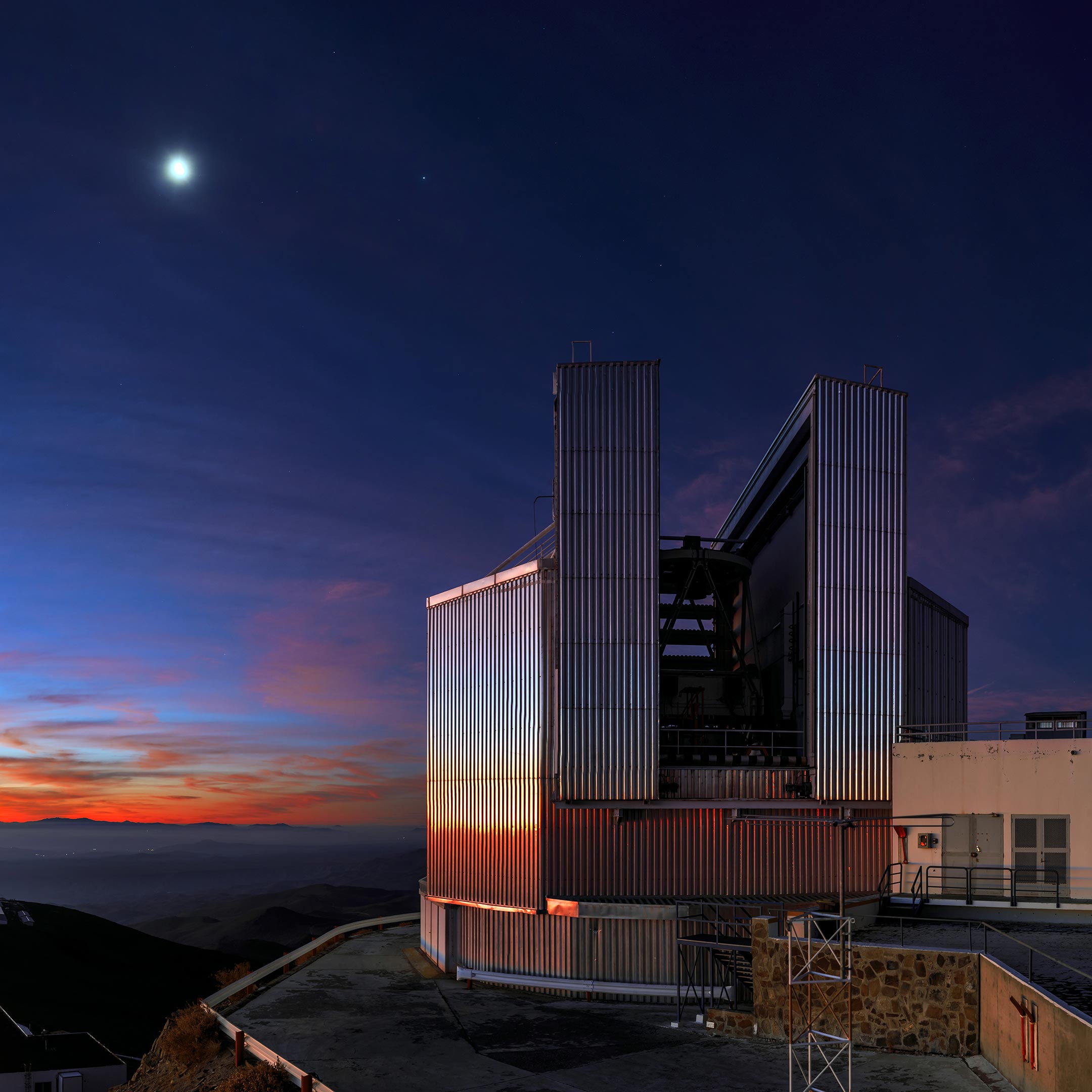
    The WINERED spectrograph was mounted on the 3.58-meter New Technology Telescope (NTT) at the La Silla Observatory in Chile. Credit: © 2020 European Southern Observatory/B. Tafreshi

    Researchers created a new astronomical instrument that has successfully aided in estimating the abundance of metals in the early universe. The WINERED instrument allows for better observations of astronomical bodies like quasars in the early universe, billions of years ago. Researchers hope this deeper level of exploration could help answer questions about the origins not only of metals in the universe but also of the stars themselves.

    Iron is one of the most important elements for life as we know it, and for the technology, both primitive and modern, that has shaped human history. But details of the exact origin of iron and other important metals such as magnesium remain elusive. Exploration of this is important in the field of astronomy as it also connected to the origins of the first stars that would have begun to shine several hundred million years after the Big Bang.
    WINERED Instrument
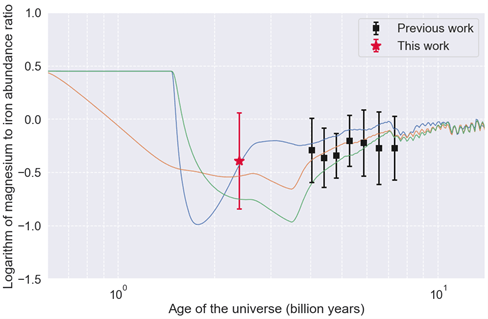
    The WINERED instrument allows observations of distant quasars from when the universe was only 2.4 billion years old. Previous studies with visible light were limited to astronomical bodies 4 billion years old. The colored lines represent three different possible models for the chemical evolution of the universe. Credit: © 2020 Sameshima et al.

    Project Research Associate Hiroaki Sameshima from the Institute of Astronomy at the University of Tokyo and his team decided a new instrument was needed to study these matters. Due to limited instrumentation, previous observations to collect data for the study of metals’ origins mainly looked at old stars nearby. But this only gave astronomers information about our own unique galaxy. A new instrument with enhanced sensitivity to near-infrared light could push the boundary and open up observations of distant quasars, ferociously energetic ancient galactic cores that emitted light when the universe was only 2.4 billion years old.

    “By mounting the WINERED instrument on a large telescope, we can see further back in time as we can observe bodies more distant, or more ancient, than those from previous studies. We can now see details of quasars over 10 billion years old,” said Sameshima. “WINERED is a special kind of spectrograph, which can read the chemical signatures present in the light from distant bodies. It revealed to us the fingerprints of iron and magnesium in the light from these quasars, and this allowed us to calculate the abundance of these elements when the universe was much younger than previous studies allowed.”

    Now that the researchers have established a new method to directly examine the abundance of metals in the early universe, the challenge becomes one of refining the technique and broadening its scope to collect more data. With improved data, astronomers can build on this study and create theories to explain the origins of metals including the iron in your blood.

    Reference: “Mg II and Fe II Fluxes of Luminous Quasars at z ~ 2.7 and Evaluation of the Baldwin Effect in the Flux-to-abundance Conversion Method for Quasars” by Hiroaki Sameshima, Yuzuru Yoshii, Noriyuki Matsunaga, Naoto Kobayashi, Yuji Ikeda, Sohei Kondo, Satoshi Hamano, Misaki Mizumoto, Akira Arai, Chikako Yasui, Kei Fukue, Hideyo Kawakita, Shogo Otsubo, Giuseppe Bono and Ivo Saviane, 1 December 2020, The Astrophysical Journal.
    DOI: 10.3847/1538-4357/abc33b
    arXiv: 2010.10548

    Never miss a breakthrough: Join the SciTechDaily newsletter.
    Follow us on Google and Google News.

    Astronomy Astrophysics Quasars University of Tokyo
    Share. Facebook Twitter Pinterest LinkedIn Email Reddit

    Related Articles

    Ancient Quasars and Massive Dark Matter Halos Reveal Black Hole Secrets

    Massive X-ray Jet – Extending for 160,000 Light-Years – Spied From Supermassive Black Hole in Early Universe

    Astronomers Have Discovered the Most Distant Source of Radio Emission Ever Known – 13 Billion Light-Years Away

    Sensing Suns: Astronomers Accurately Measure the Temperature of Red Supergiant Stars

    A Most Distant Signal: Earliest Supermassive Black Hole and Quasar in the Universe Discovered

    Puzzling Astrophysics of Quasars in the Early Universe

    When Galaxies Collide: How Galactic Collisions Can Starve Massive Black Holes

    Astronomers Discover Earliest Supermassive Black Hole and Quasar in the Universe – 1000x More Luminous Than the Milky Way

    Most Distant Quasar Discovered Sheds Light on How Supermassive Black Holes Grow

    Leave A Reply Cancel Reply

    • Facebook
    • Twitter
    • Pinterest
    • YouTube

    Don't Miss a Discovery

    Subscribe for the Latest in Science & Tech!

    Trending News

    This Copper Drug Clears Alzheimer’s Brain Toxins and Boosts Memory

    Adults Over 65 Lost Massive Amounts of Weight With Ozempic

    How Flocking Birds “Defy” One of Physics’ Most Fundamental Laws

    Physicists Create a New Kind of Schrödinger’s Cat State From Exotic Quantum Building Blocks

    Your Diet Could Be Missing the Key Ingredient for Heart Protection

    Researchers Warn Widely Prescribed Blood Pressure Drugs Could Be Harming Diabetic Kidneys

    James Webb Spots Something Strange Between Day and Night on an Alien Planet

    How Ancient People Moved a 6-Ton Stone 700 Kilometers to Stonehenge

    Follow SciTechDaily
    • Facebook
    • Twitter
    • YouTube
    • Pinterest
    • Newsletter
    • RSS
    SciTech News
    • Biology News
    • Chemistry News
    • Earth News
    • Health News
    • Physics News
    • Science News
    • Space News
    • Technology News
    Recent Posts
    • Scientists Uncover Cause of Inflammatory Bowel Disease Solving Decades-Old Mystery
    • The Surprising Reason Swimming Could Be Better for Your Heart Than Running
    • Could Vitamin C Be the Secret to Keeping Your Brain Younger?
    • The Surprising Fix for Robot Traffic Jams
    • Near Absolute Zero, This Transistor Starts Acting Like a Brain Cell
    Copyright © 1998 - 2026 SciTechDaily. All Rights Reserved.
    • Science News
    • About
    • Contact
    • Editorial Board
    • Privacy Policy
    • Terms of Use

    Type above and press Enter to search. Press Esc to cancel.