
Nature has figured out how to make great membranes.
Biological membranes let the right stuff into cells while keeping the wrong stuff out. And, as researchers noted in a paper just published by the journal Science, they are remarkable and ideal for their job.
But they’re not necessarily ideal for high-volume, industrial jobs such as pushing saltwater through a membrane to remove salt and make fresh water for drinking, irrigating crops, watering livestock or creating energy.
Can we learn from those high-performing biological membranes? Can we apply nature’s homogenous design strategies to manufactured, polymer membranes? Can we quantify what makes some of those industrial membranes perform better than others?
Researchers from Iowa State University, Penn State University, the University of Texas at Austin, DuPont Water Solutions, and Dow Chemical Co. — led by Enrique Gomez of Penn State and Manish Kumar of Texas — have used transmission electron microscopy and 3D computational modeling to look for answers.
Iowa State’s Baskar Ganapathysubramanian, the Joseph C. and Elizabeth A. Anderlik Professor in Engineering from the Department of Mechanical Engineering, and Biswajit Khara, a doctoral student in mechanical engineering, contributed their expertise in applied mathematics, high-performance computing, and 3D modeling to the project.
The researchers found that creating a uniform membrane density down to the nanoscale of billionths of a meter is crucial for maximizing the performance of reverse-osmosis, water-filtration membranes. Their discovery has just been published online by the journal Science and will be the cover paper of the January 1, 2021, print edition.
Working with Penn State’s transmission electron microscope measurements of four different polymer membranes used for water desalination, the Iowa State engineers predicted water flow through 3D models of the membranes, allowing detailed comparative analysis of why some membranes performed better than others.
“The simulations were able to tease out that membranes that are more uniform — that have no ‘hot spots’ — have uniform flow and better performance,” Ganapathysubramanian said. “The secret ingredient is less inhomogeneity.”
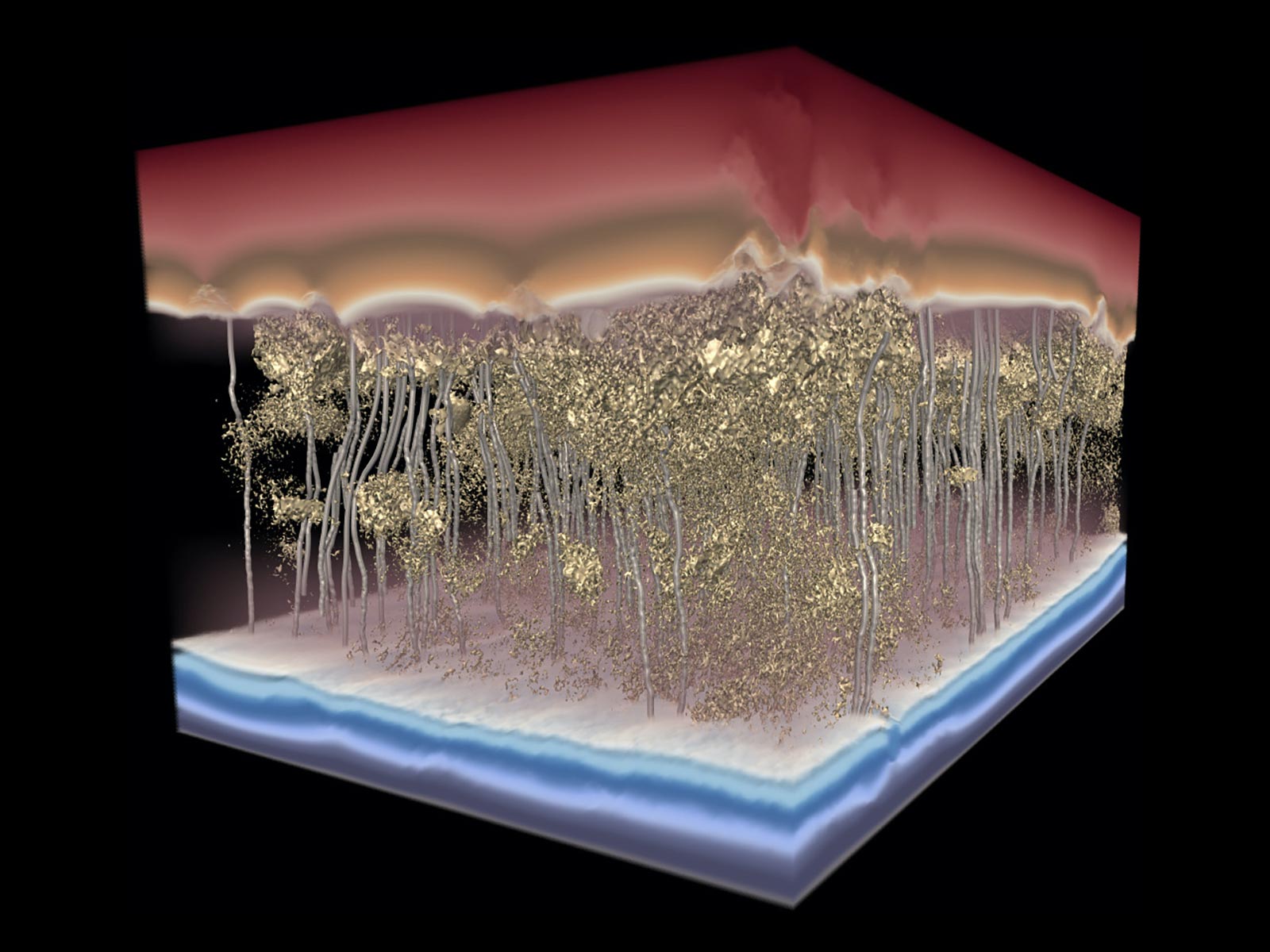
Just take a look at the Science cover image the Iowa State researchers created with assistance from the Texas Advanced Computing Center, said Khara: Red above the membrane shows water under higher pressure and with higher concentrations of salt; the gold, granular, sponge-like structure in the middle shows denser and less-dense areas within the salt-stopping membrane; silver channels show how water flows through; and the blue at the bottom shows water under lower pressure and with lower concentrations of salt.
“You can see huge amounts of variation in the flow characteristics within the 3D membranes,” Khara said.
Most telling are the silver lines showing water moving around dense spots in the membrane.
“We’re showing how water concentration changes across the membrane,” Ganapathysubramanian said of the models which required high-performance computing to solve. “This is beautiful. It has not been done before because such detailed 3D measurements were unavailable, and also because such simulations are non-trivial to perform.”
Khara added, “The simulations themselves posed computational challenges, as the diffusivity within an inhomogeneous membrane can differ by six orders of magnitude”
So, the paper concludes, the key to better desalination membranes is figuring out how to measure and control at very small scales the densities of manufactured membranes. Manufacturing engineers and materials scientists need to make the density uniform throughout the membrane, thus promoting water flow without sacrificing salt removal.
It’s one more example of the computational work from Ganapathysubramanian’s lab helping to solve a very fundamental yet practical problem.
“These simulations provided a lot of information for figuring out the key to making desalination membranes much more effective,” said Ganapathysubramanian, whose work on the project was partly supported by two grants from the National Science Foundation.
Reference: “Nanoscale control of internal inhomogeneity enhances water transport in desalination membranes” by Tyler E. Culp, Biswajit Khara, Kaitlyn P. Brickey, Michael Geitner, Tawanda J. Zimudzi, Jeffrey D. Wilbur, Steven D. Jons, Abhishek Roy, Mou Paul, Baskar Ganapathysubramanian, Andrew L. Zydney, Manish Kumar and Enrique D. Gomez, 1 January 2021, Science.
DOI: 10.1126/science.abb8518
The project was led by Enrique Gomez, a professor of chemical engineering and materials science and engineering at Penn State University, and Manish Kumar, an associate professor of civil, architectural, and environmental engineering at the University of Texas at Austin.
Also, from Iowa State University: Biswajit Khara, Baskar Ganapathysubramanian; from Penn State: Tyler Culp, Kaitlyn Brickey, Michael Geitner, Tawanda Zimudzi, Andrew Zydney; from DuPont Water Solutions: Jeffrey Wilbur, Steve Jons; and from Dow Chemical Co.: Abhishek Roy, Mou Paul.
Never miss a breakthrough: Join the SciTechDaily newsletter.
Follow us on Google and Google News.
4 Comments
You had to figure that sooner or later, these high-tech chemists would come up with something to desalinate sea water without using a high energy distillation process. There may be hope for the future after all. A seawater conversion to fresh water, like a reverse-osmosis filter. Garbage can size one will make water for 4 people per day, or something like that.
The only way you can begin to comprehend, and understand the dynamics of an atom is to be able to measure it and obviously then observe it, I dont want to use worthless and antiquated crap to bring forth ability to allow each of us to live. We therefore must use picometers and picopixals cubits and then yoo see the hexagonal structure of the tritium chain of events. And the beginning of becoming awake.look for a moment at the architecture of the crystalline design of a snow flake and think about going for a ride down ones of its pipelines, the old self sustaining energies of the magnetic moments of joy. You know joy right? So do I…. so why would you treat joy so poorly by causing her to be blind. Nanometers is all this stuff of association with it is nothing but a misleading argument but definitely a point highlighting the fact even more clearly that the funding for such study is just another obstacle to enlightenment. Because if you cant measure or observe it your doing nothing but destroying the relation we have with the cosmic background radiation as we are the antimatter. Each of us realize that those who lead others down such darkened paths care nothing about others but care only about padding their pockets with our labors, and so denying again the enlightenment and hoping that sometime in this very short lifetime, they’ll be able to get away with it.peace in the new year look please at the interior measurements of the pipelines inside such a marvelous design from our heaven. Therefore again showing what the other upper levels of jcb funding dint even think about. I dont mean ti be harsh but save your varnish for the basket that soon well all be begging for as we miss the chance to push through such snow, and see light and feel fantastic. Keep the faith.
Gibberish
Makes perfect sense that water takes the path of least resistance through the system, and takes salt with it. Also makes sense that understanding the physical shape and behavior of water molecules is crucial to designing the system such as this article https://www.nature.com/articles/srep03005. Also understanding the physical size, shape and behavior of salt when in solution is crucial, since salt is so much smaller than water molecules. Thank you for this work and publication. It would be great to have a TLDR section after the main article to step up the level of scientific detail one or two levels higher for satisfying the curiosity of those who can understand it.