
New study unravels long-standing climate mystery and provides insight into how our planet may change in the future.
Scientists claim to have found the “missing link” in the process that leads to an ice age on Earth.
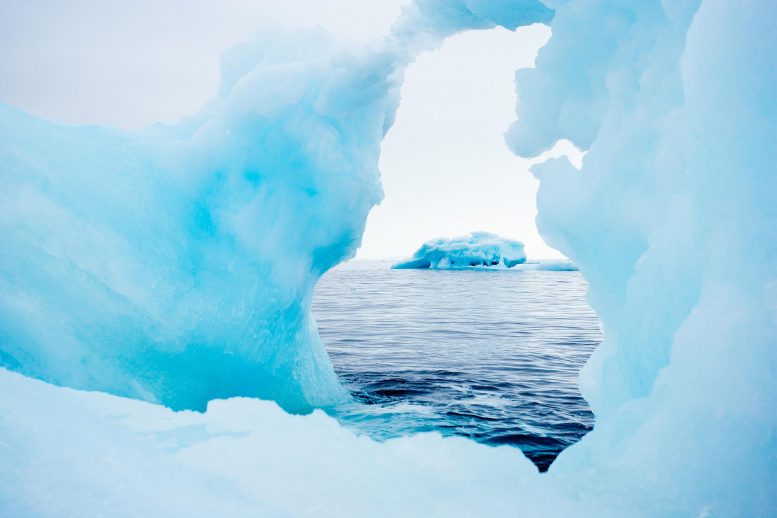
Melting icebergs in the Antarctic are the key, say the team from Cardiff University, triggering a series of chain reactions that plunge Earth into a prolonged period of cold temperatures.
The findings have been published in Nature from an international consortium of scientists from universities around the world.
It has long been known that ice age cycles are paced by periodic changes to Earth’s orbit of the sun, which subsequently changes the amount of solar radiation that reaches the Earth’s surface.
However, up until now it has been a mystery as to how small variations in solar energy can trigger such dramatic shifts in the climate on Earth.
Antarctic Icebergs Trigger Chain Reactions
In their study, the team propose that when the orbit of Earth around the sun is just right, Antarctic icebergs begin to melt further and further away from Antarctica, shifting huge volumes of freshwater away from the Southern Ocean and into the Atlantic Ocean.
As the Southern Ocean gets saltier and the North Atlantic gets fresher, large-scale ocean circulation patterns begin to dramatically change, pulling CO2 out of the atmosphere and reducing the so-called greenhouse effect.
This in turn pushes the Earth into ice age conditions.
Geological Evidence from Ice-Rafted Debris
As part of their study the scientists used multiple techniques to reconstruct past climate conditions, which included identifying tiny fragments of Antarctic rock dropped in the open ocean by melting icebergs.
The rock fragments were obtained from sediments recovered by the International Ocean Discovery Program (IODP) Expedition 361, representing over 1.6 million years of history and one of the longest detailed archives of Antarctic icebergs.
The study found that these deposits, known as Ice-Rafted Debris, appeared to consistently lead to changes in deep ocean circulation, reconstructed from the chemistry of tiny deep-sea fossils called foraminifera.
The team also used new climate model simulations to test their hypothesis, finding that huge volumes of freshwater could be moved by the icebergs.
Lead author of the study Aidan Starr, from Cardiff University’s School of Earth and Environmental Sciences, said: “We were astonished to find that this lead-lag relationship was present during the onset of every ice age for the last 1.6 million years. Such a leading role for the Southern Ocean and Antarctica in global climate has been speculated but seeing it so clearly in geological evidence was very exciting”.
Professor Ian Hall, co-author of the study and co-chief scientist of the IODP Expedition, also from the School of Earth and Environmental Sciences, said: “Our results provide the missing link into how Antarctica and the Southern Ocean responded to the natural rhythms of the climate system associated with our orbit around the sun.”
Over the past 3 million years the Earth has regularly plunged into ice age conditions, but at present is situated within an interglacial period where temperatures are warmer.
Impact of Modern Climate Change
However, due to the increased global temperatures resulting from anthropogenic CO2 emissions, the researchers suggest the natural rhythm of ice age cycles may be disrupted as the Southern Ocean will likely become too warm for Antarctic icebergs to travel far enough to trigger the changes in ocean circulation required for an ice age to develop.
Professor Hall believes that the results can be used to understand how our climate may respond to anthropogenic climate change in the future.
“Likewise as we observe an increase in the mass loss from the Antarctic continent and iceberg activity in the Southern Ocean, resulting from warming associated with current human greenhouse-gas emissions, our study emphasizes the importance of understanding iceberg trajectories and melt patterns in developing the most robust predictions of their future impact on ocean circulation and climate,” he said.
Professor Grant Bigg, from the University of Sheffield’s Department of Geography, who contributed to the iceberg model simulations, said: “The groundbreaking modeling of icebergs within the climate model is crucial for identifying and supporting the ice-rafted debris hypothesis of Antarctic iceberg meltwater impacts which are leading glacial cycle onsets.”
Reference: “Antarctic icebergs reorganize ocean circulation during Pleistocene glacials” by Aidan Starr, Ian R. Hall, Stephen Barker, Thomas Rackow, Xu Zhang, Sidney R. Hemming, H. J. L. van der Lubbe, Gregor Knorr, Melissa A. Berke, Grant R. Bigg, Alejandra Cartagena-Sierra, Francisco J. Jiménez-Espejo, Xun Gong, Jens Gruetzner, Nambiyathodi Lathika, Leah J. LeVay, Rebecca S. Robinson, Martin Ziegler and Expedition 361 Science Party, 13 January 2021, Nature.
DOI: 10.1038/s41586-020-03094-7
Never miss a breakthrough: Join the SciTechDaily newsletter.
Follow us on Google and Google News.
3 Comments
“… it has been a mystery as to how small variations in solar energy can trigger such dramatic shifts in the climate on Earth.”
Anyone who lives in snow country, or has gone skiing in the Spring, has observed that when the sun is unobscured, snow and ice melt readily even when the air temperature above the ground is below freezing. Once the bare ground is exposed, melting accelerates. Even small variations in the solar insolation will have an impact on the observed process.
Does their hypothesis account for ice ages when Antarctic didn’t exist?
They state, “However, due to the increased global temperatures resulting from anthropogenic CO2 emissions, the researchers suggest the natural rhythm of ice age cycles may be disrupted as the Southern Ocean will likely become too warm for Antarctic icebergs to travel far enough to trigger the changes in ocean circulation required for an ice age to develop.” Are they saying that Anthropogenic Global Warming may save us from another Ice Age? What’s the harm in that?
Clyde; Just the opposite, as what the quote was in part saying is; “The Southern Ocean will likely become too warm for Antarctic icebergs to travel far enough to trigger the changes in ocean circulation required for an ice age to develop.”
What this research does is put the responsibility for Global Warming right in our laps. It’s up to us what we do now. Initiate runaway GW by continuing to burn fossil fuels or find a way to produce energy without warming the planet. Also, don’t think the weather will just get wilder or hotter, because at some threshold the oceans become anoxic, that is absent oxygen, causing seaweed and other life to die and sink to the bottom, then rot and release toxic gasses that kill off most terrestrial life.
The underlying assumption is that CO2 is a major driver of a process that has been ongoing for about 12,700 years, the current inter-glacial. If we assume, for the sake of the argument, that the assumption is true, the related unexamined assumption that, despite global temperatures being hypothesized to respond linearly to the logarithm of the CO2 concentration instead of the concentration, that by the time the CO2 concentration gets high enough to be a serious problem we won’t have solved the problem of controlled thermonuclear fusion. We actually have several potential nuclear fission solutions now, but they are generally politically unacceptable to the people who seem most concerned about anthropogenic CO2.
Just what temperature are you proposing is dangerous for causing widespread anoxia? An article here ( https://scitechdaily.com/ancient-oceans-were-surprisingly-resilient-to-climate-change-but-things-are-different-today/ ) States “… the new study suggests warming of 5°C in the Paleocene Eocene Thermal Maximum (PETM) led to anoxia covering no more than 2% of the global seafloor.” They follow that with despite the fact that “… human activity is putting more nutrients into the ocean through fertilizers and pollution, which can drive oxygen loss and accelerate environmental deterioration.”, “Computer simulations based on the results suggest a maximum ten-fold increase in the area of seafloor devoid of oxygen — taking the total to no more than 2% of the global seafloor. This is still significant, at around ten times the MODERN area of anoxia,”. They are saying that even with the other anthropogenic influences, future anoxia will not exceed the extent during the PETM, which was not known for significant extinctions. It was actually well known for diversification of mammals and plants. However, again, these extrapolations are implicitly assuming that we won’t have reliable energy sources based on fission or fusion. The RCP 8.5 scenario has been shown to be unrealistic because there aren’t enough known fossil fuels to continue ‘Business as Usual’ based on burning fossil fuels.
Should something trigger another Ice Age, we’d be hard pressed to find a way to stop it. The contracted growing season, reduced CO2, and reduced arable land would make it impossible to feed the population. We would be better off to err on the side of warm than risk another Ice Age.