

Researchers have developed a compact, low-cost convolutional spectrometer that delivers lab-grade precision for applications ranging from industrial quality control to non-invasive health monitoring.
Imagine checking your blood glucose, detecting dehydration, or verifying the quality of food with a sensor no larger than a smartwatch component. A new optical technology developed by researchers at the University of Cambridge could help make that vision a reality.
The team, working with startup GlitterinTech, has unveiled a fundamentally new type of optical spectrometer that delivers laboratory-grade accuracy in a device small enough for portable and wearable electronics. Spectrometers, which analyze how light interacts with matter, are among the most powerful tools for identifying chemicals and measuring material properties. They are widely used in medicine, manufacturing, environmental monitoring, and scientific research, but high-performance systems have traditionally remained bulky, expensive, and confined to laboratories.
By rethinking how spectral information is measured and processed, the researchers created a spectrometer that costs roughly $10, measures only a few centimeters across, and maintains a level of precision rarely seen in miniaturized devices. The breakthrough could enable a new generation of compact sensors for applications ranging from industrial quality control and food analysis to continuous, noninvasive health monitoring.
A longstanding challenge in spectroscopy has been the trade-off between size and performance. As instruments shrink, they typically lose bandwidth, resolution, or accuracy, limiting their usefulness for demanding measurements.
The newly developed “convolutional spectrometer” tackles this problem with an unconventional approach rooted in the mathematics of the convolution theorem, delivering performance that the researchers say surpasses conventional dispersive, Fourier transform, and reconstructive spectrometers.
Reinventing Spectroscopy with Convolutional Design
Traditional spectrometers typically analyze light by dispersing it or reconstructing spectra through computational methods. The convolutional spectrometer takes a different approach by performing the convolution process directly on incoming light.
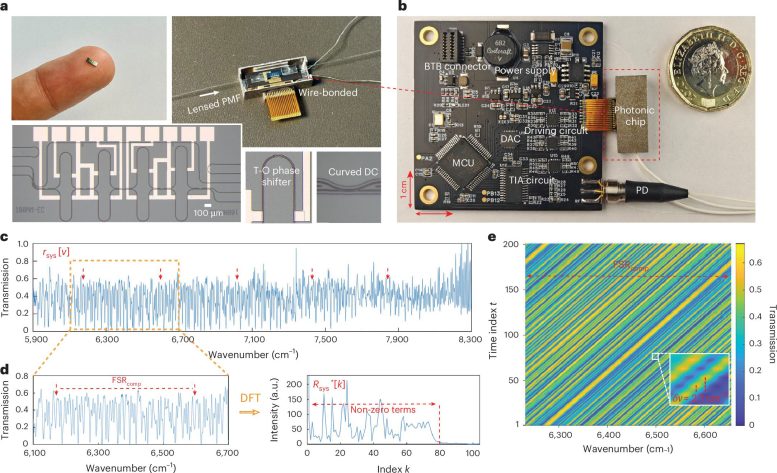
It uses a sequence of optical components with periodic spectral responses, including unbalanced Mach–Zehnder interferometers and microring resonators. By adjusting these components proportionally, the system shifts its spectral response in a controlled way, allowing accurate spectrum recovery through fast Fourier transforms.
“The key insight was to go back to the mathematics and ask whether there was a fundamentally cleaner way to retrieve spectra,” said Dr. Chunhui Yao, a lead author of the study. “By using the convolution theorem directly in the optical domain, we avoid many of the limitations that have held miniaturized spectrometers back. This gives us high precision, strong noise tolerance, and very low computational overhead, all in a compact and low-cost system.”
Built on a silicon nitride photonic integration platform and combined with onboard electronics, the device operates across a broad near-infrared wavelength range (1200–1700 nm). It can capture and process data in less than a second. Its periodic design also enables almost unlimited expansion of spectral bandwidth without modifying the hardware. Resolution can be increased dramatically by adding more components to the system.
High Accuracy Across Industry and Healthcare
The researchers tested the spectrometer in a variety of practical applications. For materials and food analysis, it correctly identified plastics, pharmaceuticals, coffee, flour, and tea with a 100% success rate. It also measured concentrations in aqueous and organic solutions with accuracy around 0.01%, outperforming commercially available benchtop spectrometers.
One of the most notable demonstrations involved noninvasive monitoring of human biomarkers under realistic physiological conditions. The device accurately measured skin moisture, blood alcohol, blood lactate, and blood glucose levels. Researchers also successfully tracked glucose levels over extended periods in a single participant.
“These biomedical demonstrations are particularly exciting,” said Prof. Qixiang Cheng, who led the project. “What makes this work stand out is not just performance in the lab, but technical readiness. Dr. Chunhui Yao’s contribution was crucial in translating a mathematical concept into a fully packaged, robust system that operates reliably across temperature extremes and real-world conditions. That combination is what opens the door to practical deployment.”
The device maintained stable performance at temperatures ranging from –20°C to 80°C (–4°F to 176°F). This level of durability is uncommon among miniaturized spectrometers and is critical for wearable, industrial, and outdoor applications.
Robust Performance with Minimal Computing Power
Beyond its measurement capabilities, the convolutional spectrometer offers a simpler design and lower computational demands than many competing systems. Existing high-performance miniaturized spectrometers often depend on complicated calibration procedures and computationally intensive reconstruction methods that can be vulnerable to noise. The linear nature of convolution allows this system to recover spectral information quickly and reliably while requiring very little processing power.
“This is a beautiful example of how elegant engineering can unlock real impact,” said Prof. Richard Penty, who contributed to the photonic system design and integration. “The architecture is simple, scalable, and manufacturable, yet it delivers precision that rivals or exceeds much larger instruments. Dr. Chunhui Yao played a central role in bringing together the photonic design, system integration, and experimental validation that made this possible.”
Enabling Ubiquitous Embedded Spectral Sensing
The researchers believe this new category of spectrometer could represent a major step forward for embedded spectroscopy. Affordable, highly accurate devices could support smart sensors in manufacturing, real-time food quality monitoring, and large-scale environmental analysis. Potential healthcare applications include hydration monitoring, intoxication detection, fitness tracking, and continuous glucose monitoring for people with diabetes.
“Our vision is to make spectrometry as ubiquitous as temperature or motion sensing,” added Prof. Qixiang Cheng. “This work shows that high-quality spectral information doesn’t have to be confined to the laboratory — it can be embedded directly into the technologies people use every day.”
As photonic technologies continue to advance, the convolutional spectrometer demonstrates how mathematical theory, engineering innovation, and practical system design can come together to create a new generation of sensing technologies.
Reference: “Optical convolutional spectrometer” by Chunhui Yao, Jie Ma, Ningning Wang, Peng Bao, Wei Zhuo, Tao Zhang, Wanlu Zhang, Kangning Xu, Ting Yan, Liang Ming, Yuxiao Ye, Tawfique Hasan, Ian White, Richard Penty and Qixiang Cheng, 15 April 2026, Nature Photonics.
DOI: 10.1038/s41566-026-01891-6
Never miss a breakthrough: Join the SciTechDaily newsletter.
Follow us on Google and Google News.